Late Talkers: 5 Surprisingly Easy Ways to Help Your Toddler Now
- 0 comments
Late talkers are toddlers who are developing spoken language more slowly than expected for their age. Some late talkers understand almost everything, but use very few words themselves, while others have difficulty with both understanding and using language.
If your toddler isn't talking as much as other children their age, you may be wondering whether they're simply taking their time or experiencing a speech or language delay.
In this article, we'll explore:
What is considered a late talker and at what age late talking becomes a concern
Signs a toddler might be a late talker
The difference between late talking, speech delays, and autism
Five simple strategies to encourage your toddler's communication at home, no matter how many words they’re saying
What research tells us about when late talkers begin talking
How to know when it might be time for speech therapy
As an early intervention teacher, I've spent more than 15 years helping families of toddlers who are late talkers. One of the most important things I want parents to understand is that you don't need to wait any longer to start encouraging your child’s first words in powerful ways.
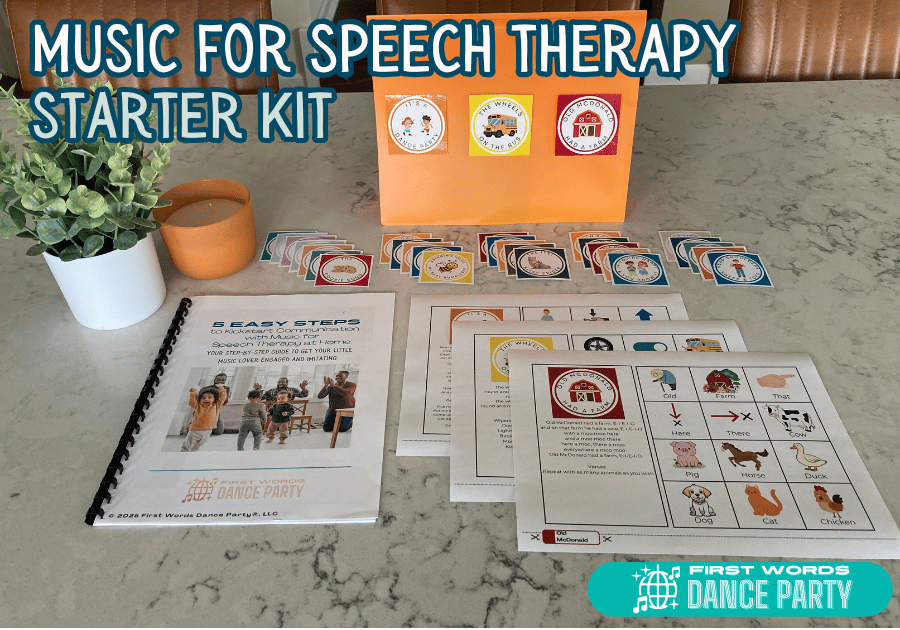
There are many powerful activities for speech therapy you can do in the comfort of your home. My favorite? Using music intentionally to help your child to gain the very speech and language skills they are missing. You can grab a free starter kit of original speech therapy songs, plus printable song boards, choice cards, and a guide of simple ways to get started right away.
Key Takeaways About Late Talkers
Late talkers typically have fewer spoken words and word combinations than expected for their age.
Some late talkers have strong language comprehension, while others have delays in both receptive and expressive language.
Many late talkers eventually catch up to their peers, but it's difficult to predict which children will suddenly take off with their language and which will need intervention to make progress.
An evaluation through your local early intervention program or a private speech therapist is the best way to truly capture your child’s strengths and language needs
You can encourage communication at home through everyday activities with strategies like self-talk, parallel talk, repetition, child-led play, and singing intentionally with your child.
What Is Considered a Late Talker?
A late talker is generally a toddler who is developing spoken language more slowly than expected with no other diagnosed disabilities or developmental delays in other areas.
The American Speech-Language-Hearing Association (ASHA) uses the term late language emergence (LLE) to describe delayed language development without another diagnosed developmental disability or delay in cognitive or motor development.
Children with late language emergence are commonly called late talkers.
However, many people use the term more broadly to describe any toddler who isn't talking as much as expected, and that's understandable.
When a child is not yet talking as much as you would expect for their age, you may not know yet whether they're experiencing a language delay or whether other developmental differences are involved.
Being a late talker doesn't automatically mean a child will have ongoing language difficulties. Some children catch up to their peers, while others benefit from continued support.
At What Age Is a Toddler Considered a Late Talker?
While there isn’t a specific late talker age, language delays often become most noticeable between 18 and 24 months, when most toddlers are typically learning new words rapidly and beginning to combine them.
According to the CDC's developmental milestones for 18 months, most children at the age of 18 months are trying to say at least three words besides "mama" and "dada." The average number of words 18 month olds use is anywhere from 10-50 words.
By 24 months, the CDC expects most children to use at least two words together, such as "more milk."
It's important to understand that CDC milestones represent skills that at least 75% of children demonstrate by a particular age. Milestones are lower than the average number of words children use.
In fact, one commonly used criterion for identifying late language emergence is having fewer than 50 words and not combining two words by 24 months.
But vocabulary size isn't the only thing professionals consider.
We also look at how toddlers communicate through gestures, how they understand language, how they participate in play, and whether they're continuing to develop new communication skills.
If you'd like a more detailed breakdown of what skills and milestones to look for from infancy through age two, you can read my article on Not Talking by 2? How to Help Your Toddler Now (Don't Waste Time), which breaks down the preverbal and verbal skills that typically emerge at each age.
Signs a Toddler Might Be a Late Talker
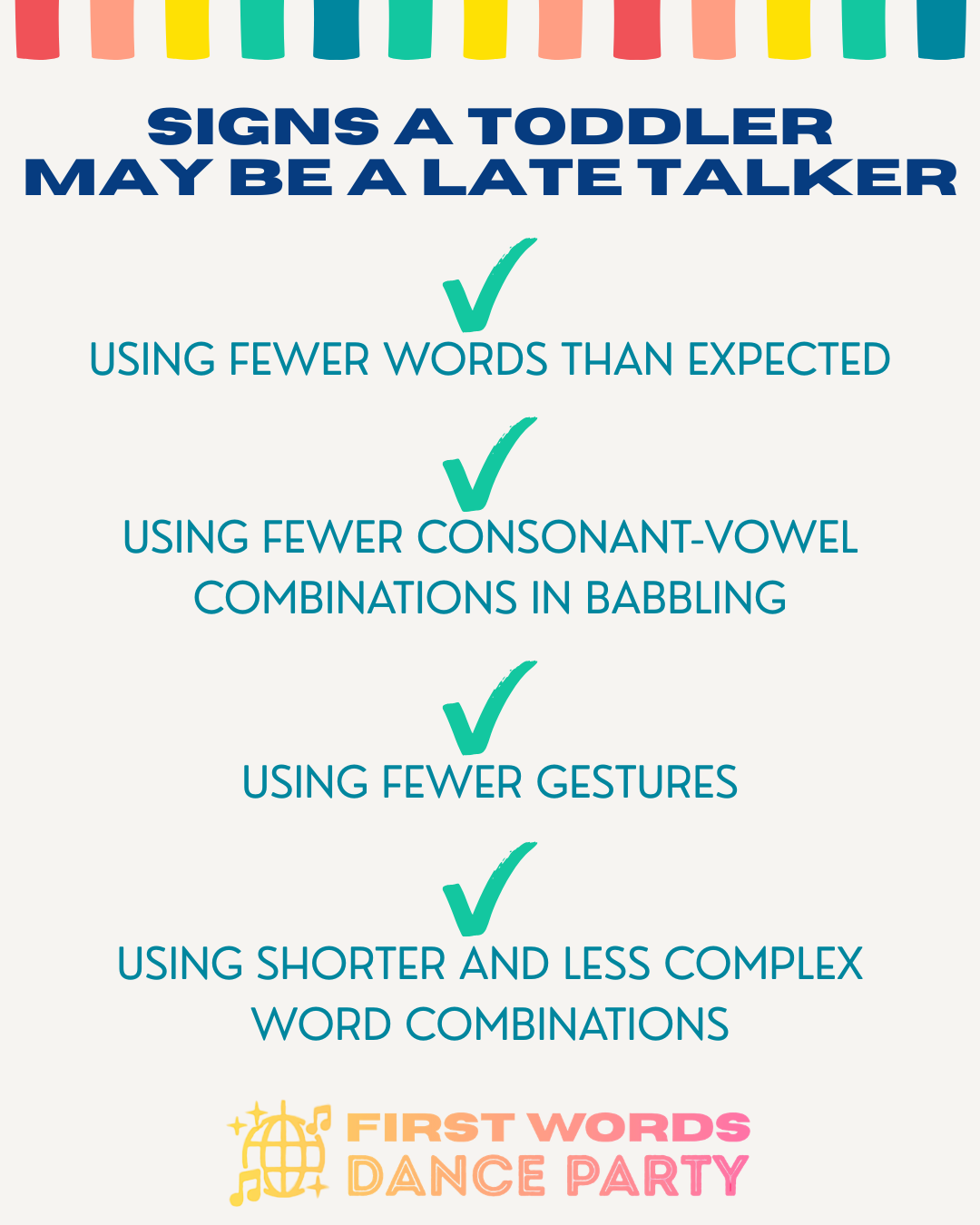
Some common signs that your toddler might be a late talker include:
Using fewer words than expected for their age.
Fewer symbolic gestures than expected for their age
Relying heavily on pointing or actions to get a point across. For example, your toddler may point or pull you toward something they want instead of using words.
Having difficulty imitating sounds or words. Your toddler may enjoy interacting with you but rarely attempt to copy the sounds, exclamations, or words you model.
Using fewer consonant-vowel combinations in their babbling and words than expected for their age
Using the same few words for many different purposes. Your toddler may have a small vocabulary that isn't growing steadily over time and use words like “mama”, “num num”, or “this” in place of other words to let you know what they want.
Not yet combining words. By age 2, most toddlers are beginning to put two words together, such as "go outside" or "help mama."
Using fewer and shorter word combinations and phrases than expected for their age
Key Takeaway: Late talking is often identified between 18 and 24 months, but understanding your child's communication development involves much more than counting spoken words.
Late Talkers vs. Speech Delay: What's the Difference?
The terms late talker and speech delay are often used interchangeably, but they don't technically mean the same thing.
A late talker, by ASHA’s definition, is a toddler experiencing late language emergence, where language is delayed. In everyday conversation, though, people often use "speech delay" to describe the same concern.
While late talkers technically don't have diagnosed delays in other areas, the term "speech delay" is often used to describe a developmental delay in the area of communication when there may also be a delay in another area, like social emotional skills, adaptive skills, fine or gross motor, or cognition.
Speech and language actually refer to different skills.
Speech involves actually producing sounds and words, including articulation, voice, and fluency. Language involves understanding and communicating meaning through words, gestures, signs, and other forms of communication.
A toddler might have difficulty producing certain speech sounds while using plenty of words and sentences. Another toddler might pronounce the few words they use clearly but have difficulty developing vocabulary or combining words.
Late language emergence can involve:
Expressive language: Difficulty using words and other forms of language to communicate.
Receptive language: Difficulty understanding words and directions
Both receptive and expressive language: Delays involving both understanding and using language.
Some late talkers understand much more than they can express. Others have difficulties in both areas.
This distinction is important because strong language comprehension often goes along with stronger play, adaptive, and social emotional skills.
You can also learn more about speech and language development through ASHA's parent resources.
Key Takeaway: Late talking describes delayed language development, while speech and language delays can affect different aspects of communication skills. A comprehensive evaluation can help identify your child's strengths and areas where additional support may be helpful.
If you're looking for simple ways to encourage your toddler's speech and language at home, and your toddler loves music, you’ll love First Words Dance Party®. These are speech therapy songs written specifically to encourage language development. You can grab a free Music for Speech Therapy Starter Kit that will help you begin using music and movement at home to create more opportunities for gestures, sounds, and words.
How to Help a Late Talker at Home: 5 Simple Strategies
You can help a late talker develop communication skills by modeling language naturally throughout the day, following their interests, and creating opportunities for back-and-forth interactions.
There are two major misconceptions I encounter when working with parents of late talkers:
1) that encouraging a toddler to talk means that the adult should be talking more to fill in the silence, and
2) that adults should ask a child questions to prompt them to say new words.
In reality, we actually don’t want to do either of these things.
When your toddler is a late talker, the secret to helping them say more words isn’t “talking more”. It’s actually talking less in order to open up opportunities for turn taking, and sprinkling in the right strategies to encourage imitation.
Most of the strategies we use in early intervention to encourage first words are indirect. Rather than asking a toddler to perform, we provide meaningful language models during activities they're already participating in.
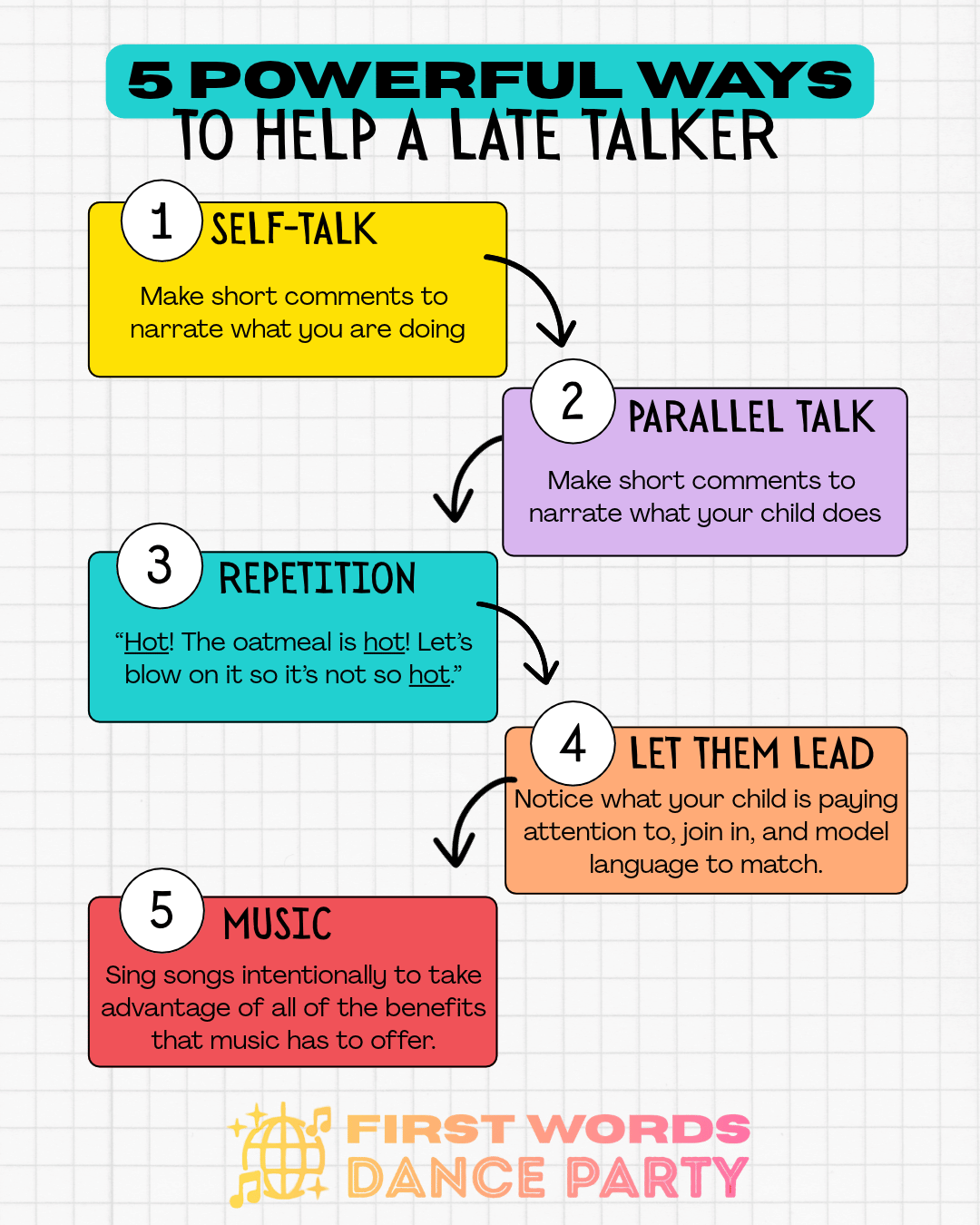
Here are five incredibly powerful strategies you can start using at home .
1. Use Self-Talk During Everyday Routines
Self-talk is a language modeling strategy in which you describe what you're doing and experiencing as you go about your day.
Instead of explaining everything in long sentences, use short, meaningful phrases that match the actions your toddler is watching.
For example, while washing dishes, you might say:
"I'm washing."
"Wash, wash, wash."
"So many bubbles!"
"Pour!"
While getting dressed, you might model:
"Shirt on."
"Pull, pull!"
"One more."
"Ta Da! All done."
Self-talk gives toddlers opportunities to hear words connected to meaningful actions and experiences.
2. Use Parallel Talk During Play and Meals
Parallel talk is just like self-talk, except you're describing what your toddler is doing rather than what you're doing.
For example, if your toddler is playing with toy cars, you might say:
"Go up, car!!"
"Zoom, that was fast!"
"Uh oh, it crashed!"
"Let’s do it again.”
During snack time, you could model:
"You're eating apples!"
"More bananas."
"You want water."
"Bananas are all gone!"
Parallel talk works especially well because you're providing language that matches what your toddler is already experiencing.
Instead of asking questions like,"What color is your car?" or “What sound does a car make?”, simply model the words that are meaningful in the moment.
This takes some of the pressure off your toddler to perform, and it gives them much richer language models. This leads to more words!
3. Model Words With Repetition
Repetition is one of the most useful tools for helping toddlers notice and learn new words.
But repetition doesn't mean asking your toddler to repeat a word after you prompt them.
Instead, try modeling the same word three times within a natural interaction.
Imagine your toddler sees a garbage truck stopping in front of your home. For many toddlers, this is the most exciting part of the week!
You might be tempted to say:
"The garbage truck is here! Look, look! See, over there, the driver is picking up the bin. Now he's getting the other one. Look, there it goes!”
There's nothing wrong with talking to your toddler in complete sentences. But if your goal is to help them notice and learn a particularly meaningful word (like truck), you can help your toddler learn and imitate that word by repeating it three times.
Try:
"Look, the garbage truck! The truck is stopping! Now the truck is picking up the garbage.”
The second example still offered language to describe what was happening, but the word “truck” was modeled three times to give the child the repetition they need.
Now the child will be much more likely to imitate the word “truck”.
You can use the same strategy with action words.
Modeling action words with repetition can work particularly well during routines like:
Bathtime (splash, pour, wash)
Dressing (in, out, on, off)
Meals and snacks (cut, eat, drink, sip, stir)
Playing outside (jump, hop, run, walk, swing)
You don't have to eliminate longer sentences from your interactions. It’s more about simplifying your language and repeating highly meaningful words so they're easier to notice and imitate.
4. Follow Your Late Talker's Lead
Another powerful strategy for later talkers is following their attentional focus. This means paying attention to what they're doing or looking at in the moment, and then modeling language based on their interests.
This is one of the most important principles behind the language strategies we've already discussed.
When your toddler is drawn to an activity, you have a natural opportunity to model words that are meaningful to them.
For example, imagine your toddler is placing play food onto a toy plate.
Rather than asking them to name the foods or the colors of the foods, notice what is holding their attention and make comments about it.
This goes hand in hand with parallel talk, but it’s super powerful because you were careful not to direct your child away from the thing they were motivated by.
You can go even further by joining in alongside your toddler and playing, too.
You can use self-talk, parallel talk, and repetition while following your toddler's interests.
This approach also gives you opportunities to notice how your toddler communicates. They may look toward you, hand you a toy, make a sound, use a gesture, or invite you to participate in another way.
Responding to those communication attempts helps keep the interaction and the language going.
5. Sing Songs to Encourage Your Late Talker's Communication
Singing is my absolute favorite way to encourage communication, because music naturally incorporates repetition, predictable language, actions and gestures, and so many opportunities for back-and-forth interactions.
Many late talkers say some of their very first words to a favorite song, because music is just that powerful for language development.
For tired, worried parents, songs naturally package opportunities to practice the exact imitation skills that come just before words. And when you sprinkle in some intentional strategies to encourage imitation, it's amazing to see what happens next.
You don't need to be a great singer or know dozens of children's songs to use music effectively. Start with a familiar song your toddler enjoys and look for opportunities to encourage participation.
For example, when singing "Ring Around the Rosie," you can pause just before everyone falls down. Your toddler might anticipate what's coming by smiling, moving their body, making a sound, or attempting the word "down."
Music creates a fun, predictable interaction where communication can happen naturally. When you sing a song with your child, you can take advantage of all of the benefits of music and sprinkle in self talk, parallel talk, and following your child’s lead for even more progress.
For a deep dive into how to use music to support speech and language development, read my guide to using Music in Speech Therapy.
You can also explore Music-Based Activities for Speech Therapy at Home for practical ideas you can start using today.
Key Takeaway: Helping late talkers communicate doesn't require flashcards, constant questioning, or repeated requests to say words. Self-talk, parallel talk, repetition, following your child's lead, and singing provide natural opportunities for language learning throughout the day. Music can bring several of these strategies together in one enjoyable activity.
First Words Dance Party®: Speech Therapy Songs for Late Talkers
After more than 15 years working in early intervention, I began writing my own songs as First Words Dance Party® because I wanted parents to have music that intentionally targets the communication skills children need most.
These songs are designed around evidence-informed strategies and everyday routines, making it easy to model gestures, sounds, core words, functional phrases, and opportunities for turn-taking and imitation.
Here are three songs you can try with your late talker.
1. Open
Open focuses on three of the most useful functional words for toddlers: open, help, and please. These words are repeated throughout the song and can easily be paired with a simple sign language.
2. It's a Dance Party
This song is especially useful for children who aren't pointing to body parts (eyes, nose, ears, etc.) or naming them. You can model the movements alongside your toddler as you sing and dance along, and learn the words “up” and “down”.
This song encourages the first words yeah (yes), no, eat, and cookie. It’s especially helpful for late talkers who aren’t yet nodding their heads or saying yes.
Want to know exactly what I do when I help later talkers to communicate with music? Grab your free Music for Speech Therapy Starter Kit for original speech therapy songs and printable song boards, song choice cards, and a simple guidebook to get you started.
Late Talkers: When to Worry and Seek Help
Parents should consider seeking an evaluation when their toddler isn't meeting expected communication milestones.
Although children develop at different rates, there are certain signs that deserve additional attention.
These include:
Not imitating words consistently by 18-20 months
Not adding new words consistently
Not combining words by 24 months
Having difficulty understanding familiar words or simple directions
Using few gestures like waving, pointing, giving high fives, and showing something to others
Losing words, signs, or gestures they previously used
You don't need to wait until your child reaches a specific age before asking for help. Instead of “wait and see”, refer and see!
Early Intervention for Late Talkers
Early intervention provides developmental services and support for infants and toddlers with developmental delays and their families.
In the United States, families can contact their state's early intervention program directly to request an evaluation for a child under age three. You don't need to wait for a pediatrician to make a referral.
During an evaluation, professionals will look at how your toddler understands language, communicates with gestures, sounds, and words, and engages in play.
By looking at both receptive and expressive language development, you can get a much clearer picture of what your child’s needs are and what services will best meet those needs.
If your child qualifies for services, early intervention professionals can work with you to incorporate communication strategies into everyday routines.
As an early intervention teacher, my favorite part of working with families is helping parents discover exactly what to do to support their toddler's development during activities they're already doing together.
You can find your state's early intervention program through the CDC's Early Intervention Contact Information by State.
Why Hearing Must be Addressed for Late Talkers
A hearing screening or ENT/Audiology consultation is an important part of assessing a toddler who isn't talking as expected, even if the child seems to hear everyday sounds.
This is because mild to moderate hearing loss isn’t always obvious, and conductive hearing loss over the early childhood years is incredibly common.
Toddlers who experience frequent ear infections and/or fluid buildup behind the eardrum may have fluctuating hearing levels from day to day and week to week.
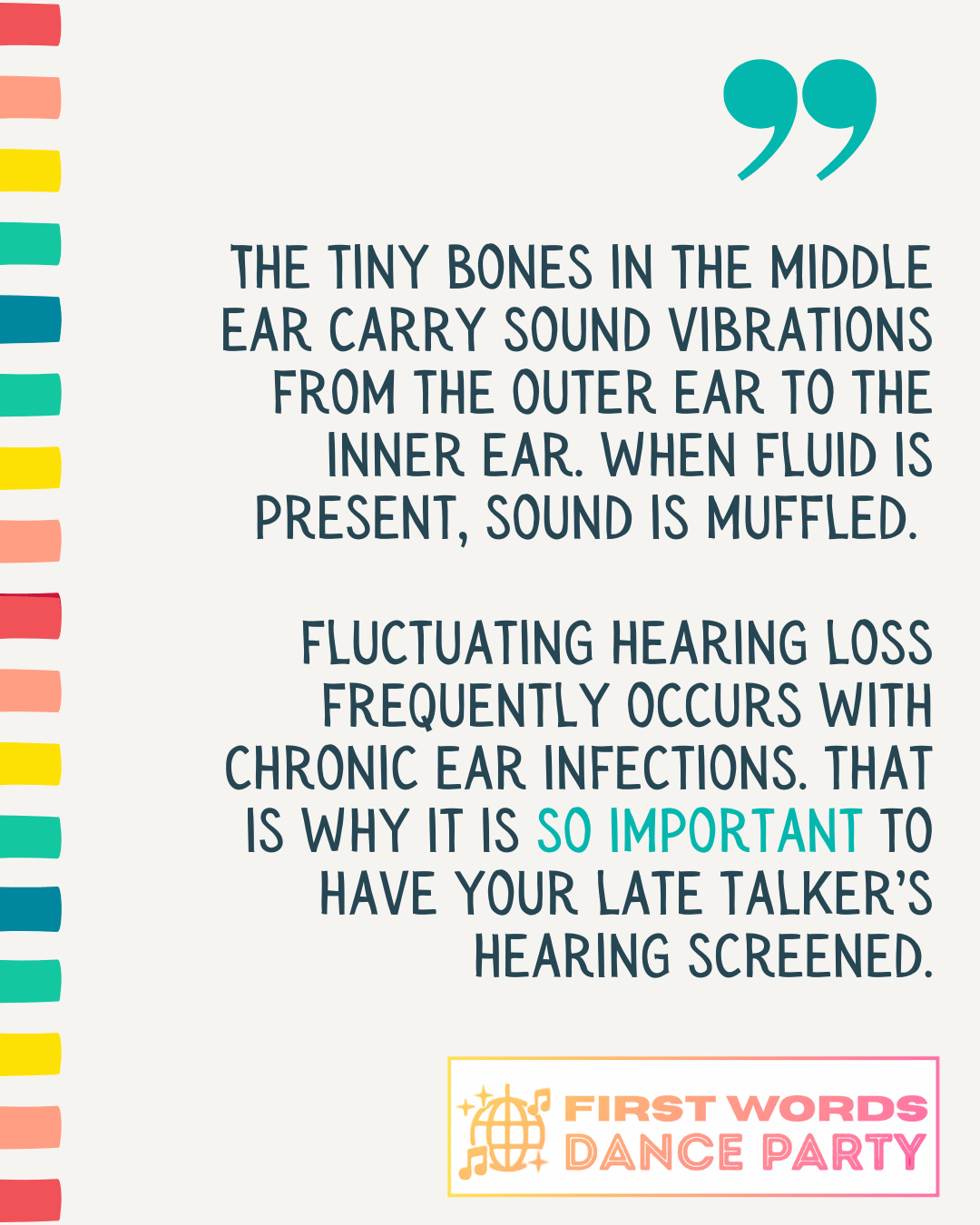
A child might respond when you call their name and recognize familiar sounds while still having difficulty hearing all speech sounds clearly across all of the different frequencies (pitches). And because it isn’t possible to see fluid behind the ear drum in the pediatrician’s office, it is important for hearing status to be confirmed with either a hearing screening or audiological evaluation.
ASHA recommends hearing screening as part of the assessment process for late language emergence, with referral for a more complete audiological evaluation when appropriate.
If your toddler has a history of frequent ear infections, persistent middle ear fluid, or you have concerns about hearing, discuss this with their pediatrician and ask for a referral to ENT/Audiology.
Key Takeaway: If you're concerned about your toddler's communication development, requesting an early intervention evaluation and checking their hearing are two important steps. You can continue supporting communication at home while seeking professional guidance.
Autism or Late Talker? Understanding the Differences
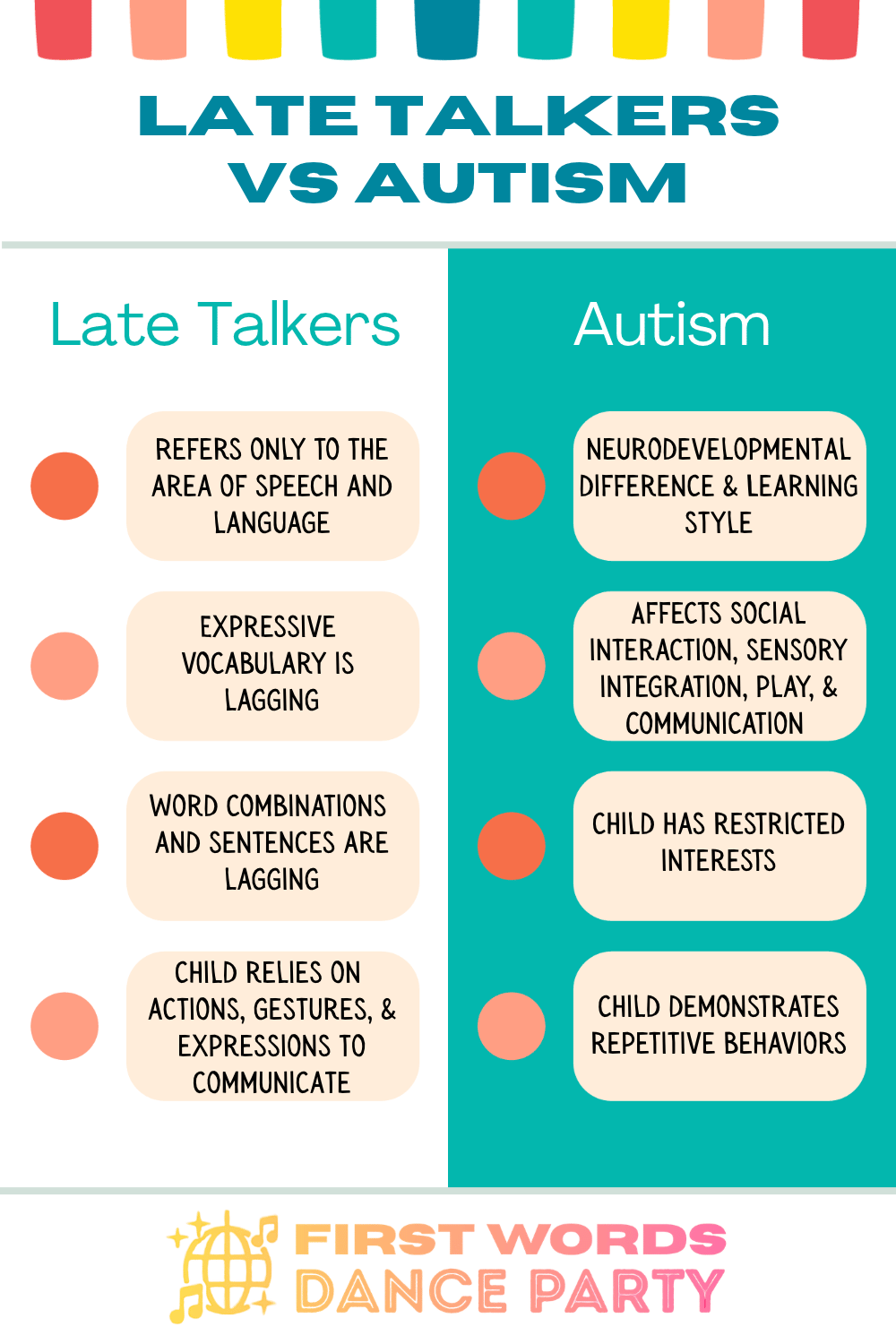
As the months go by without much language growth, you may wonder about late talkers vs autism.
By ASHA’s definition, late talkers demonstrate delays in speech and language with no other delays in other areas (like cognition or motor). However, as a child grows older, late language emergence may evolve into autism, ADHD, or a learning disorder.
When we look at autism vs late talkers, the distinction is that autism involves a broader pattern of developmental differences, including social communication and interaction, along with restricted or repetitive patterns of behavior, interests, or activities.
Consider how your child:
Communicates through gestures, sounds, words, or other methods
Shares interests and experiences with other people
Participates in social interactions and play
Understands and responds to communication
Engages with routines, sensory experiences, and preferred activities
No single behavior, including pointing, eye contact, or responding to a name, can determine whether a toddler is autistic. It’s about a pattern of characteristics across communication, social interactions, and restricted or repetitive behavior.
For specific signs to look for, and more on late talkers vs autism, you can go through this post on the subject: Autism or Speech Delay? How to Be Sure When Your Wonderful Child's Not Talking.
Key Takeaway: Late talking and autism aren't mutually exclusive. A child's spoken vocabulary is only one part of their development, and an evaluation can help identify their individual communication strengths and support needs.
When Do Late Talkers Start Talking?
There isn't a specific age when all late talkers begin talking. Some toddlers make rapid progress over a relatively short period, while others develop spoken language more gradually or continue to need support.
According to ASHA, research suggests that approximately 50–70% of children with late language emergence eventually develop language skills within the typical range by late preschool or school age.
However, these findings don't mean that every late talker has the same likelihood of catching up.
Researchers have also found that some children with a history of late language emergence continue to experience difficulties with more complex language skills, even after their early vocabulary has improved.
What Helps Predict Whether Late Talkers Will Catch Up?
Language comprehension, gestures, vocabulary growth, and other developmental skills can provide useful information about a toddler's language development.
For example, toddlers who understand language well and are consistently learning new words may have a different developmental profile than toddlers who have difficulty both understanding and using language.
However, no single skill can reliably predict whether an individual child will catch up without additional support.
This is one reason professionals look at communication development over time rather than relying on one vocabulary count or developmental milestone.
Parents sometimes hear that their toddler will begin talking when they're ready, particularly if another family member was also a late talker.
While many children do make significant progress, waiting without monitoring their development can delay access to helpful services.
An evaluation doesn't mean something is necessarily wrong, and receiving early intervention doesn't prevent a child from progressing at their own pace.
It simply provides more information and opportunities for support.
Key Takeaway: Many late talkers eventually develop language skills within the typical range, but there's no reliable way to predict exactly when an individual toddler will begin talking. Monitoring progress and seeking support when concerns arise are more helpful than waiting for a particular age.
Final Thoughts on Late Talkers
Late talking can look different from one toddler to another. Some children understand much more language than they use, while others need support with both understanding and expressing themselves.
Although many late talkers eventually catch up to their peers, it's important to pay attention to your toddler's overall communication development rather than focusing only on their spoken vocabulary.
If you have concerns, consider requesting an early intervention evaluation and discussing an audiology evaluation with your child's pediatrician.
In the meantime, you can support your toddler's communication through simple interactions during activities you already share.
Model words during everyday routines with self-talk and parallel talk, repeat meaningful words, follow their interests during play, and capitalize on music to create enjoyable opportunities for communication.
If you'd like to start using music to support your toddler's communication, download my free Music for Speech Therapy Starter Kit. You'll learn simple ways to encourage your child's participation and early communication skills by turning everyday music into meaningful opportunities for speech and language growth.
Frequently Asked Questions About Late Talkers
Does Being a Late Talker Affect Intelligence?
Being a late talker doesn't automatically correlate with intelligence or cognitive skills (like play, thinking, and problem solving).
In the more specific definition of late language emergence provided by ASHA, children with true late language emergence (LLE) actually do not have other identified cognitive or motor developmental delays.
That being said, cognitive delays are not always as easy to spot as a speech and language delay. Many children with delayed language do have developmental delays in another area, like cognition, motor, adaptive, or social emotional skills, that haven't yet been identified. These children will benefit from support to address all of their communication and learning needs.
That is why federal law mandates that all early intervention evaluations for children under the age of 3 must include all domains of development: communication, cognition, motor, social emotional, and adaptive skills.
What if My Child is a Late Talker and a Late Walker?
Many infants with delayed motor skills (sitting, crawling, pulling to stand, and walking) are also delayed in their communication skills.
There are many potential reasons why a child may be a late talker and a late walker, but at such a young age, the exact cause isn’t always clear. Some common reasons can include difficulties with motor planning or balance, coordination, and hearing challenges stemming from chronic ear infections. Other times, delays in both motor and communication can be part of the broader developmental pattern of autism spectrum disorder.
And then there are instances in which the cause is never truly known. Some children will have a burst of learning and catch up to their peers, but others will require specialized instruction to make progress.
We just don’t have a good way to predict which late talkers and late walkers will have that burst of learning, so “wait and see” is not a good idea.
What If My Toddler Understands Everything but Doesn’t Talk?
Some late talkers have receptive language skills that are right on track while their expressive language skills lag behind. This discrepancy is common among children with speech and language delays.
Children experiencing this difference between receptive and expressive language skills are very likely struggling with verbal imitation. Since there are many pre-verbal skills that unfold before words, it is very helpful to look at what those skills are in order to know what to focus on with your child. You can check out this article for more information: Toddler Not Copying Words? Don't Miss These Eye Opening Skills
If your child is a music lover, you can also check out this page with all kinds of music-based activities for speech therapy to get your toddler imitating at home.