Toddler Not Copying Words? Don't Miss These Eye-opening Skills
- 0 comments
If your toddler is not copying words yet, take a look at the preverbal skills they are already able to imitate before focusing only on speech.
Imitation does not begin with words. Long before children start mimicking the words they hear from the people around them, they learn to copy what other people do.
When a toddler is not copying words, noticing these earlier imitation skills can give you important clues about where to start.
In this article, we'll look at:
Why your toddler may not be copying words yet
The early imitation skills that typically develop before word imitation
What to look for to figure out where your child is with their imitation skills
Simple ways to help your toddler imitate
When it may be helpful to seek additional support
If you're looking for easy activities you can start using right away with your toddler, be sure to grab my free Music for Speech Therapy Starter Kit. It includes a guidebook, printable song boards, song choice cards, and original speech therapy songs designed to help you turn everyday music into meaningful opportunities for speech and language growth.
Key Takeaways:
If your toddler isn’t copying words yet, it’s incredibly important to look at the imitation skills that develop before spoken words.
Imitation typically develops in a progression from actions with objects → gestures and actions → sounds → words.
Starting with what your toddler can already copy can make practicing imitation feel easier and more successful.
Music creates predictable and fun opportunities to work toward imitation, no matter what stage of imitation your child is in.
Why Is My Toddler Not Copying Words?
If your toddler is not yet imitating words, like saying “milk” after you say it, that doesn’t necessarily mean they aren't imitating at all.
Repeating a word is actually a pretty complex skill. First, your toddler has to shift their attention toward you as you say the word, and they also have to understand it. Then they have to try and figure out how to produce and sequence the sounds in "milk", in order to imitate it.
But there are lots of ways infants and toddlers learn to copy other people before they are ready to start copying spoken words.
If you're wondering, "Why does my toddler not imitate me?", it's important to first look at the imitation skills that come before speech.
How Do Infants and Toddlers Learn to Talk?
Infants and toddlers learn how to talk by imitating the people around them. Imitation skills unfold long before toddlers start copying spoken words.
These little steps are so important for speech and language that I call them the “Wins Before Words”.
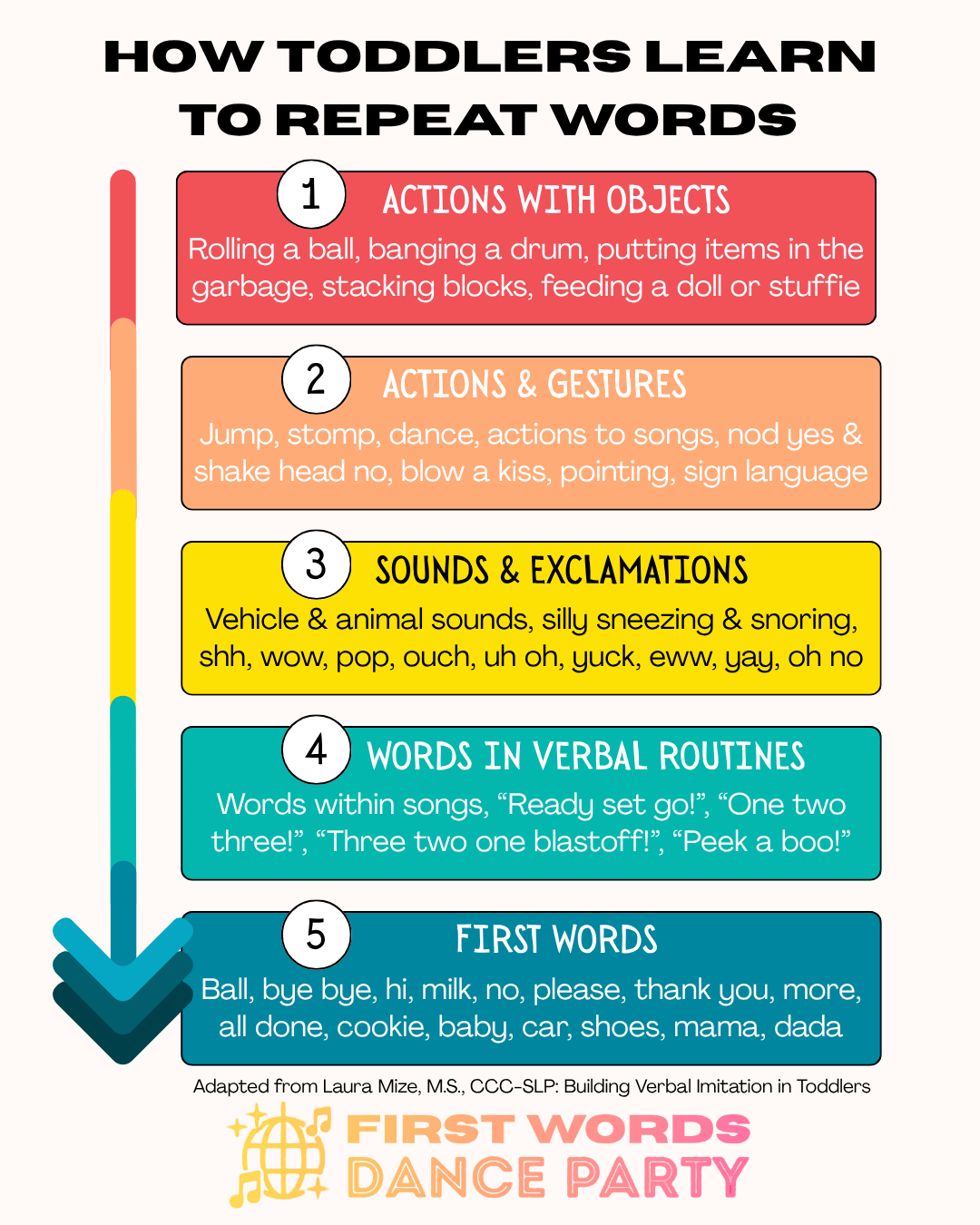
Early imitation skills include:
actions with objects
actions and gestures
playful sounds
animal and vehicle sounds
exclamatory expressions
words
These skills build on one another over time, which is why looking at more than just spoken words can be so helpful when you're trying to understand your toddler's communication development.
As a pediatric speech-language pathologist Laura Mize has long emphasized, children learn to imitate much more than words before they truly start talking. Let's take a closer look at what all of these preverbal imitation skills look like.
Imitating Actions With Objects
One of the earliest places you may notice imitation is during play with toys and everyday objects.
For example, your toddler might watch you:
feed a baby doll
bang a drum with a mallet
push a toy car
stir with a spoon
wipe a table with a cloth
Then they try the same thing.
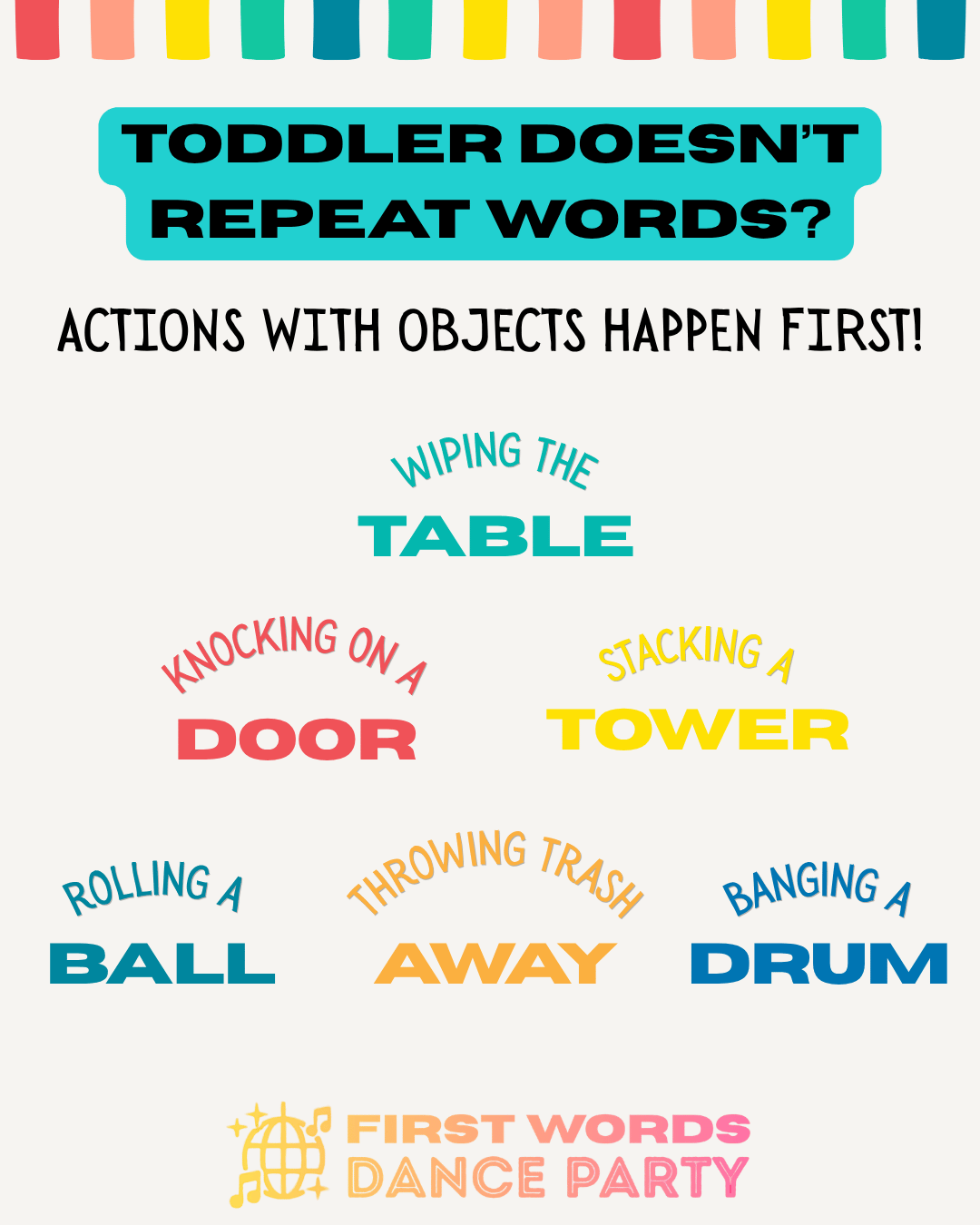
Notice that no words are required from your toddler to do this, but your child is practicing something incredibly important. They are watching what another person does and then trying to do it themselves.
When children imitate actions with objects, they are also learning how to use objects purposefully. This supports receptive language, or understanding, as well as attention and play skills, and all of these go hand in hand with speech development.
Imitating Actions and Gestures
Children also learn to copy actions and gestures before they imitate words.
Actions can include things like:
jumping (even if their feet don’t actually leave the ground)
stomping
kicking
Gestures are all of the ways we talk with our hands, like:
clapping
waving
pointing
blowing a kiss
giving a high five
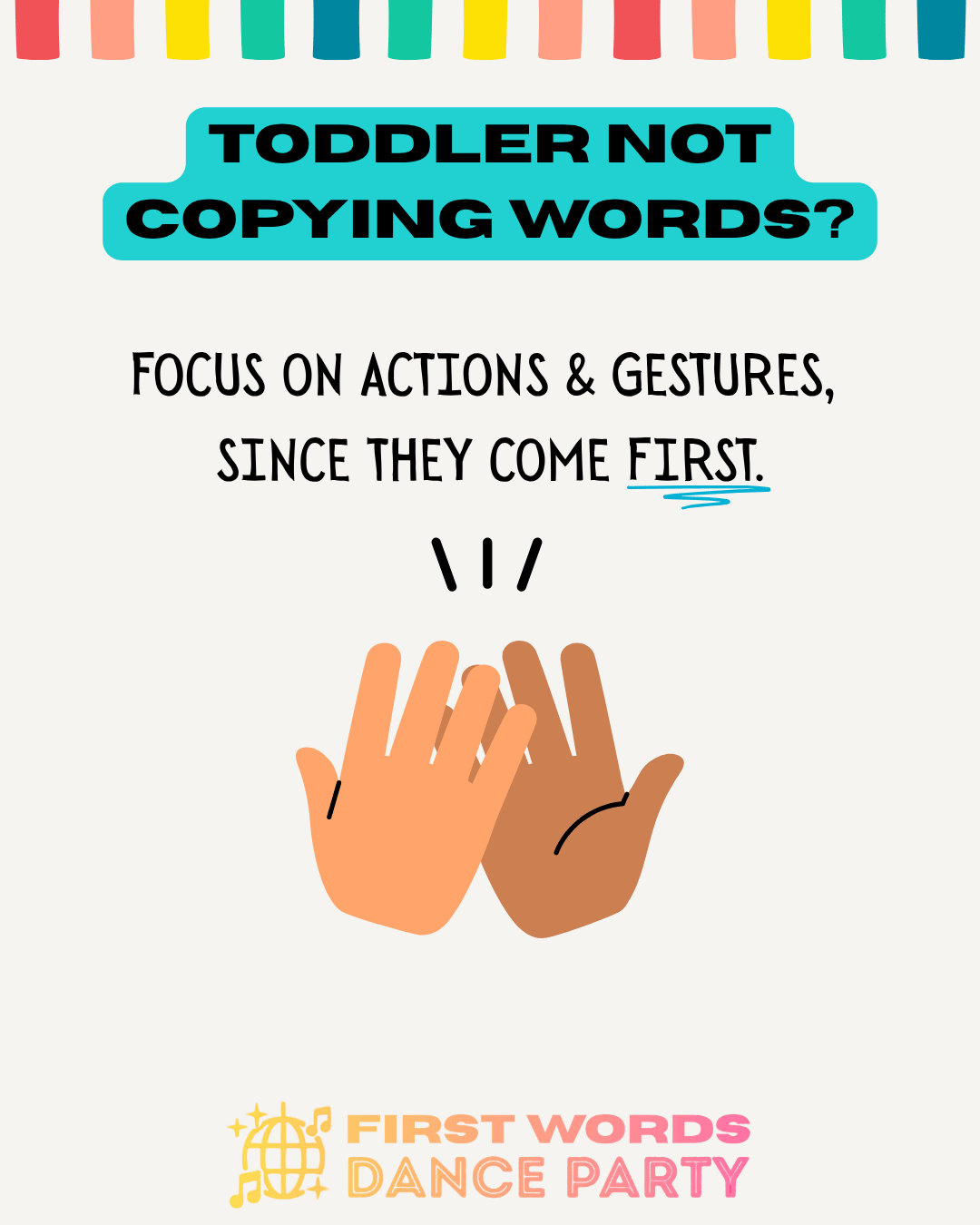
Gestures carry meaning, because they are symbols for something. When a child points out the window at a squirrel in the yard, it’s a nonverbal way of saying, “Look!”.
When a child blows a kiss, it’s a way of saying “Love you!”.
Gestures are symbolic, just like words are. This is why gestures are so incredibly important.
Imitating Sounds
Before expecting a toddler to copy words, listen for simpler kinds of vocal imitation. Playful sounds are the perfect place to start.
Imitation of playful sounds can include things like:
blowing raspberries
making a sound into a paper towel tube after you do it
making a sound as you stick out your tongue
making a playful munching or "Mmmm" sound while pretending to eat play food.
When your toddler imitates playful sounds like these, they discover what their voice can do. Not only that, they are also learning how to engage in turn taking, which is exactly how communication works!
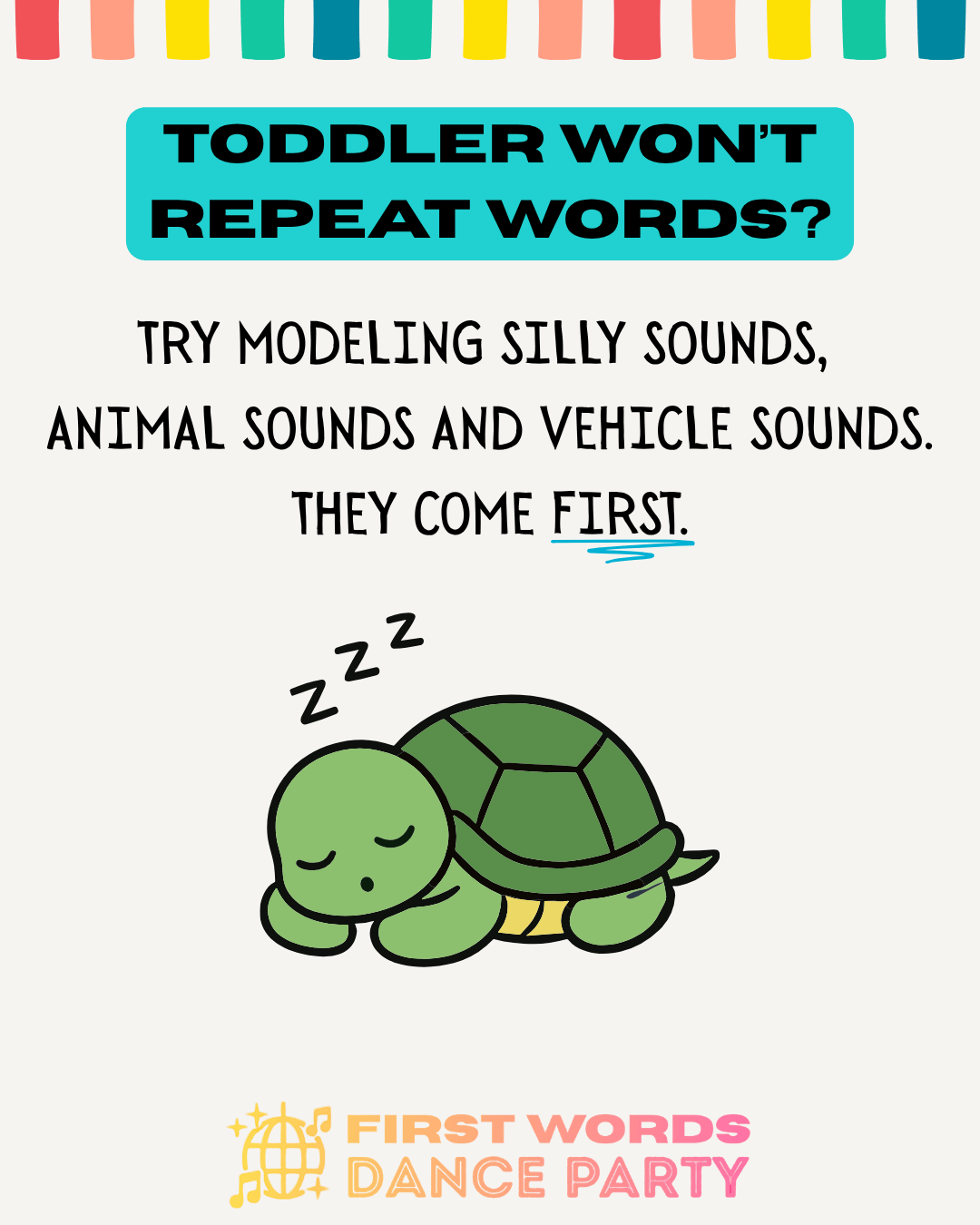
As vocal imitation develops, you may also hear your toddler begin imitating environmental, animal, and vehicle sounds, like:
barnyard animal sounds like moo, neigh, baa, cheep cheep, and quack quack
vehicle sounds like beep beep, vroom vroom, and siren sounds
environmental sounds, like beep, click, and boom
These types of sounds pave the way for exclamatory expressions such as "uh-oh," "wow," and "ouch", before getting into imitation of all kinds of first words.
Key Takeaway: Toddlers typically follow a predictable sequence of imitation skills that begins long before they can imitate words. Infants and toddlers first learn how to imitate actions with objects before imitating gestures, sounds, and exclamatory expressions.
When Do Toddlers Start Repeating Words?
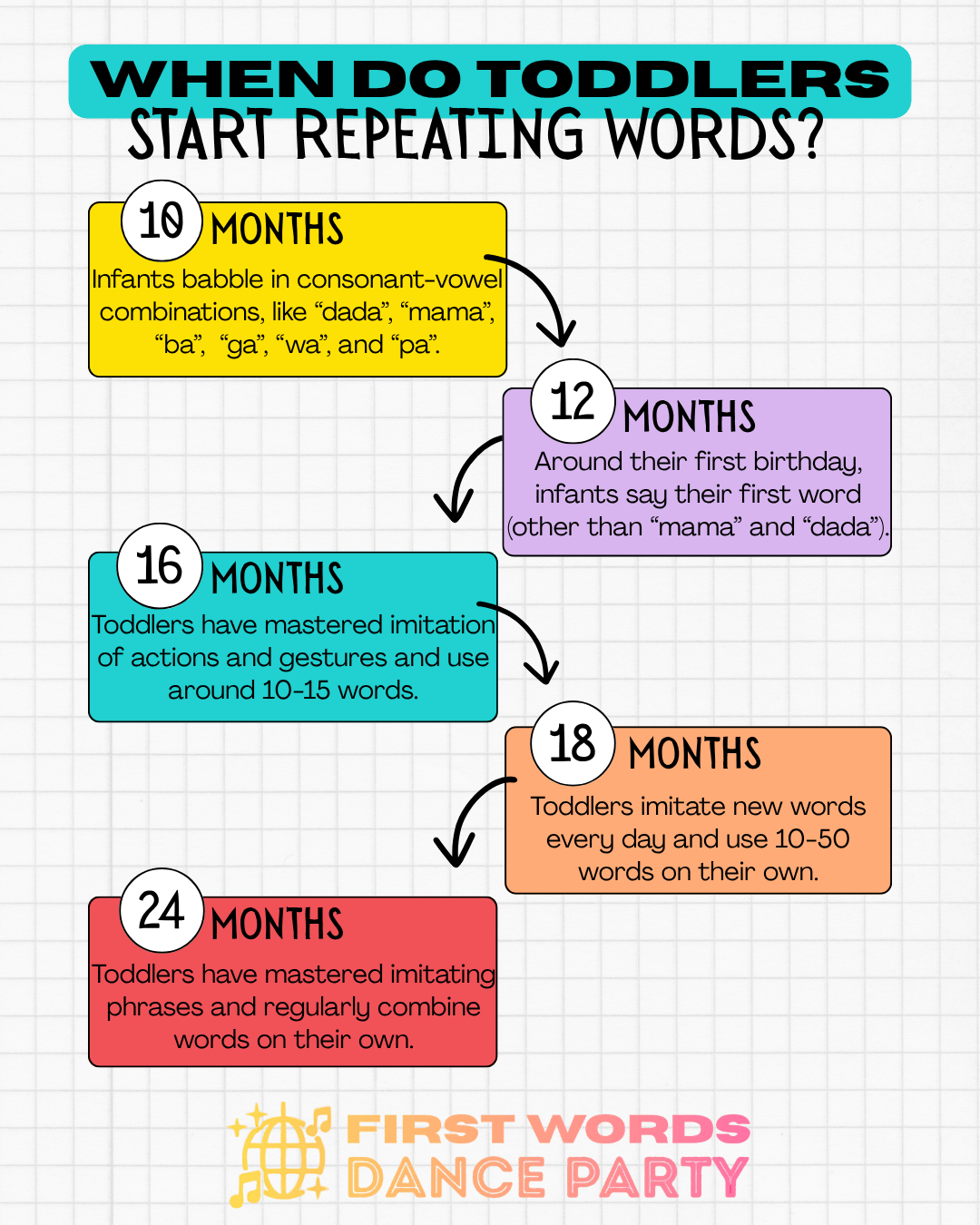
Infants spend their first year of life listening to others talk. When they start babbling, they combine consonants and vowels together to say things like “baba”, “gaga”, “mama”, and “dada”. These eventually become shorter as they produce consonant-vowel combinations like “ba”, “sa”, “pa”, and “wa”.
Then, right around that first birthday, infants typically say a common first word like “hi”, “ball”, or “baba” (bottle), in addition to saying “mama” and “dada” purposefully to refer to parents.
In the period of time between 12-18 months, toddlers are typically mastering the preverbal imitation skills outlined above. Most toddlers use 16 different actions with objects and 16 different gestures by the time they are 16 months old.
For free lookbooks and printables on what these actions and gestures are, you can check out the First Words Project.
Having mastered these preverbal skills, toddlers then slowly add new words into their vocabularies. Most toddlers use anywhere between 10-50 words by the age of 18 months.
Around the 18 month mark, toddlers are typically imitating new words consistently during everyday interactions. They start to imitate the last word in a short sentence.
This looks like a toddler readily imitating new words, like this:
Parent: “Oh no! It’s stuck.”
Toddler: “Stuck!”
This is also a period when spoken language starts to grow quickly.
Between approximately 18 and 24 months, toddlers regularly add new words to their vocabularies, with vocabulary growth accelerating quickly during this period.
By their second birthdays, most toddlers are using at least 50 words spontaneously and regularly combining words into all kinds of two-word phrases, like “more milk”, “big doggie”, and “my cookie”. Many toddlers are using 3-5 word phrases and short sentences by this time.
Should I Be Concerned About My Toddler Not Repeating Words?
You might be thinking, “My toddler will not repeat words. Should I be worried?”
While of course, every child is different, years and years of research have shown us what typical communication development looks like over the infant and toddler years.
If your child isn't repeating words yet, it's worth taking a closer look at the foundational communication skills that support spoken language. When those skills need extra support, the earlier we begin, the more opportunities children have to practice them.
Moving Beyond Actions For a Toddler Not Mimicking Words
If your toddler isn't repeating words, but already copies actions with objects, that's fabulous! They are already showing you an important skill that you can build on right away.
When a toddler isn’t mimicking your words, the very first skills to look for are whether they use a variety of different actions with objects, because those actions turn into gestures.
If they have those actions with objects down, now you can begin focusing on gestures, sounds, and powerful first words.
And if your toddler loves music, this is exactly why I created First Words Dance Party®.
Key takeaway: Years of research on speech and language development, including well established norms from the have MacArthur-Bates Communicative Development Inventories (CDI), provide helpful milestones and averages for worried parents. These help parents to know when to ask for an evaluation.
How Music Can Make Imitation Easier When Your Toddler Doesn’t Repeat Words
If I could recommend just one activity to support early communication, it would be music.
Why? Because music naturally packages together almost every foundational communication skill children need before they begin talking.
Think about your favorite children's songs. They're full of:
Actions and movement
Gestures and signs
Animal sounds and sound effects
Exclamatory expressions like "ouch!" or "pop!"
Repetition
Predictable lyrics
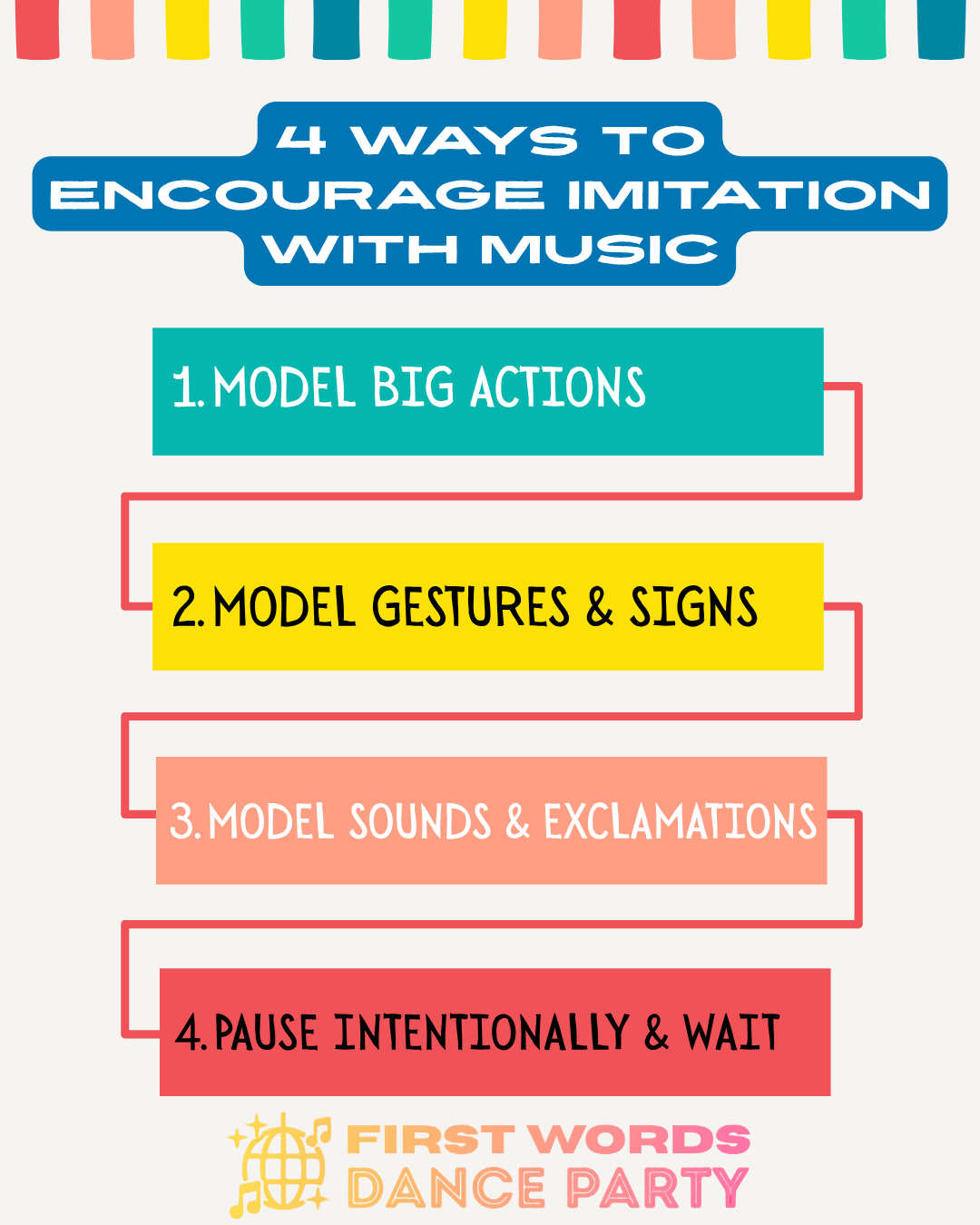
For tired, worried parents, songs naturally package opportunities to practice the exact imitation skills that come before words.
That's why using the joyful nature of music to encourage language is such a no-brainer. For a deep dive into how to do this, you can check out this comprehensive guide to using music in speech therapy.
If you'd like help figuring out which stage of imitation your child is in, and which songs are best for their current skill set, you can check out this guide to using music-based activities for speech therapy at home.
One of the best ways to support communication is by adding simple actions and gestures to familiar songs.
While singing The Wheels on the Bus, you might make the motions for the wheels, wipers, or the horn. Songs like Open, Shut Them naturally encourage children to imitate actions and gestures long before they're ready to imitate words.
Almost any music can become an opportunity to encourage communication when you slow down, repeat key moments, and leave space for your child to participate.
First Words Dance Party® Songs for Late Talkers and Speech Delays
After more than 15 years working in early intervention, I began writing my own songs because I wanted parents to have music that intentionally targets the communication skills children need most.
Each song is designed around evidence-informed strategies and everyday routines, making it easy to model gestures, sounds, core words, functional phrases, and opportunities for turn-taking and imitation.
Here are three of my favorites for toddlers who aren’t yet copying words:
It's a Dance Party: A Song for Actions and Body Parts
"It's a Dance Party" gets children moving while introducing names for body parts and simple actions and gestures, like putting hands up, hopping down to the floor, and pointing.
Children can point to their nose, eyes, and ears and put their hands up while hearing those words paired directly with the actions.
This song also offers so many opportunities within the lyrics to use the words “up” and “down”.
Open: Signs for Two Powerful Words Your Toddler Needs
The "Open" Song focuses on a few powerful words that children can use throughout their day, including "open" and "help."
You can pair the spoken words with signs while you sing, giving your child another way to participate even if they aren't ready to say the words yet.
That means the goal isn't simply getting your toddler to repeat "open."
You're giving them repeated opportunities to see, hear, and practice communication that can actually help them get their needs met.
It's My Turn: A Better Way to Ask for a Turn
"It's My Turn" pairs the phrase "my turn" with a gesture children can use during play.
For a child who isn't using many words yet, learning a meaningful gesture can give them another way to communicate that they want a turn instead of reaching for or taking a toy from another child.
Your child can begin with the action or gesture for “my turn” while repeatedly hearing the words that go with it. And then over time, they can replace the gesture with the words.
If you're wondering where to start, my free Music for Speech Therapy Starter Kit was created for parents just like you. It includes my 5 Easy Steps to Kickstart Communication with Music for Speech Therapy guidebook, printable song boards, song choice cards, and original speech therapy songs that will help you confidently use music to support your child's communication from the very first day.
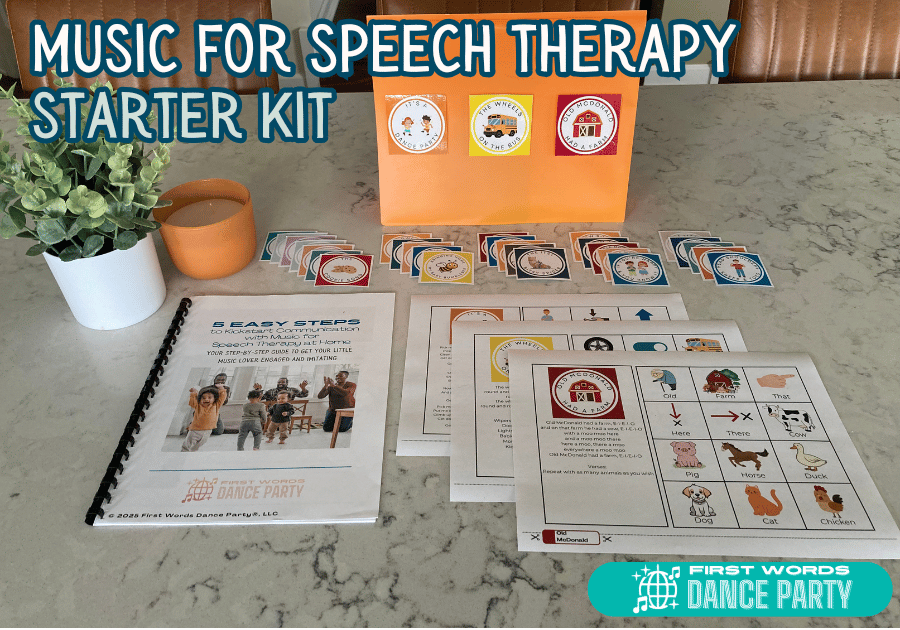
If you're ready to go even deeper, my Homeschool Speech Therapy Handbook expands on the strategies embedded within the lyrics of my songs with step-by-step guidance, practical activities, and everyday routines that help you build communication throughout your day.
Whether you're waiting for a speech evaluation, receiving Early Intervention services, or simply looking for more ideas to try at home, it's designed to give you the knowledge and confidence to support your child's communication journey.
Key takeaway: Music is one of the easiest and most enjoyable ways to encourage the foundational communication skills that help children learn to talk.
Final Thoughts: What to Do When Your Toddler Won’t Repeat Words
If your toddler isn't imitating words yet, don't focus only on the words they aren't saying.
Start noticing what preverbal imitation skills they are already copying.
Watch what happens when you play with toys together. Look for actions and gestures. Try modeling some playful sounds and see if your toddler tries to make them after seeing and hearing you do it first.
Those little moments can give you important clues about the imitation skills your child already has.
And instead of making every interaction about getting your toddler to repeat a word, you can create playful opportunities for them to watch, listen, participate, and communicate in the ways that are accessible to them right now.
If you're looking for a place to start, I'd love to help. Download my free Music for Speech Therapy Starter Kit to learn how to use everyday music to encourage communication at home. You'll receive my 5 Easy Steps to Kickstart Communication with Music for Speech Therapy at Home. If you're feeling stuck with your child's speech and language development, your kit will give you fun, fresh ideas you can use right away.
Frequently Asked Questions
Why won’t my toddler copy words?
There can be many reasons as to why a toddler isn’t mimicking their parent’s words. Speech and language are so complex.
But, generally speaking, if a child isn’t imitating, it’s because there is some aspect of speech and language that is challenging for them.
It could be that it is hard for a child to shift their attention between objects and people in order to see, hear, and process what is being said.
It could be that a child has had chronic ear infections and/or chronic fluid in the middle ear, impacting their access to sound.
It could be that a child is struggling to coordinate their articulators (the tongue, lips, and teeth) in order to produce the sounds needed for speech.
Very often, we don’t yet know why a child is struggling to imitate, but we do know what to do to support them with those crucial next steps.
How do I get my toddler to imitate words?
Start by noticing what your toddler does copy.
When we look at different kinds of imitation, including actions with objects, motor actions and gestures, playful sounds, animal and vehicle sounds, and words, we gain very helpful insight.
If your toddler doesn't imitate across many of these areas, start with actions with objects and work up from there.
If you have concerns about your toddler's overall communication development, talk with your child's pediatrician or contact your local early intervention program.
A speech-language pathologist or your local Early Intervention team can help determine whether your child's communication is developing as expected and support you with strategies to support expressive language.
My toddler doesn’t copy me. Should I be concerned?
By around 18 months, most toddlers are typically imitating single words consistently, and spoken vocabularies generally expand rapidly between 18 and 24 months.
All of that imitation between 12-24 months is what turns into spontaneous language, so that most toddlers are using at least 50 words and combining words into two-word phrases by their second birthday.
While every child develops at their own pace, 18 months is an important time for speech and language development. While some late-talking toddlers naturally catch up on their own, we don't have a reliable way to predict which children will and which need extra support.
That's why today's recommendation is no longer to simply "wait and see." It’s important to intervene early and offer the support a child needs, rather than waiting to see what happens and missing out on valuable time for progress.
If your toddler is right within this age range, you might appreciate learning more: 18 Month Old Not Talking? How to Make Valuable Progress This Week.
Why does my two-year-old understand words but not repeat them?
Understanding, or receptive language, and using spoken language, or expressive language, are different but related skills. Many toddlers understand far more language than they can express. While it's encouraging when a child understands what you say, we also expect expressive communication to continue developing around this age.
By the age of two, if a child isn’t repeating words, it is because there is some skill within the development of preverbal imitation that they haven’t mastered yet.
Consider those imitation skills that come before words: actions with objects, actions and gestures, and playful sounds. Where in this sequence might they be stuck?
Once you determine which imitation skill isn’t solid yet, then you’ll have a better sense of what to do for a toddler not imitating words consistently.