Mixed Receptive-Expressive Language Disorder: 3 Solutions for Communication & Behavior
- 0 comments
Mixed receptive-expressive language disorder affects both a child's ability to understand language and their ability to use language to communicate. And for young children, those language difficulties can sometimes show up in ways we don't immediately recognize as communication.
A child might become upset during a transition, struggle to follow a direction, or have a big reaction when they can't communicate what they want or need.
When we look beyond the behavior and consider what a child may be trying to communicate, we can find more supportive ways to help.
In this article, we'll look at three practical strategies for supporting communication and behavior when a child has receptive and expressive language difficulties.
If your child isn’t using many words yet, you may be unsure of what to do and what not to do, and you’re not alone. Many parents I coach in early intervention feel stuck, frustrated, or overwhelmed when their child won’t imitate their words.
That’s why I started creating music for speech therapy that weaves in the strategies we use everyday in early intervention.
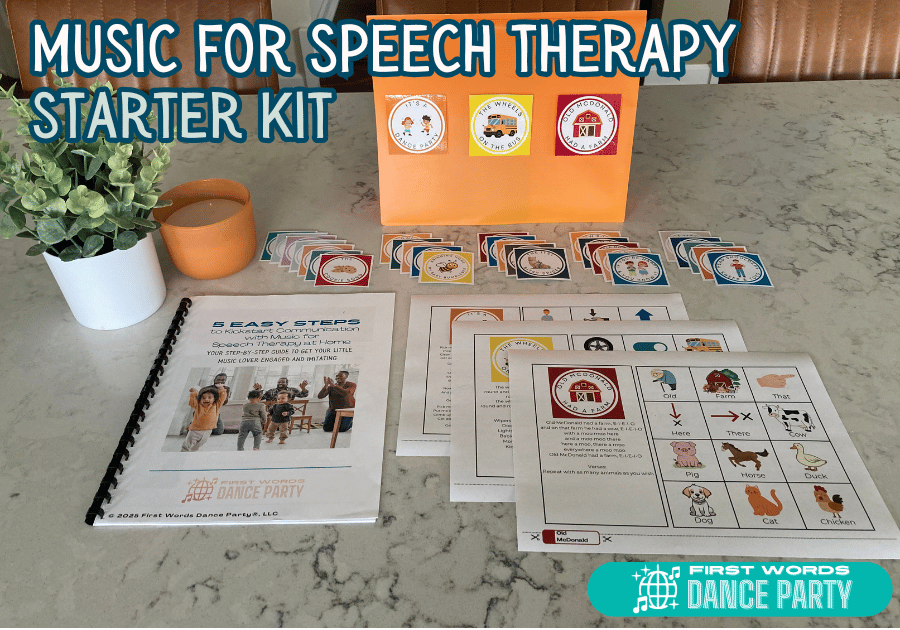
If you're looking for easy activities you can start using right away with your toddler, be sure to grab my free Music for Speech Therapy Starter Kit. It includes a guidebook, printable song boards, song choice cards, and original speech therapy songs designed to help you turn everyday music into meaningful opportunities for speech and language growth.
What is mixed receptive-expressive language disorder?
Mixed receptive-expressive language disorder is also referred to as receptive and expressive language disorder, mixed expressive and receptive language disorder, and expressive receptive language disorder. This communication disorder involves significant delays in the areas of both receptive language and expressive language.
What is receptive language?
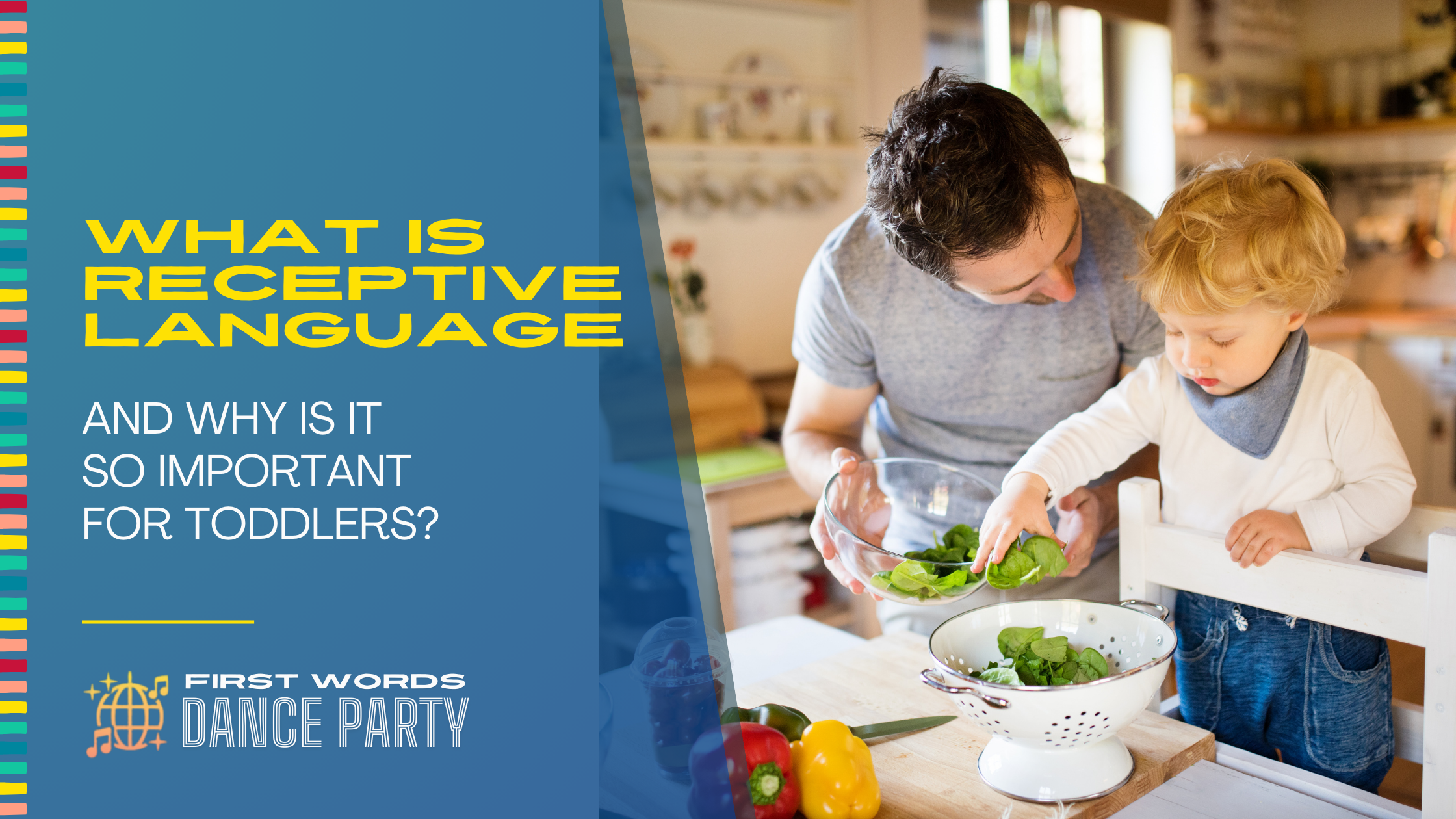
A receptive language definition is simply the understanding of language. For toddlers, receptive language milestones include: following directions, understanding the names of objects and people, identifying body parts and clothing, and pointing to pictures in a book when an adult labels them.
For more in-depth information on how to support your child's receptive language development, you can check out this article: What is Receptive Language and Why Is It So Important for Toddlers?
What is expressive language?
Expressive language refers to the words and phrases that a child can communicate. For toddlers, this includes the ability to express their wants, needs, and other functions.
It involves the ability to use words as symbols that represent concepts- for example, that when you string together the three different sounds in the word “ball”, that sound sequence is a symbol for the round object that bounces and rolls across the floor.
How Can Mixed Receptive-Expressive Language Disorder Affect Behavior?
The parents I work with are often struggling with the same kinds of communication breakdowns:
When they give their child a direction, the kiddo just doesn’t respond.
When it’s time to transition from one activity to another, a meltdown follows.
When the parent asks the child a question about what they want or need, the child doesn’t answer.
When they prompt the child to imitate the name of something, they don’t respond.
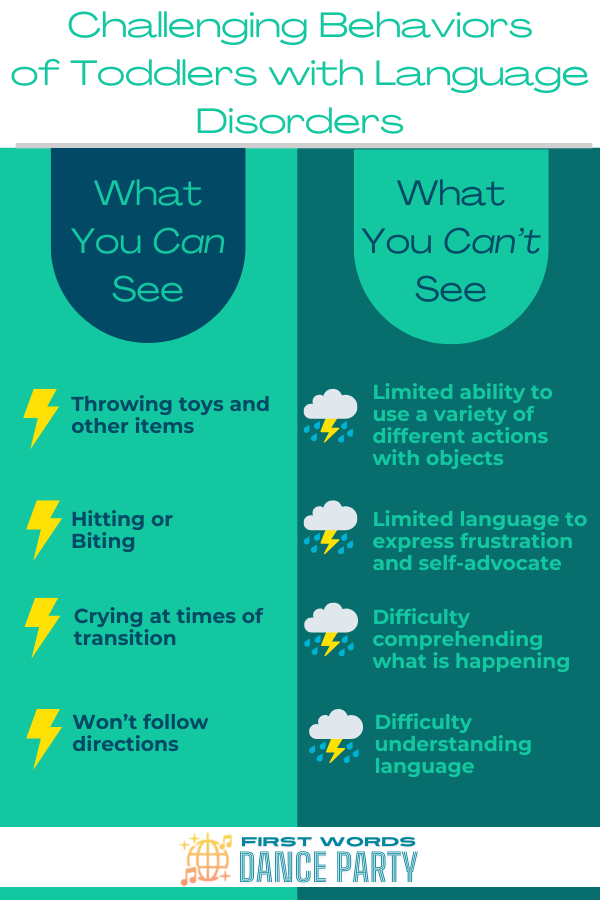
Sometimes children are so frustrated that they hit others or themselves, or use other physical means to express themselves.
Do any of these sound familiar?

Why do kids with receptive expressive language disorder struggle with behavior?
Children can have a receptive language disorder or an expressive language disorder independently of each other. Children diagnosed with receptive expressive language disorder, however, have difficulty with both aspects of language.
With delays in the areas of both expressive and receptive language, little ones with receptive expressive language disorder often struggle to understand what is happening around them. They also struggle to use language to express themselves and to let others know what they need.
With these significant challenges, it’s no wonder why these children may demonstrate challenging behaviors.
Parents are a chlid's most influential communication partners
So what’s a parent to do? Over the years, I’ve worked with many parents struggling with the same kinds of challenges- and finding solutions together never gets any less rewarding.
There are small changes you can make to the things you are already doing that will have profound impacts on your child’s ability to understand and communicate better with you across the day.
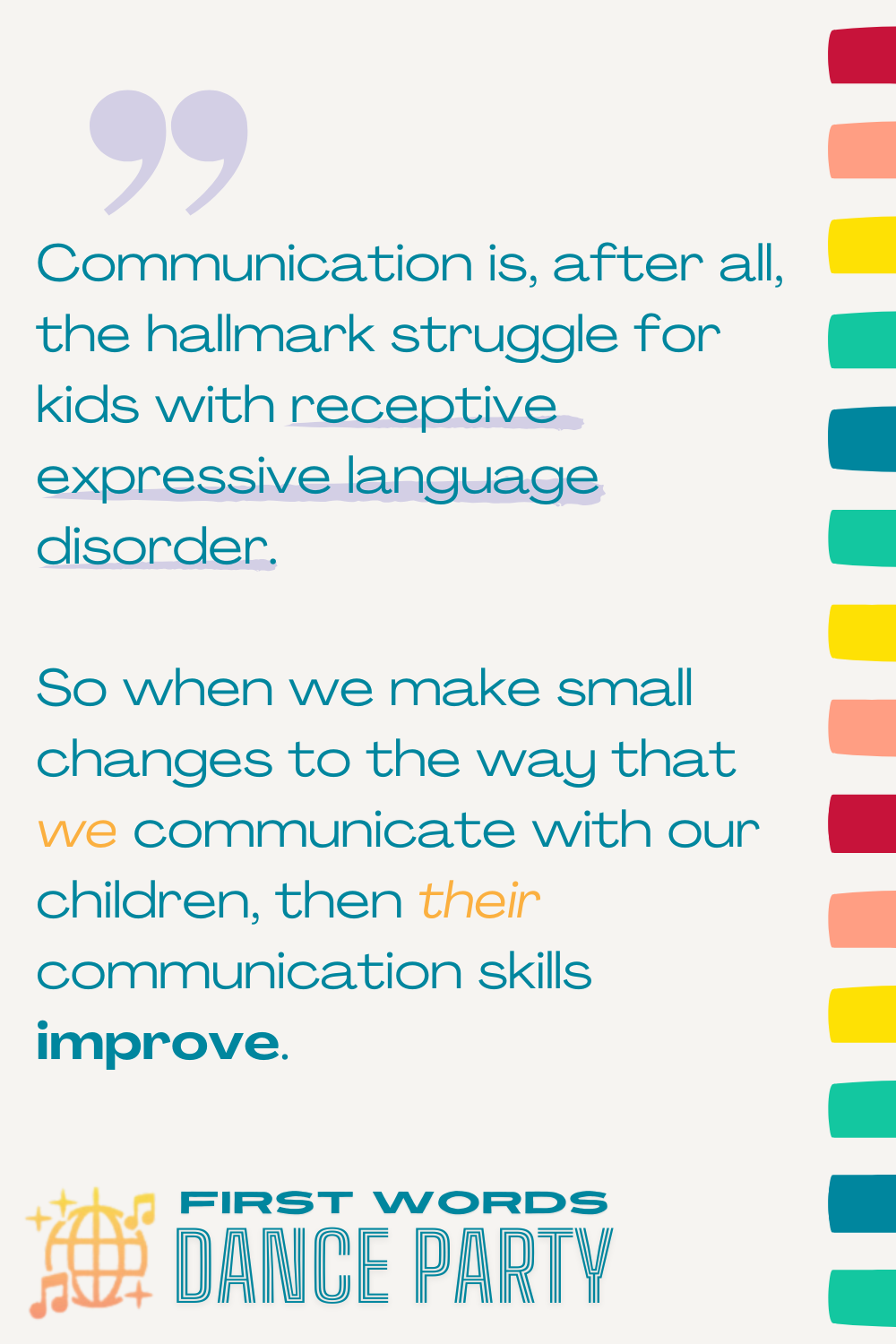
Communication is, after all, the hallmark struggle for kids with receptive expressive language disorder. So when we make small changes to the way that we communicate with our children, then their communication skills improve.
Behavior is a form of communication
The single most important thing to understand when addressing any behavior is to acknowledge that behavior is a form of communication.
Children with language delays often use behavior to communicate because it is very effective, and they lack other means of getting their message across.
When our children have big behaviors, the one thing we have to ask ourselves is, “What is my child trying to tell me?”.

To answer this question, we first have to think about the antecedents to the behavior, or the thing(s) that happen just before the behavior occurs.
Look for the message behind the behavior
Let’s consider an example.
Say that a child is playing with cars. The parent is enjoying a few minutes of precious downtime and suddenly notices it’s a little past the typical time to start the bedtime routine. So the parent tells the child that it is time to go upstairs and take a bath, and then the parent begins cleaning up the cars.
The child responds by shouting, crying, and hitting the parent. The parent responds by telling the child to stop, and then asks “Do you want to take a bath?”
In this relatable example, the behavior is easy to identify: the behavior is shouting, crying, and hitting.
The antecedent (the thing that happened before the behavior occurred) was that the parent announced that it was time for a bath and then began cleaning up the cars.
So when we think about both the antecedent and the behavior together, what do you think the child was trying to say with their behavior?
Likely the child was trying to say something along the lines of: “Hey! What are you doing?!? I am in the middle of something here. I’m SO frustrated that you just started cleaning up my stuff without even consulting me!”
Obviously, toddlers don’t have the language to communicate like this. And a toddler with receptive expressive language disorder is behind their same-aged peers in their ability to communicate.
A toddler with a speech delay has relatively few words to try to relay any of those feelings to their parent. That toddler also doesn’t have the receptive language to think through their feelings with that kind of inner dialogue.
What these toddlers do have are strong feelings and lots of them. But, they don’t have the brainpower yet to manage their impulsivity.
So now, we can gain a clearer understanding and empathy for the dissonance a child must feel when they have these strong emotions and little language through which to make sense of those feelings bubbling inside.
Here are three highly effective strategies you can start using today to start working through those challenging behaviors.
3 Strategies to Support Communication and Behavior
Now that we’ve established that behavior is a form of communication, we can use it to our benefit. We can use this as a lens to make sense of common but challenging behaviors.
With the knowledge that behavior is actually a form of communication, we can get away from common misperceptions, like the belief that a child is being naughty, spoiled, or lazy, in order to make way for solutions that work.
1. Helping a child with a receptive language delay learn to follow directions
The parents of the toddlers I work with are often struggling to get their children to follow simple directions like, “Go get your cup”. It makes sense why following directions is such a struggle for these little ones when you first consider that understanding the names of objects and following basic directions are foundational receptive language skills.
They often just don’t understand the actual words within the direction that are being spoken to them.
And, if and when they have some emerging understanding, if the child’s attention is on something else, like a favorite toy or a show at the time the direction is being given, they are much less likely to shift their attention to process that language.
Use visuals to teach directions
What do I mean by visuals? I mean objects, pictures, and even gestures and sign language to add a visual component to the direction.
Let’s go back to our example above of the toddler who cried and hit their parent when it was time to clean up.
The direction given to the child in that scenario was that it was “time to go upstairs and take a bath”. This direction may have gone much better if the parent had added a visual to help the child understand what was going to happen next.
The parent could go get the child’s favorite bath toy and show it to the child. The parent could also simplify the direction from “It is time to go upstairs and take a bath,” to just, “Bath time” or “Time for bath.”
It would also be incredibly beneficial to give the child extra time after the direction to process what was said before shifting gears into bath time.
Whenever possible, try to incorporate visuals when giving directions- especially at times of transition. This is a proactive strategy that will help to ensure that your child understands what is about to happen next before things start changing.

Pictures can be used as a bridge to help children communicate their messages to others, alleviating tons of frustration for both parents and children. Visuals can also be used to break down directions, like the steps needed to get ready for childcare, and for schedules to help a child anticipate what their morning will look like.
Head over to Autism Little Learners for a free starter pack of visuals you can start using with your little one.
Pro Tip for Receptive Language Skills
Here is a pro tip for helping your child follow other directions during self-care, meals, play, and other activities: start by focusing on directions in which you ask your child to put something in as part of the instruction. Here are some examples:
Throwing trash away
Putting clothes into a hamper
Placing a cup or dish into the sink
Placing bath toys into the tub
Placing laundry into the washing machine
The reason this works so well as a starting point is that taking items in and out is one of the first actions with objects that little ones tend to use.
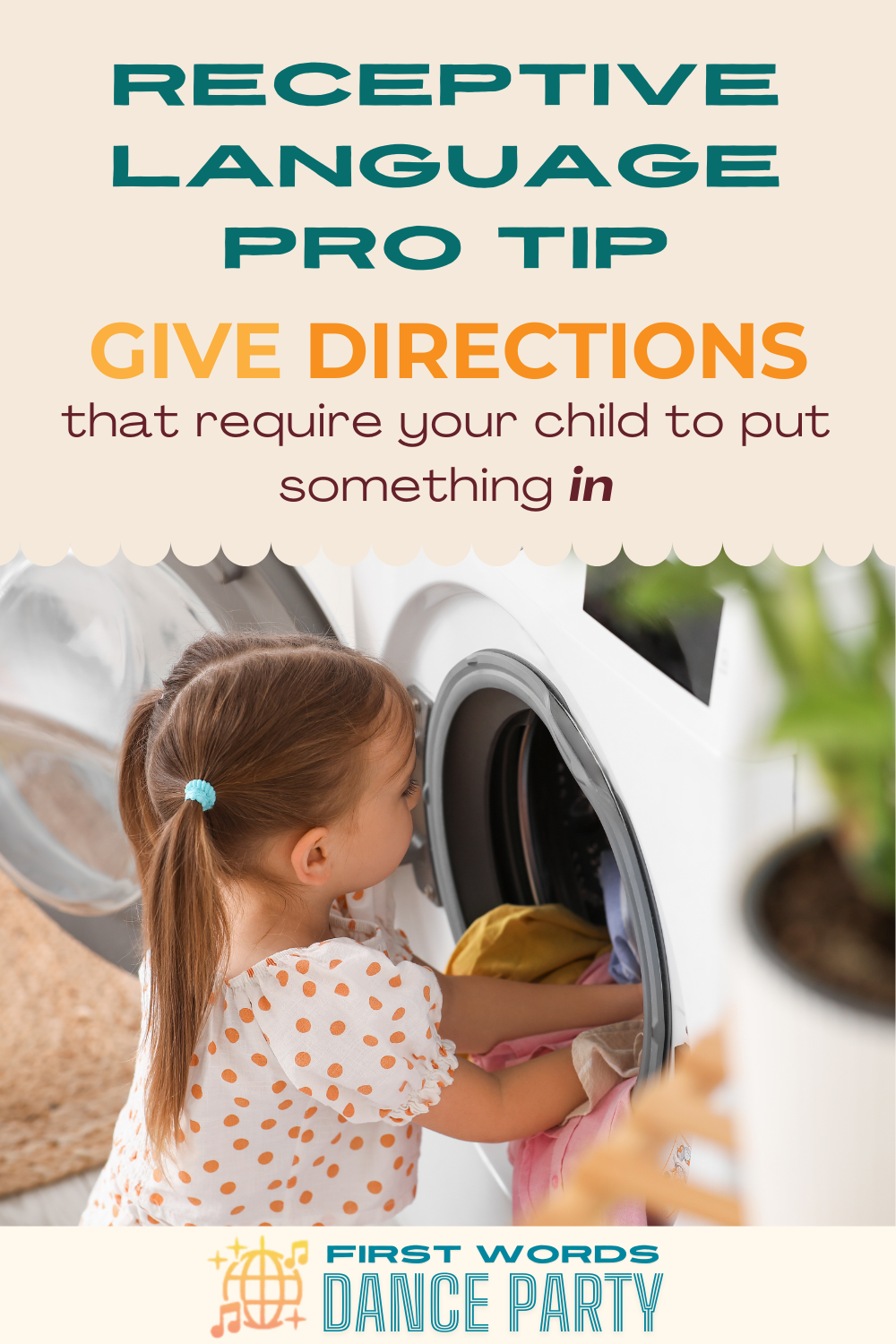
Children have to imitate a variety of different actions with objects before they are ready to imitate higher-level skills like gestures, sounds, and words. So when you have your child help with simple household activities like these, you are also helping them with their expressive communication, too. Win-win!
2. Helping a child with receptive and expressive language delays to express their wants and needs
Children with receptive expressive language disorder often become frustrated when they are unable to share their basic wants and needs with others. Throwing, crying or screaming, climbing, and other challenging behaviors often crop up when kids just don’t have another way of sharing these messages with others.
To help children express these needs, it’s important to meet children where they are, and they might not yet have the foundational skills to imitate verbally.
In addition to using actions with objects, little ones have to be able to imitate gestures before they can imitate words. This is why modeling sign language and gestures is so beneficial for little ones who are struggling to communicate.
Use Sign Language
I’ve worked with many parents and childcare providers who are nervous that if they use sign language, then their child won’t be motivated to talk. Not to worry! Research has demonstrated that sign language increases a child’s verbal imitation skills- not the opposite. So sign away!
Here are my all-time favorite signs to model to toddlers to decrease frustration and challenging behavior:
Eat
Milk
More
All done
Help
Open
Stop
Go
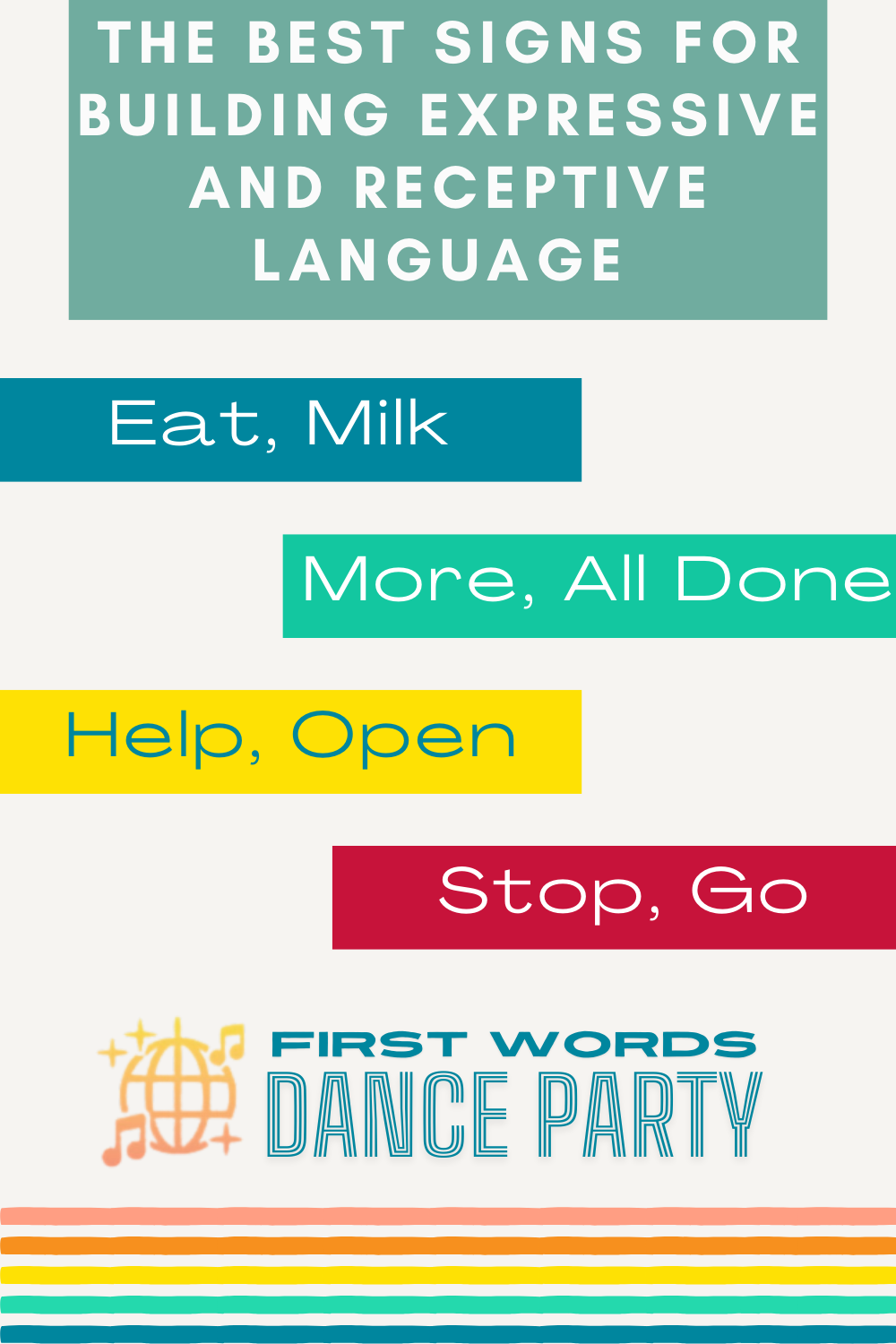
If you’ve been thinking about trying some signs with your little one but you’re not quite sure how to start, head over to Baby Sign Language. You’ll find a dictionary of pictures and videos for just about any word you need, as well as helpful tips and videos to get you started.
Model Gestures
Don’t forget about gestures! Which of these gestures is your child using? Are there any you could start sprinkling into playtime and other activities so that your child has the opportunity to imitate you?
Waving hi and bye
Ta Da! (Arms up high)
So Big! ("How big is JJ? SO BIG!" with arms up high)
Where are you? (or Where did it go?)
Blowing a kiss
Clapping
Actions in songs like “Wheels on the Bus” and “Itsy Bitsy”
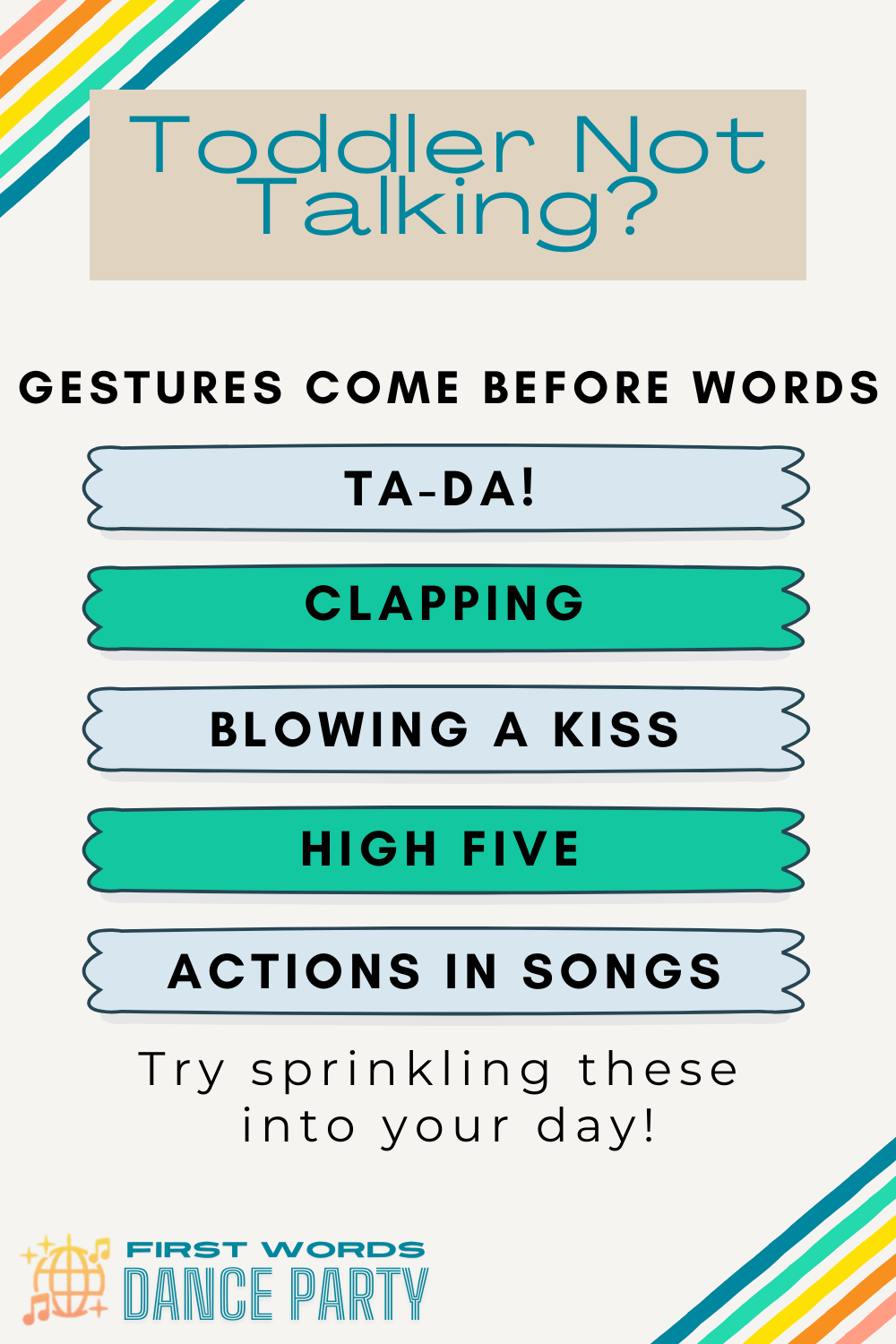
Check out the 16x16 series from the First Words Project for free, beautiful printouts of 16 Actions with Objects and 16 Gestures by 16 Months. They’ll help you figure out which skills your child is already doing and get you thinking about which ones to focus on next.
Sometimes kids throw toys and other objects when they have limited play skills, and they don’t yet use a variety of other actions with objects. It’s worth taking the time to consider which actions with objects you could spend some time modeling to your child as you play and go about your daily routines in order to cut down on throwing.
Try a Core Board
Core boards are communication boards that use picture symbols for highly functional words, like eat, drink, help, etc. Core boards make it possible for children who aren't yet speaking to express their thoughts, needs, and feelings with picture symbols.
If you're interested in learning more about how to get started with a core board and are interested in some free core words printables, start here: How to Feel Good Using an AAC Core Board (No Experience Needed).
Instead of Asking Questions, Make Comments
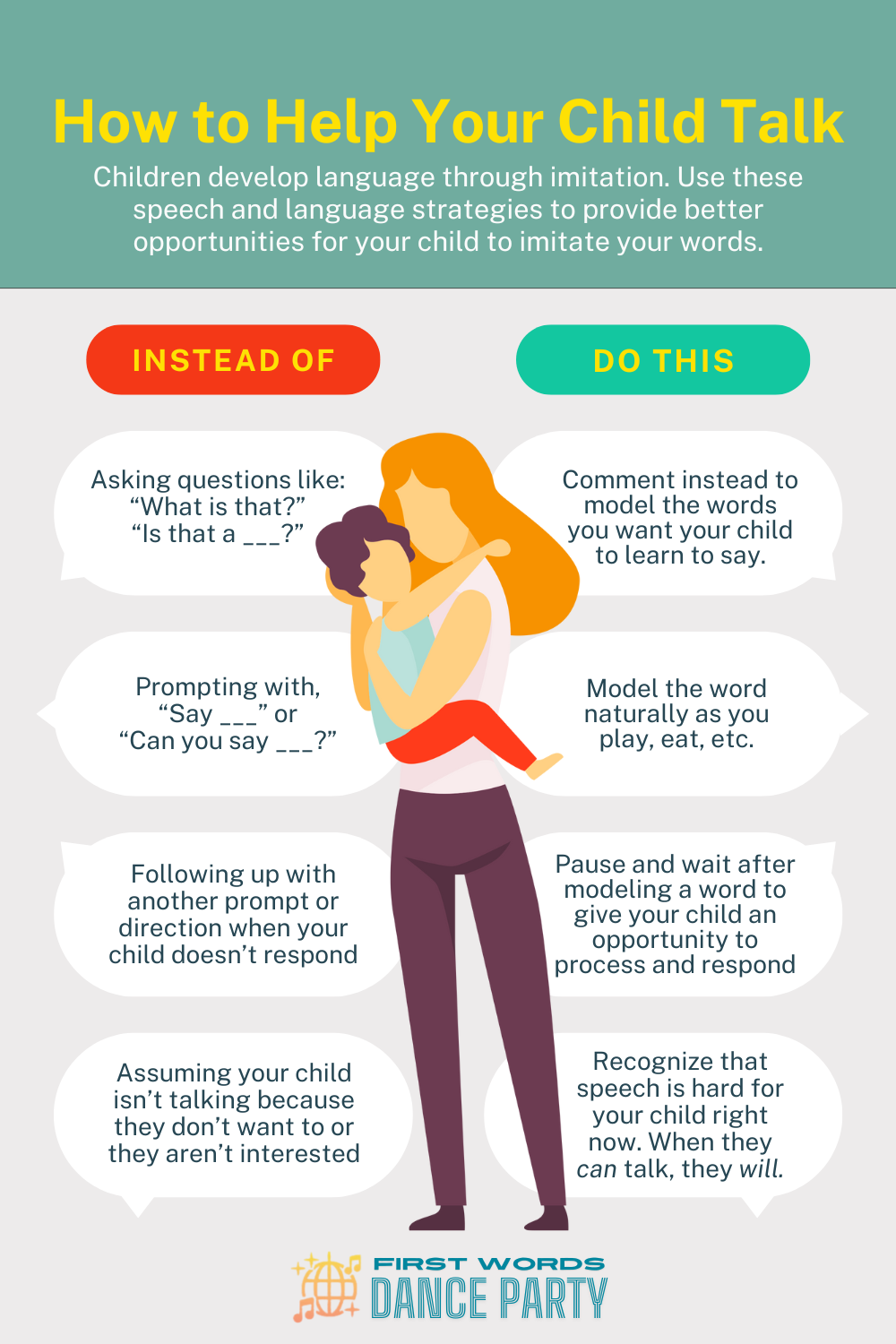
When you ask your child a question like, “What do you want?” or “What is that?”, what usually happens next? Do they answer? Or do you end up following up with another question or prompt?
One of the biggest ruts we get into as parents is to ask too many questions. What usually happens is that little ones start to process the question we just asked, but then when they don’t respond right away, we fill the silence with another question.
Don’t feel guilty. We all do it. Sometimes it feels a little challenging with all these one-sided conversations, am I right?
So here’s the solution: comment, comment, comment.
Every time you’re tempted to ask, “Is that a cow?” just label it by saying “Cow”.
Instead of “What color is it?”, say, “A red apple.”
Instead of, “What do you want?” or “Do you want milk?” when the child shoves their empty cup into your hand, say, “You want milk.” (Bonus- sign “milk” while you say it!).
Comments are processed faster and more easily than questions, and they offer much richer language models. So, when your goal is to help your child to talk and understand more, you’ll get SO much more bang for your buck with comments than you will with questions.
For more tips on how you can help your child talk by providing better language models, check out this article: Delay in Speech? 5 Easy and Effective Ways to Boost Language.

Avoid prompts
On a related note, prompting your child has the same effect as questions. So instead of prompting your child by saying things like, “Say ‘more’ ” or “Can you say ‘more’?”, just model the word “more” and sign it instead.
Modeling instead of prompting takes the pressure off, resulting in a much more natural, back-and-forth interaction that offers more language and turn-taking.
Make the most of play, books, and daily routines
You don't need special toys, apps, or flashcards for children with speech delays. In fact, the most beneficial activities for speech therapy use the very toys, books, and materials you already have in your house.
For simple at-home activities you can start doing today, start here: Speech Therapy Home Practice: 7 Quick, Easy Activities You Need for Success.
3. Using Music for Speech Therapy
The repetition, prosody, and motivating nature of music is worth its weight in gold for children with language disorders. Think about your favorite children's songs. They're full of the foundational skills children need before they begin talking:
Actions and movement
Gestures and signs
Animal sounds and sound effects
Exclamatory expressions like "ouch!" or "pop!"
Repetition
Predictable lyrics
Music provides a motivating and fun way to support children with mixed receptive-expressive language disorder. You can check out this article to learn more: Expressive and Receptive Language Disorder: How to Use Music for Joy and Success.
That's why using the joyful nature of music to encourage language is such a no-brainer. For a deep dive into how to do this, you can check out this comprehensive guide to using music in speech therapy.
If you'd like help figuring out which stage of imitation your child is in, and which songs are best for their current skill set, you can check out this guide to using music-based activities for speech therapy at home.
First Words Dance Party's Speech Therapy Songs
After more than 15 years working in early intervention, I began writing my own songs because I wanted parents to have music that intentionally targets the communication skills children need most.
Each song is designed around evidence-informed strategies and everyday routines, making it easy to model gestures, sounds, core words, functional phrases, and opportunities for turn-taking and imitation.
If you'd like to see these strategies in action, here are two of my favorite examples:
The Cookie Song: What first seems like a cute song about every kid’s favorite dessert is actually a dance-y little number that targets the first words yes, no, eat, mommy, daddy, doggie, and of course… cookie! This one is perfect for kiddos who aren’t yet saying “yes” and “no”.
It's My Turn: Another fan favorite. This fun song about sharing helps toddlers and children with speech delays learn the words necessary to ask others for a turn.
It’s a Dance Party encourages the words up and down while also teaching body parts. As children dance along, they point to their eyes, nose, ears, hands, and feet in time with the lyrics.
You can stream First Words Dance Party on Spotify, YouTube Music, Apple Music, and anywhere else you get your music.
A Simple Way to Get Started with Music for Speech Therapy at Home
If you're wondering where to start, my free Music for Speech Therapy Starter Kit was created for parents just like you. It includes my 5 Easy Steps to Kickstart Communication with Music for Speech Therapy guidebook, printable song boards, song choice cards, and original speech therapy songs that will help you confidently use music to support your child's communication from the very first day.
First Words Dance Party® Speech Therapy Music Video Series
Ever feel like your child imitates things they see in videos, but it's almost impossible to get them to imitate you?
You're not alone. I can't tell you how many kiddos I've worked with who struggle to imitate, but there's something about watching a video that works some sort of magic with gestalt language learning.
It's what inspired me to create a brand new series of music videos that incorporate video modeling, AAC (Augmentative and Alternative Communication), and so much more.
These are short, engaging music videos that show real children communicating in everyday routines, paired with the language modeled directly within the song.
You’ll see examples of:
sign language used during meaningful moments
core words modeled on a communication board
functional language paired with real actions like requesting favorite foods, taking turns with peers, and playing with a variety of toys
Each video is built around situations children experience every day, like snack time, play, and getting ready to go outside.
And because the language is modeled in time with the music, it provides the repetition and predictability that many children with speech delays respond to so well.
These videos are designed to support your child, but also to support you.
They give you a clear picture of how to model language in a way that feels natural, so you don’t have to guess what to say or how to say it. When the songs are over, you have the exact phrase to model in real-world situations as they come up.
If you’ve been wanting to support your child’s communication but weren’t quite sure where to start, this is an easy way to begin.
Final Thoughts
Parenting a toddler is hard work. It’s a thankless job that is messy, loud, and keeps you working 24 hours a day, 7 days a week.
While tantrums are typical for this age, children with receptive expressive language disorder often have more challenging behaviors. They may cry, yell, and use physical means to express themselves more frequently than their same-aged peers due to challenges with understanding and using language.
Reframing that behavior to see it as a means of communication can help tremendously. When we ask ourselves, “What is my child trying to tell me with this behavior?”, we gain valuable insight that can help us to figure out how to solve the problem.
Before you go prep the fifth snack of the day or clean up the toy room, don't forget grab your free Music for Speech Therapy Starter Kit and take the first step toward fun, easy, music-based activities for speech therapy at home.
Parents are a child's most influential communication partners, so no one is better suited than you to help your child with their communication.
I hope that the tips in this article have given you some practical ideas that you can use to reduce your child’s challenging behaviors.
Having a child with a receptive expressive language disorder can be hard work, but with the right tools to support you and your child, you’ve got this!
FAQ: Mixed Receptive-Expressive Language Disorder
What is mixed receptive-expressive language disorder?
A receptive expressive language disorder (also called a mixed receptive and expressive language disorder) means a child has difficulty both understanding language and using language to communicate. This can impact how they follow directions, process what they hear, and express their wants, needs, and ideas in everyday interactions.
What is the difference between receptive and expressive language?
Receptive vs expressive language refers to two different aspects of communication. Receptive language is what your child understands, This includes following directions, understanding questions, and processing what others say. Strong receptive language skills are the foundation for learning, communication, and social interaction.
Expressive language is how your child communicates. Some children have delays in one area, while others experience challenges in both, which is known as a receptive and expressive language disorder.
Is mixed receptive-expressive language delay the same as mixed receptive-expressive language disorder?
While the technical diagnosis is mixed receptive-expressive language disorder, this name is so long and wordy that people ultimately end up referring to it in different ways.
What are the signs to look for in young children?
Children with challenges in both receptive and expressive language may:
Have difficulty understanding language or following directions
Not consistently respond when spoken to
Use few words, especially for a variety of different functions (greeting, requesting, protesting, seeking information, etc.)
Struggle to express wants and needs clearly
Seem to “tune out” during conversation
Show frustration or challenging behavior when trying to communicate
How does language delay affect behavior?
When a child has difficulty understanding or using language, it can directly impact behavior. If they don’t understand what’s being said—or can’t express themselves—they may become frustrated, withdraw, or show behaviors like tantrums or avoidance.
These behaviors are often a form of communication, not defiance.
Can children grow out of language delays?
Some children with delays in receptive and expressive language make significant progress over time, especially with support.
For others, language differences may continue as part of their developmental profile. Early intervention can make a huge difference in the early childhood years.
How can I support my child’s communication at home?
You can support receptive language development and expressive language skills through simple, everyday interactions:
Follow your child’s lead and interests
Model short, functional phrases during routines
Use visuals to support understanding
Reduce questions and increase modeling
Create opportunities for connection and shared attention
These small moments help build communication over time
Is mixed receptive-expressive language disorder the same as autism?
Some children with differences in receptive and expressive language are later diagnosed with autism, but not all children with language delays are autistic.
In early childhood, there can be overlap in how these differences appear, which is why ongoing observation and support are important. If you're trying to figure out whether your child's communication struggles are related to autism you can check out these articles: