10 Best Speech and Language Toys for Toddlers (Recommended by Experts)
- 0 comments
The best speech and language toys for toddlers are simple, open-ended toys that encourage pretend play, imitation, turn-taking, and plenty of language opportunities. In this article, I’ll list ten of my absolute favorites that I use everyday..
After more than 15 years working with toddlers with speech delays and their families as an early intervention teacher, I've learned something important:
The more a toy does, the less there is for your child to do.
Toys that talk and entertain children aren't actually the best choices for encouraging language.. Instead, we want toys that give children opportunities to explore, interact, and imitate.
Below are ten of my favorite toys for speech and language development, along with simple ways you can use them to encourage communication at home.
If you're concerned that your toddler isn't talking as much as expected, you can also read this article for information about speech development and ways to support your child: Late Talkers: 5 Surprisingly Easy Ways to Help Your Toddler Now.
Key Takeaways
The best speech and language toys are simple, open ended, and encourage children to be creative..
Toys don't need to talk or make electronic sounds to support language development. In fact, toys that talk and entertain can actually limit the amount of language during play.
The best toys provide opportunities to model beginning sounds and functional words.
How you play with your child matters just as much as the kinds of toys you offer.
For the biggest impact on speech and language, model functional words, gestures, and playful sounds instead of prompting or quizzing.
This article contains affiliate links.
What Are the Best Toys for Speech Development?
The best toys for speech development encourage turn taking, imitation, and opportunities for functional language. They are open-ended and allow for lots of creativity.
Consider something simple, like blocks. Your toddler can stack a tower, make a train, or place blocks into a cup to pretend they are ice cubes. As their play partner, you can provide all kinds of language for these different ideas.
Your child can stack, create structures, symbolically pretend the block is something else, and anything else their imagination comes up with.
Compare that with an electronic, plastic book that names colors when a button is pushed. This type of a toy is meant to entertain, and your child might imitate a word here or there, but the opportunities are lacking.
Beyond passively pressing the buttons to hear what they say, there isn’t much for your child to do. And the best toys for speech therapy provide endless opportunities for your child to do something actively.
The blocks are hands-down the better toy to help with speech. They offer countless opportunities for your child to participate and communicate with you, while the electronic toy can't compete.
How to Choose Good Toys for Speech Therapy
When choosing speech development toys, look for ones that:
Encourage your child to use different actions with them (like putting things in and out, building, moving things up and down or back and forth)
Can be used in different ways as they grow older
Support pretend play
Create opportunities for turn-taking (so you or another child can play alongside them)
Make it easy to model simple, functional words
Electronic toys aren't inherently bad. But when you're choosing good toys to help with a speech delay, open-ended toys are best.
And here's a little secret: You can use many of these same language-building strategies while singing! My free Music for Speech Therapy Starter Kit includes original speech therapy songs for toddlers and preschoolers, plus song choice cards and a guidebook of five simple ways to turn music into opportunities for communication.
10 Best Speech and Language Toys for Toddlers
These are ten toys I regularly recommend to families because they're versatile and fun. These toys go hand in hand with simple strategies for speech therapy practice at home.
Pair these phenomenal speech and language toys with the right strategies for speech delays, and you're off to the races. Make sure to check out this article for simple techniques and strategies to get your little one communicating: Delay in Speech? 5 Easy and Effective Ways to Boost Language,
You may already have some of these, and if that’s the case, try to get them out more often!
1. Farm Sets and Toy Barns are the Best Toys for Speech Therapy
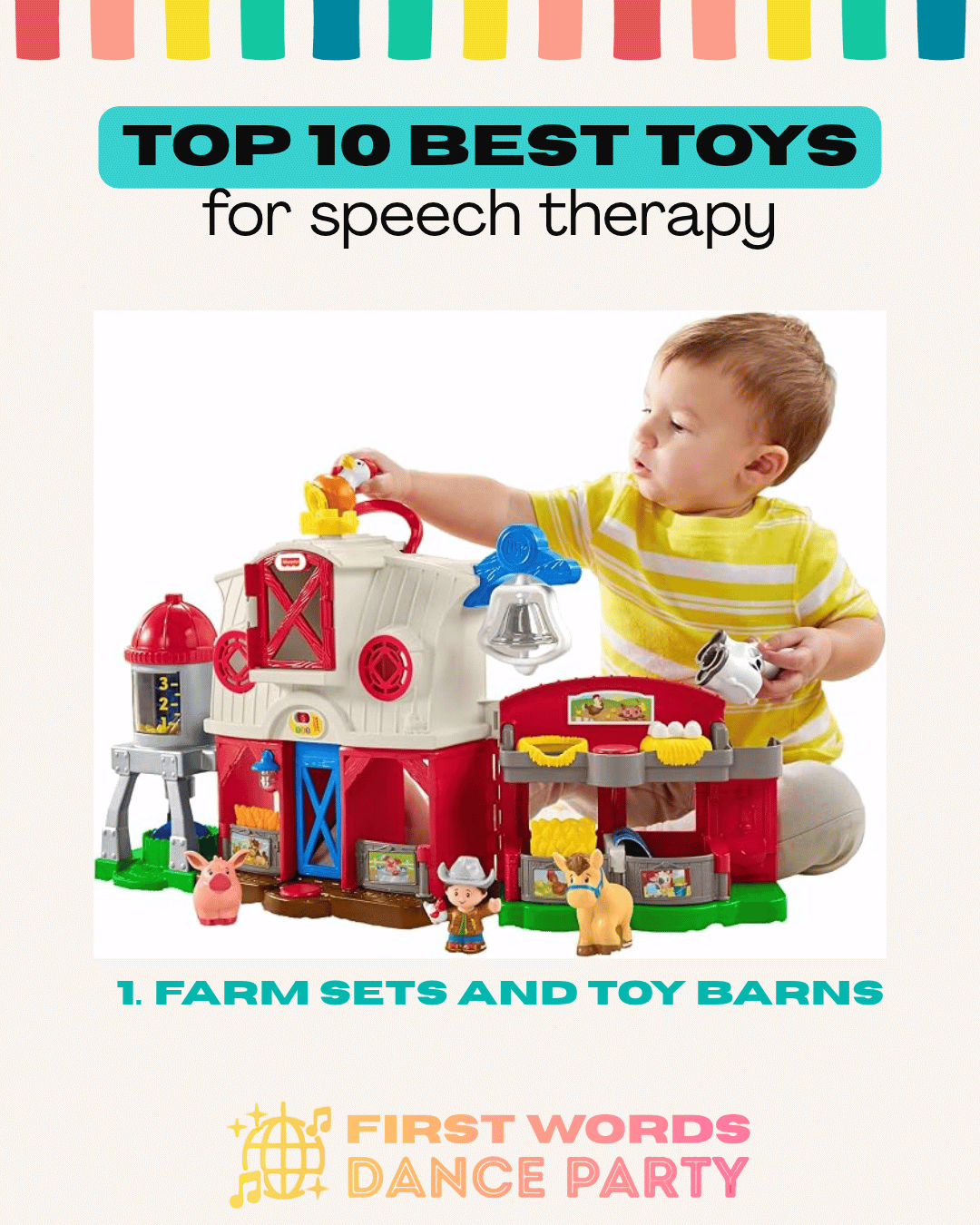
A farm set is hands down one of my favorite toys for modeling animal sounds, functional words, and beginning pretend play. For many toddlers with speech delays, animal sounds are a fantastic way to encourage sounds.
This makes barns and farm animals an obvious pick as far as the best speech delay toys go.
Your toddler can move animals around the barn, feed them, put them to sleep, or make them jump and run.
Words and sounds to model:
Moo, baa, neigh, oink, etc.
Open, close
In, out
Eat, sleep
Try this: Put an animal inside the barn and close the door. Model "Open!" as you open it, followed by a playful animal sound when the animal comes out.
If your toddler isn't imitating words yet, focus on modeling actions, gestures, and playful sounds as a starting point. You can learn more in this article: Toddler Not Copying Words? Don't Miss These Eye-opening Skills.
2. Bubbles
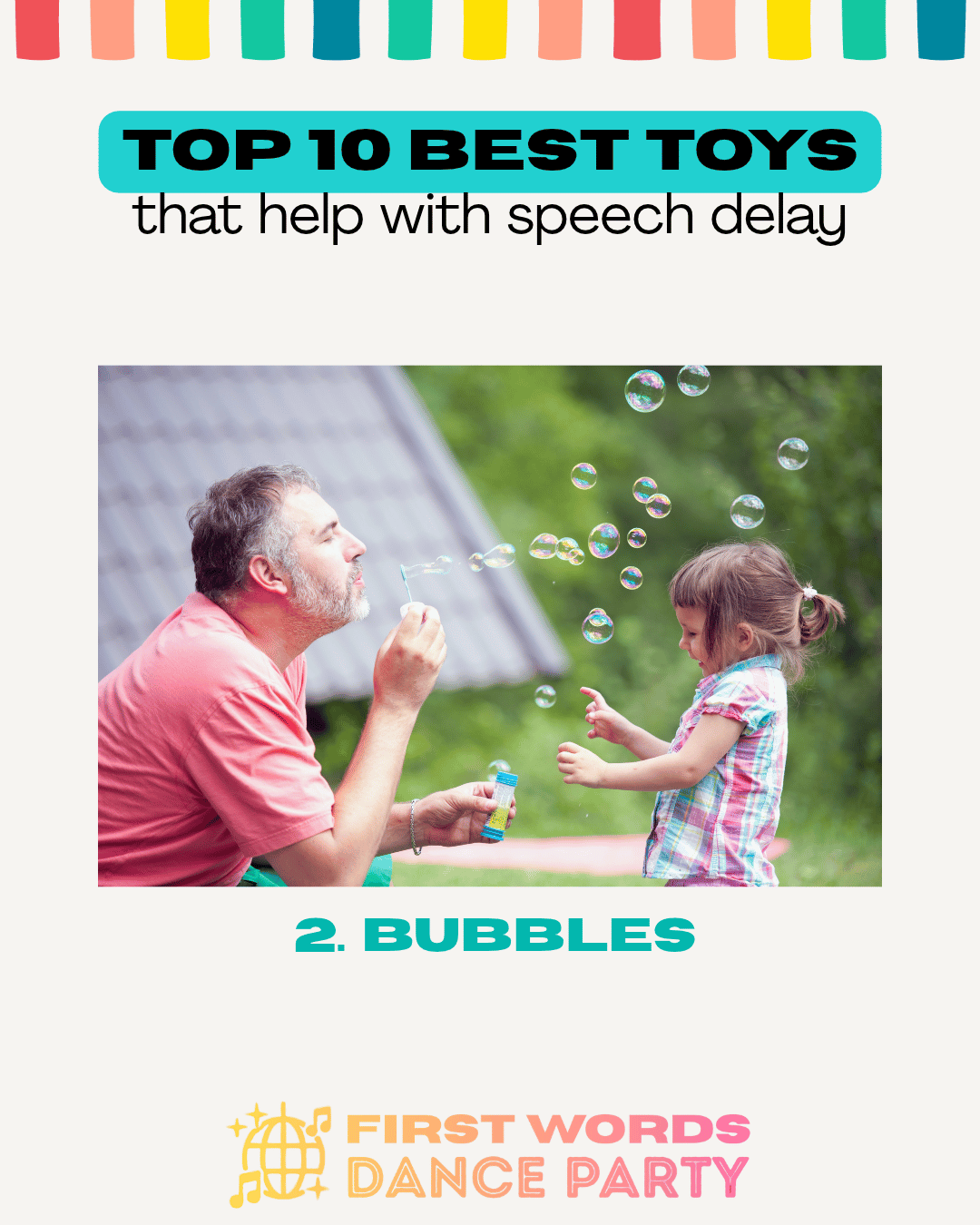
Ask any speech-language pathologist or early intervention teacher about bubbles, and they’ll likely tell you their favorite brand and where they keep their personal stash.
Bubbles are the holy grail of speech and language toys, because they are fabulous for building engagement. Toddlers and preschoolers get excited for bubbles, so the motivation is high.
Combine that motivation with tons of opportunities to ask for more, and you have one of the best toys to help with speech delays.
Words and sounds to model:
Pop!
Open
More
Bubbles
Blow
Up
Again
All gone
Try this: Blow a few bubbles and model "Pop, pop, pop!" as you pop them together.
When the bubbles disappear, pause and watch for your child's response. They might reach for the bottle, look toward you, make a sound, or use a gesture or word to request more.
Respond to their communication by modeling the word "more" and keep the fun going!
3. Baby Doll Sets and Accessories
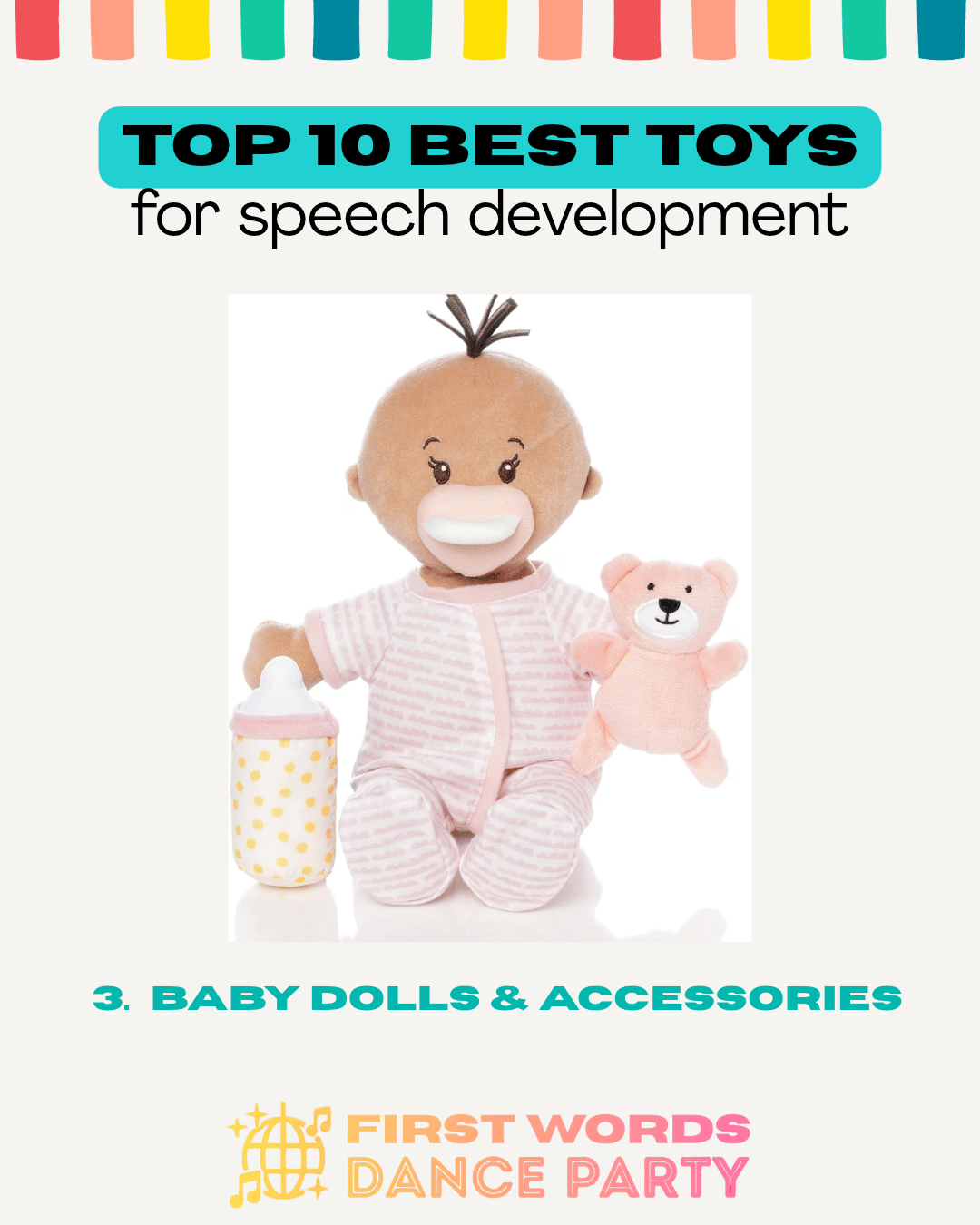
Baby dolls are perfect for encouraging pretend play and modeling language associated with familiar routines.
Children can feed the baby, give it a bath, change its clothes, and put it to sleep. This gives you, their play partner, opportunities to model all of the words that go with those actions and routines.
My favorite baby sets include magnetic bottles and pacifiers. There’s something about that pacifier that really gets toddlers interested.
Words and sounds to model:
Eat, drink, num num
Wash, brush, change
Shh, night-night, sleep
Try this: Pretend to put the baby to bed by setting it down and covering it with a blanket. Say “night night, baby” and “Shhh!” with a gesture. Wake the baby up, and then give the baby to your child to see if they imitate you.
You can also sing a familiar lullaby while putting the baby to bed.
4. Building Blocks are Fabulous Toys to Help with Speech
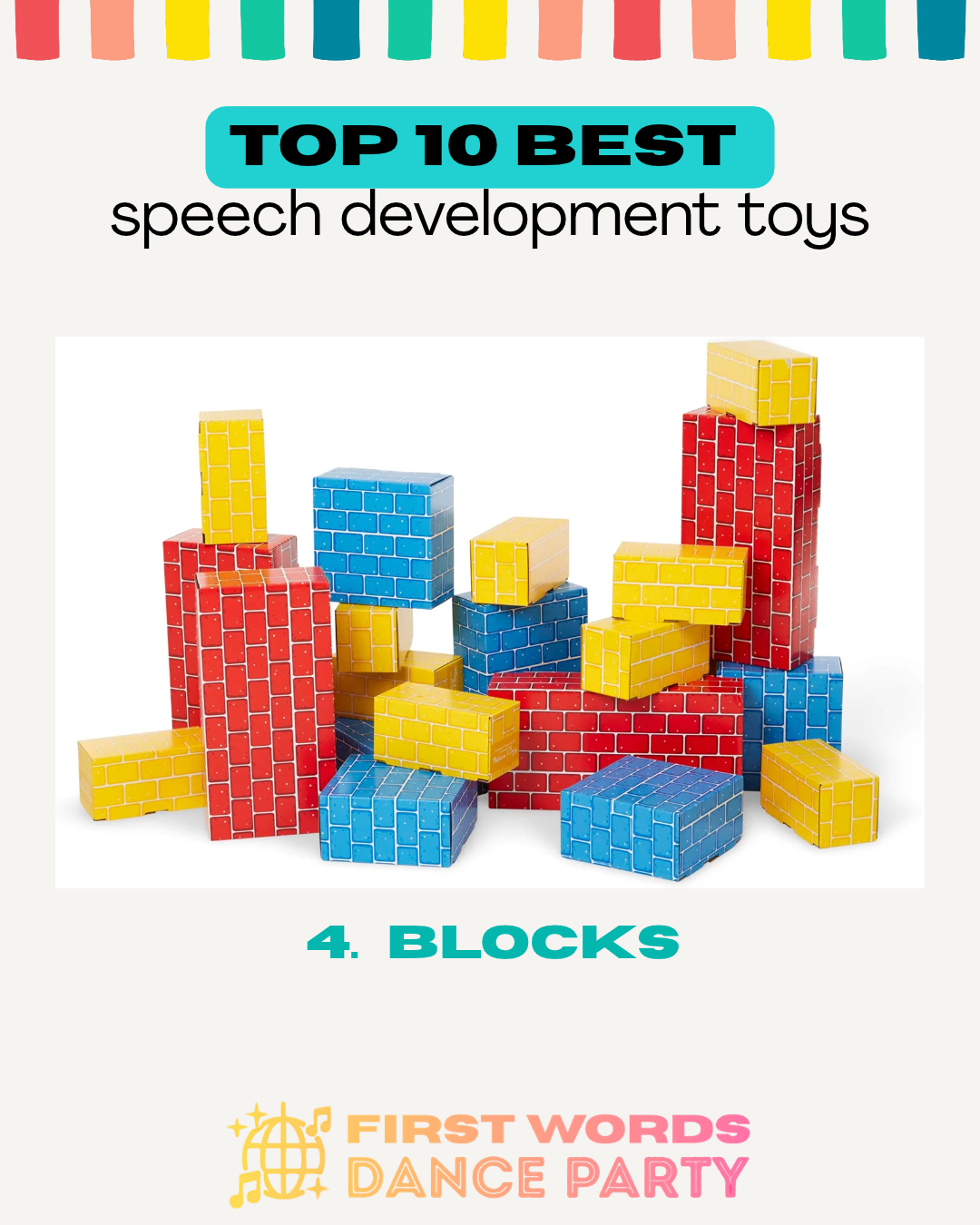
Blocks are excellent for encouraging imitation, turn-taking, and early action words.
You can stack them, knock them down, and build structures like a train or wall. You can also combine them with other toys, like small characters.
Small wooden blocks allow your child to start with small towers and then create more elaborate structures as they get older. For a fun twist, jumbo cardboard blocks are great for building big towers in seconds.
Words and sounds to model:
Up, down
On, on top
More
Uh-oh!
Crash!
Stop, go
Try this: Stack a few blocks while modeling "Up, up, up!". Then say, “Ready, set…go!” and knock them down. You can do this again and again, offering your child a chance to say “Go!”.
Repeat the activity and give your toddler opportunities to add blocks or knock down the tower.
5. Fisher-Price Little People® and Favorite Characters
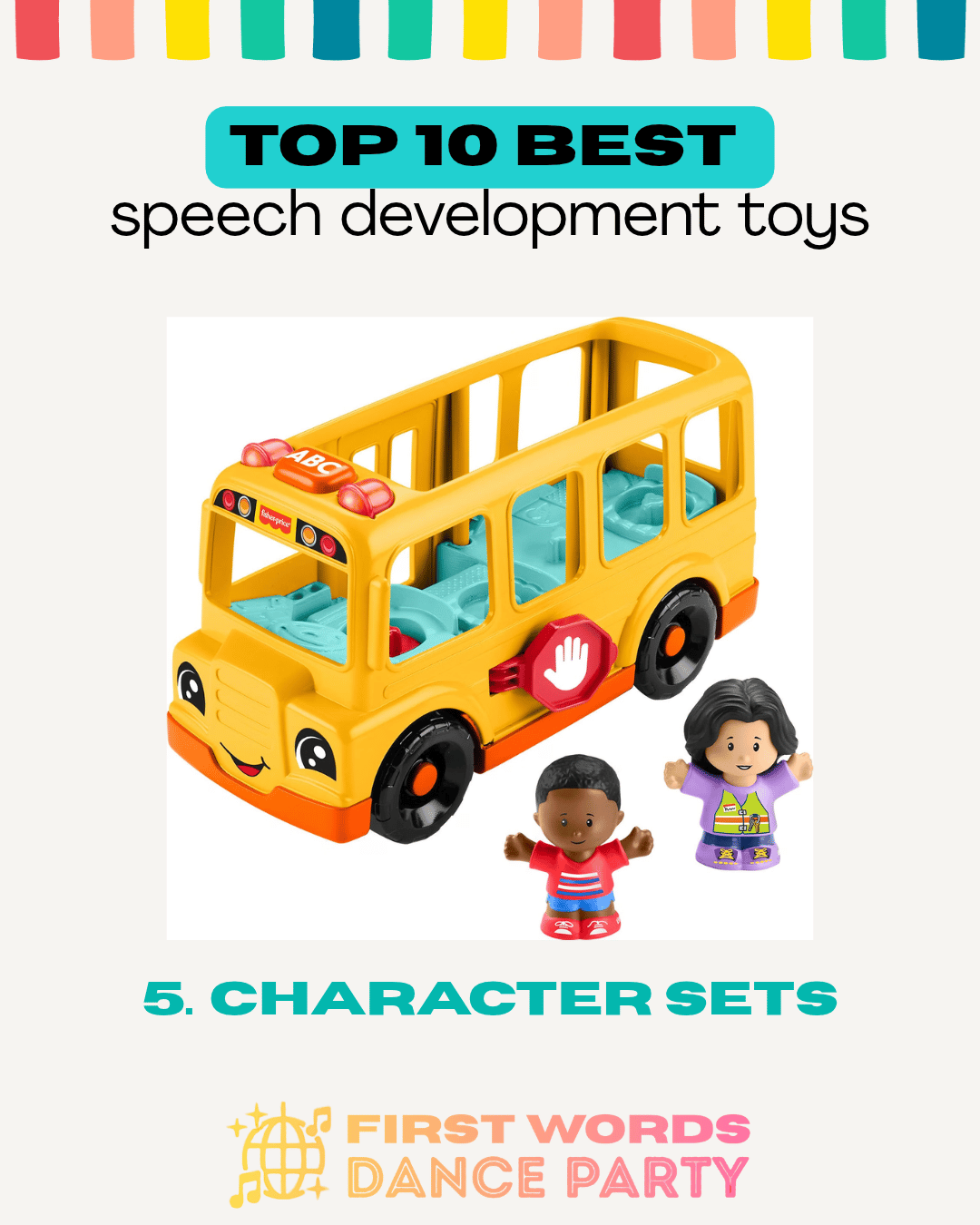
Little People® and other small character figures or stuffies are wonderful for encouraging pretend play.
I especially love using characters from a child's favorite show, because favorite characters can make play more motivating.
Characters make for the best speech development toys when you combine them with other toys to use them in different ways. The Fisher-Price Little People school bus set is always a hit with little ones who love school buses.
Get creative with vehicles, blocks, play food, etc. Combine the toys you already have for more play and language opportunities.
Words and sounds to model:
Eat, drink, sleep, jump, hop, walk
Hi, bye-bye
Try this: Follow your child's interests. Does your child like Elmo?
Take an Elmo stuffie and combine it with other toys or objects. You can pretend to brush Elmo’s teeth or feed him crackers from your child’s bowl.
Model "brush, brush, brush” while you brush Elmo’s teeth or “Here’s a cookie, Elmo. Num num num!” while feeding him.
Want another easy way to encourage communication?
Many of the same words, gestures, and actions you're practicing with these toys can also be modeled through songs. Every First Words Dance Party® song I write includes the exact words your child needs, but isn't saying yet.
My free Music for Speech Therapy Starter Kit includes my original songs, song choice cards, printable communication boards, and simple strategies for making music interactive.
6. Mr. Potato Heads Are the Perfect Speech Development Toys
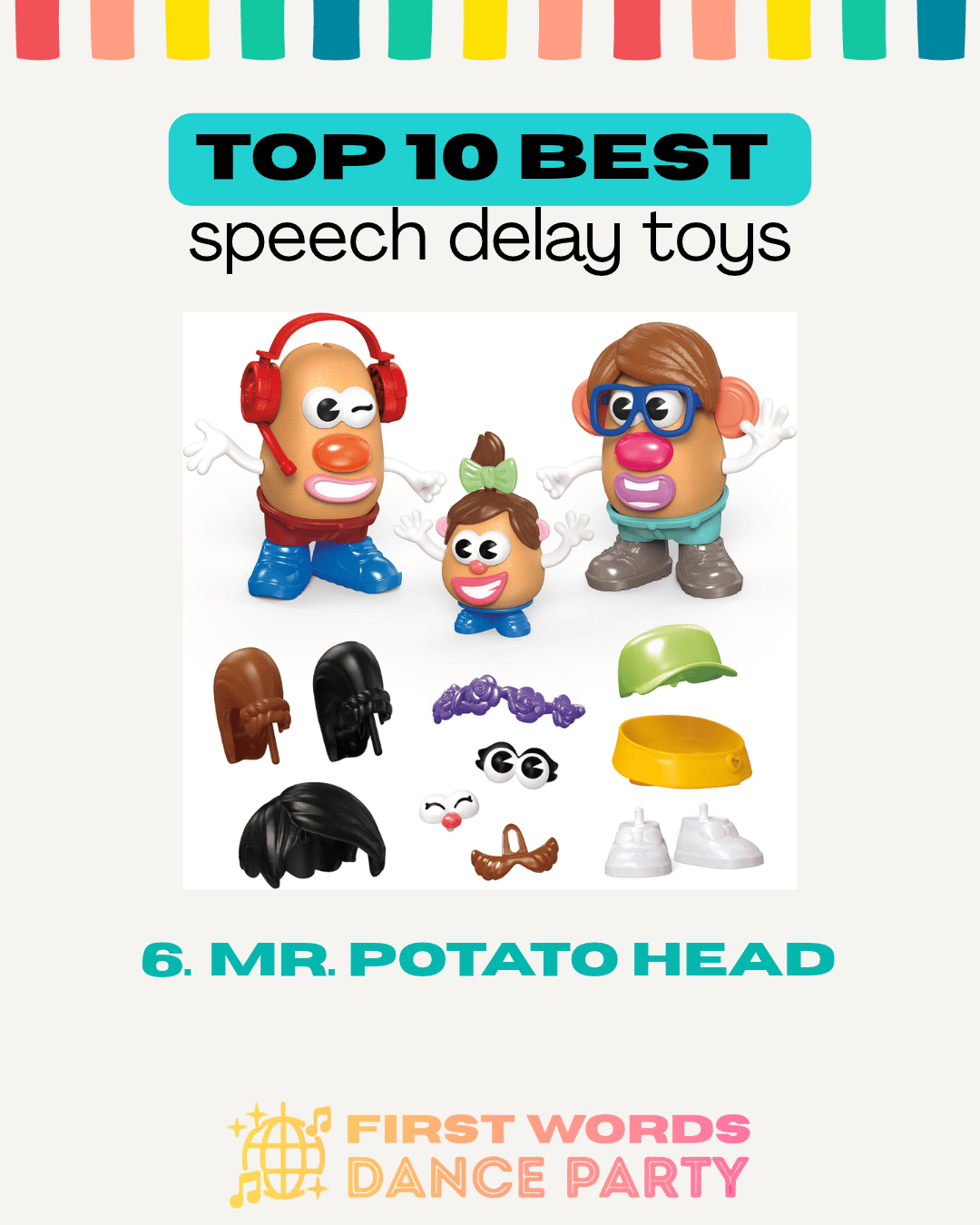
Mr. Potato Head is a classic for learning the names of body parts.
Children can choose pieces, put them in, take them out, and create silly combinations. And you can model words like eyes, nose, mouth, ears, feet, and arms while you play.
Words and sounds to model:
In, out
Push, pull
Help
On, off
Names of body parts
Try this: Try holding out two different pieces. Give your child a choice: “Do you want eyes or a nose?”. Wait to see how your child responds. They might reach, point, or make a sound to let you know. Over time, as you offer more choices, they’ll be more likely to say the word for the item they want.
7. Cars and Trucks
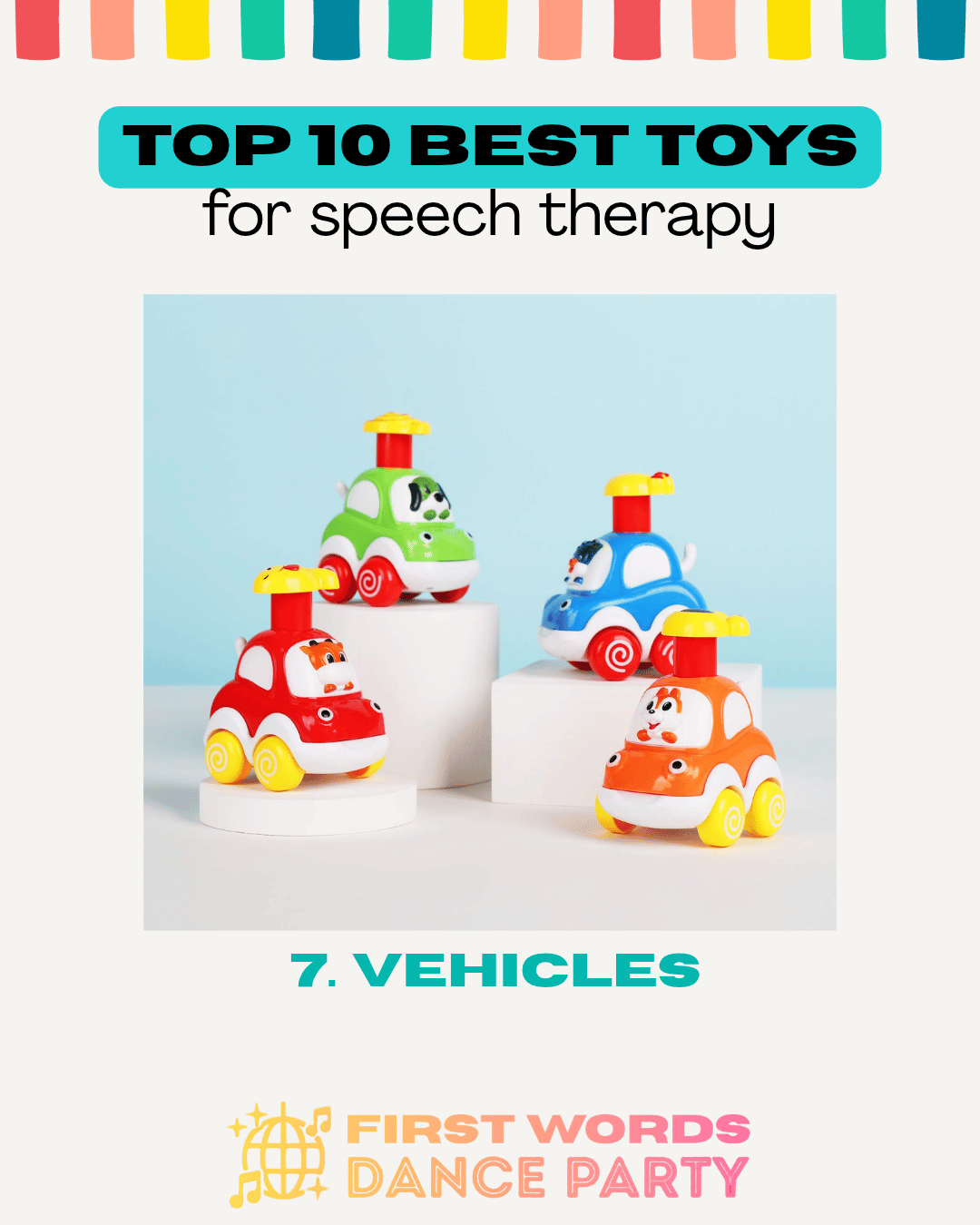
Cars, trucks, buses, trains, and other vehicles are perfect for action words and playful sounds.
Vehicle sounds are a lot like animal sounds: a perfect starting point for toddlers who aren’t yet repeating words.
Words and sounds to model:
Beep-beep, vroom vroom, siren noise (wee-ooh, wee-ooh)
Go, stop
Fast, slow
Crash!
Try this: Push and go cars are one of my favorites because they're perfect for turn-taking.
Sit across from each other and take turns making the car go, modeling "Ready, set...go!"
As you send the car back and forth between you, you can also model "My turn," and "Your turn."
8. Squeeze Ball Poppers
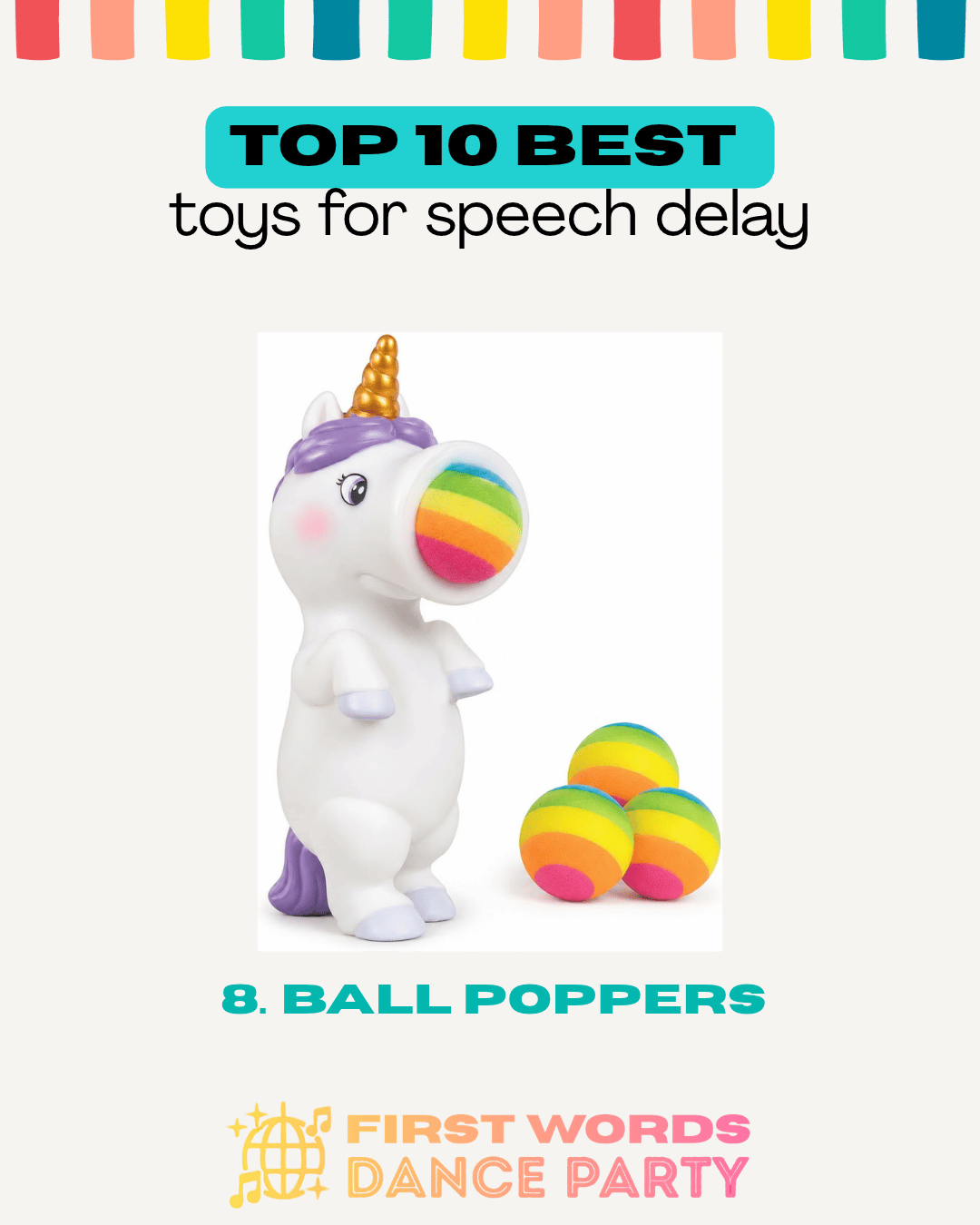
These little plastic ball poppers are usually in the shape of an animal, with a ball that fits into the toy's mouth. When you squeeze the belly, the ball pops out.
These are wonderful toys for speech delay, because they create anticipation and lots of engagement. You can enjoy these similarly to how you use bubbles.
Words and sounds to model:
In, out
Pop
Go
More
Again
Push
Help
Try this: Put the ball into the toy's mouth and create a verbal routine, like "Ready, set… go!" , “One, two… three!” or “Ready, set…pop!” before squeezing it.
Take turns squeezing the toy, giving your child opportunities to communicate that they're ready for another turn or that they need help putting the ball in.
9. Play Food and Toy Kitchens are Good Toys for Speech Development
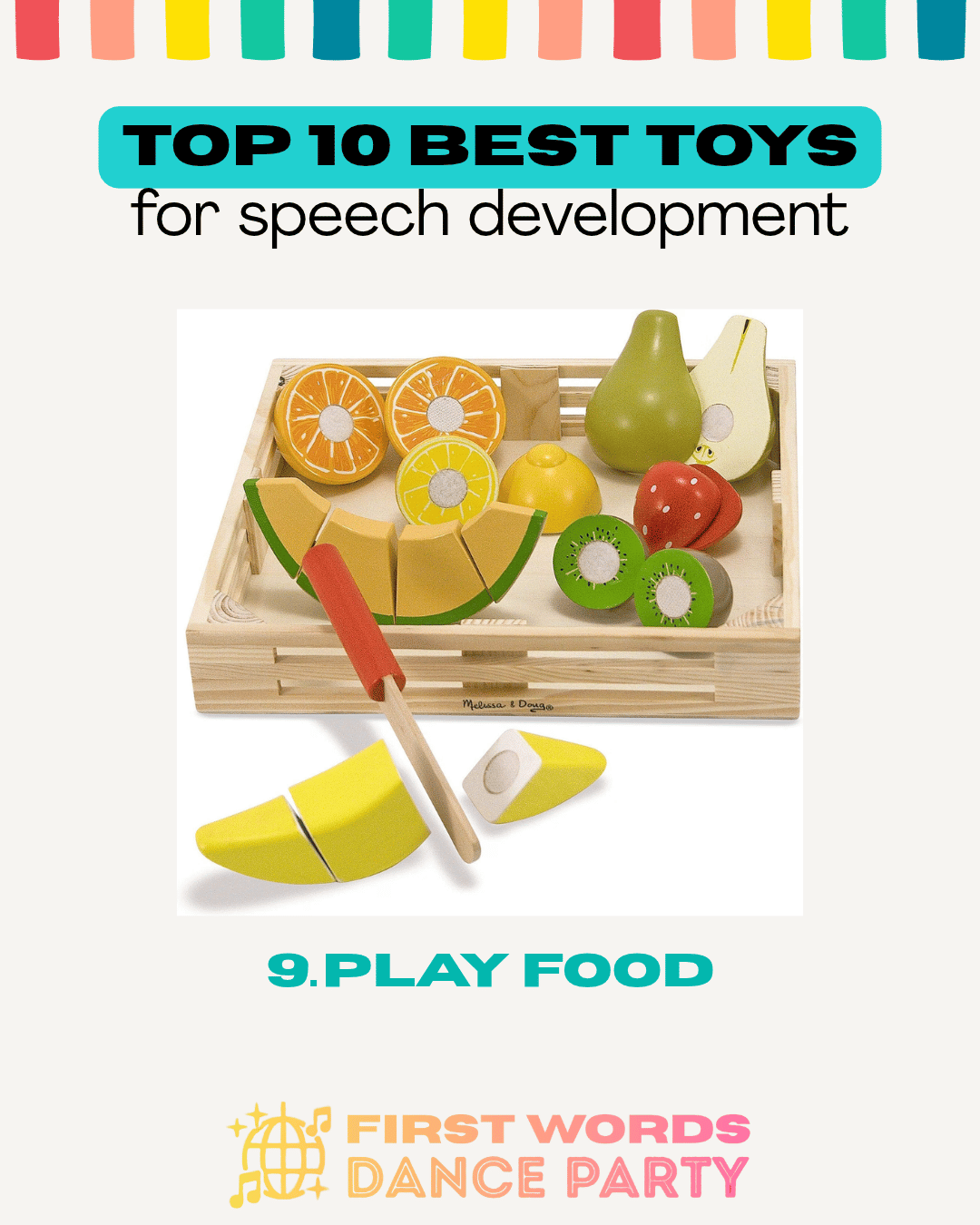
Pretend food and toy kitchens are some of my favorite speech and language toys because they connect directly to everyday routines.
I especially love cut-apart fruit that children can separate and put back together.
Toy kitchens are the perfect toys for young toddlers, because they can open and close the doors and place items in the different compartments.
Words and sounds to model:
Cut, stir, scoop
Eat, drink
Open, close
More, all done
Hot, cold
Yum, num num
Try this: This one is as simple as pretending to prepare food and eat it. You can pretend to cook it on the stove, to combine things into a pot to make soup, and to place food on plates to then serve to your child’s stuffies.
For more ways to build communication into familiar routines and play, visit my guide to Speech Therapy Home Practice: 7 Quick, Easy Activities You Need for Success.
10. Musical Instruments and Microphones
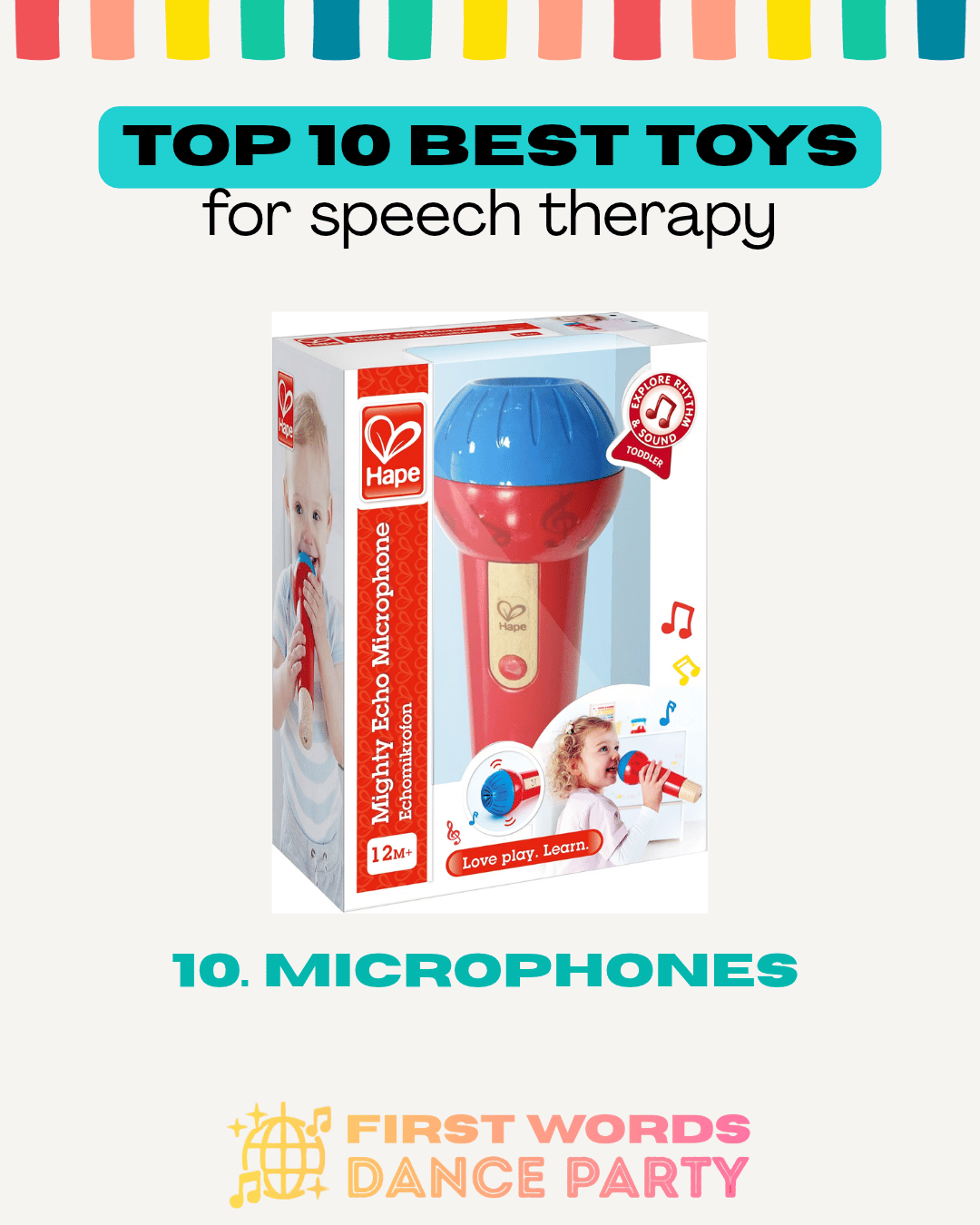
If I could recommend just one speech therapy activity for parents to do with their children at home, it would be singing together. The power of music for speech and language is absolutely undeniable. You can check out this article to learn more: Music in Speech Therapy: How Songs Can Transform Communication.
Music is an absolutely golden speech and language activity, and by adding instruments, your child can participate in different ways.
Simple musical instruments are some of my favorite toys for encouraging imitation and turn taking. Shakers, drums, and tambourines add an extra element of fun.
Add in a microphone that echoes (remember these from your childhood?), or even a paper towel tube, and your child will LOVE hearing their own voice as they participate.
How to Use Music for Speech and Language at Home
Does your child love music? Maybe you’ve noticed that they can imitate words or actions in a song more easily than they can imitate in conversation.
Many of the communication skills we've practiced with these ten toys can also be encouraged through familiar songs. And for many parents, singing comes more easily than playing.
Singing together provides opportunities to:
Model functional words through repetition
Encourage imitation of actions, gestures, and sounds
Practice turn-taking and shared attention
Make everyday routines more predictable and engaging
Help children participate with foundational skills even before they're using spoken words
After more than 15 years working with toddlers with speech delays in early intervention, I began writing my own original speech therapy songs through First Words Dance Party®.
These speech therapy songs incorporate many of the strategies I use when working with families, including functional language and simple syllable shapes for the exact words your child needs most.
For example:
Open models functional words like open, help, and please, along with sign language.
It's a Dance Party encourages children to imitate movements while learning body parts and words like up and down.
It's My Turn provides opportunities to model language related to turn-taking.
Get Your FREE Music for Speech Therapy Starter Kit
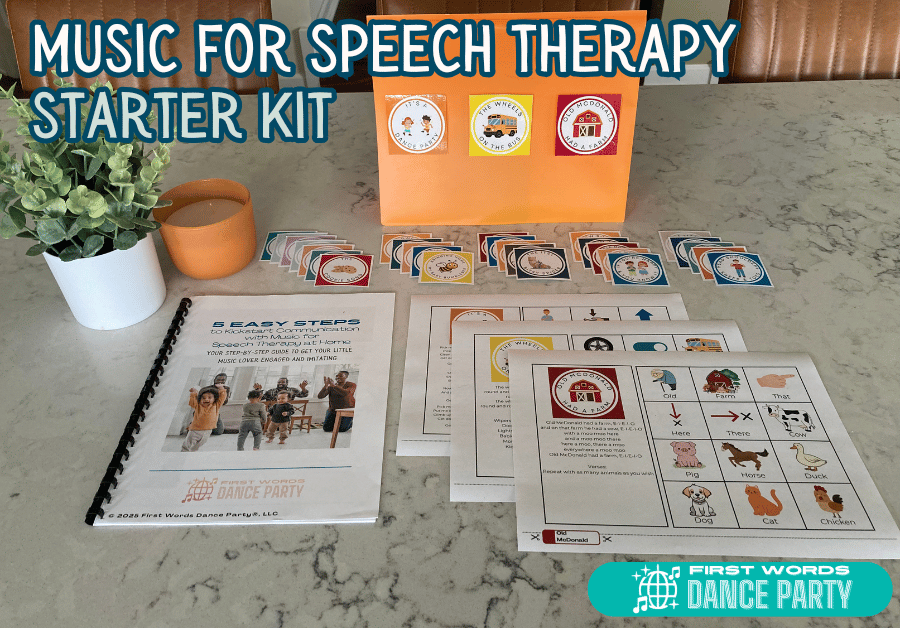
If your toddler loves music, my free Music for Speech Therapy Starter Kit can help you turn that strength into meaningful and powerful opportunities for communication at home.
I created this resource to help parents use both familiar songs and my original speech therapy songs for fun, easy speech and language activities at home.
If you’re tired of the guesswork of wondering how to help your child with their language when they just aren’t talking yet, you’ll love that this Starter Kit gives you everything you need.
Inside the free kit, you'll find:
A five-step guide: Simple ways to use music intentionally to get your child imitating
Song choice cards: So your child can choose the songs they want
Printable song communication boards: Visual supports for Old MacDonald, The Wheels on the Bus, and It's a Dance Party.
Original First Words Dance Party® songs: Original music created specifically for kids with speech delays
Get your free Music for Speech Therapy Starter Kit and start turning everyday songs into opportunities for connection and communication.
How to Use Toys That Help with Speech Delay
Even the best toys for speech therapy won't automatically teach your child to communicate.
What makes the biggest difference is how you interact with your toddler during play.
Here are five strategies I regularly recommend to families:
Follow your child's lead. Notice what interests your toddler, join them in that activity, and make comments about what you both are doing to model functional language.
Make comments instead of prompting and asking questions. Instead of asking, "What is this?" or “Say ‘car’”, simply model, “You have the big car! Beep beep. Car coming though!”
Use short, functional words. Focus on words like go, stop, more, help, open, and all done that children can use in many different situations. They need these functional words much more than they need the names of colors, shapes, numbers, or letters.
Model gestures and playful sounds. Actions, gestures, animal and vehicle sounds, and exclamations are incredibly valuable for late talkers because they come before words.
Sing with your child. A familiar song can capture your child’s attention and offer phenomenal speech and language practice that is fun for both of you! Here's a deeper dive into Music-Based Activities for Speech Therapy at Home.
Final Thoughts on Choosing Speech and Language Toys
You don't need a house full of expensive toys to help your toddler develop their speech and language skills.
Some of the best opportunities happen with simple toys you probably already own.
Choose toys that interest your child, join them in play, and model useful words, sounds, and gestures without pressuring them to repeat after you.
The most important thing to consider when choosing speech and language toys isn't what the toy can do. It's what kinds of opportunities a toy creates for you and your child to connect and share language..
And remember that music can be a wonderful and FREE way to practice many of these same communication skills.
If you haven’t had a chance to grab it yet, make sure to get your FREE Music for Speech Therapy Starter Kit so that you’ll have everything you need to use music intentionally for speech success right away.
Frequently Asked Questions About Speech and Language Toys
What are the best speech and language toys for children with delayed speech?
The best speech and language toys are those that are open ended and can grow with your child. You might think that best toys for speech therapy should talk or say the names of objects, colors, shapes, etc., but it’s actually the exact opposite.
The best speech and language toys offer opportunities for a child to create, build, and play pretend. When an adult or another child plays alongside your child to model all kinds of functional words, that is when play turns into a speech and language activity. So choose toys like blocks, pretend food, baby dolls, vehicles, and other toys that can grow with your child over time.
Are there any toys to avoid for children with speech delays?
In general, the more a toy does, the less there is for your child to do. This is the opposite of what we want for a child with a language delay. Many electronic toys market themselves as being educational, because the stuffed animal or the plastic book names colors or other academic concepts. But they really don’t offer educational opportunities.
Save your money and your sanity and avoid electronic toys that do the talking.