Not Talking by 2? How to Help Your Toddler Now (Don’t Waste Time)
- 0 comments
If your child is not talking by 2, it’s a good idea to reach out for an evaluation rather than waiting to see if they catch up on their own. But you don’t have to wait for an appointment to start making meaningful progress at home. There are many powerful strategies you can start using today.
Babies and toddlers spend their first two years building the foundational skills they need to communicate, from babbling and gestures to imitating sounds, copying words, and eventually combining words together by their second birthday.
If your 2 year old is not talking yet, looking at these earlier skills can help you understand where they are in the process and what to focus on next.
Key Takeaways From This Article
Babies begin preparing to talk long before their first words appear.
Actions, gestures, sounds, and word imitation all help lay the foundation for spoken language.
By around 18 months, word imitation should be becoming more consistent.
Between 18 and 24 months, toddlers begin imitating simple word combinations and eventually using combinations on their own.
It’s better to focus on teaching functional words over preacademic concepts, like colors and shapes. Functional words, like action words and adjectives that describe, give toddlers more words to advocate for themselves and to combine into phrases, which leads to bigger vocabularies.
If your toddler is not talking by 2, reach out for early intervention rather than taking a wait-and-see approach.
You can start supporting communication immediately by using powerful strategies within the routines of your day if your child is not talking at 2.
If you want something easy and fun that you can start using today, grab my free Music for Speech Therapy Starter Kit. It includes songs created specifically for late talkers, song choice cards, printable song boards, and my 5 Easy Steps to Kickstart Communication to help you turn music your child already enjoys into opportunities for communication.
Before Words: Why Imitation is Essential When Your Toddler Is Not Talking by 2
If your toddler isn’t talking yet, the first thing to consider is their imitation skills.
Toddlers don’t jump straight from hearing a word to spontaneously saying it. Over their first two years of life, they spend a long time learning how to watch, listen, copy, and take turns with other people. This lays the groundwork for learning how to talk.
Imitation develops gradually and includes:
Copying actions with objects, like pushing a toy car after you push it
Copying body actions, like clapping or stomping
Copying gestures, like waving, blowing a kiss, or pointing
Imitating playful sounds, like blowing raspberries, sound effects, and vehicle and animal sounds
Imitating single words
Imitating simple word combinations
Eventually using words and combining them spontaneously
This isn’t a rigid checklist that every child follows in exactly the same way. But it can help you figure out your child’s current starting point.
For example, if your toddler isn’t repeating words like “milk” and “crackers” yet after you say them, but they consistently copy actions and gestures, you don’t have to spend your day repeatedly prompting them to “say milk.” Instead, it’s best to look at and build from the imitation skills they already have.
For ideas on how to get your 2 year old talking, check out this article: Toddler Not Copying Words? Don’t Miss These Eye-opening Skills
Singing songs with your toddler is especially helpful here, because music naturally combines repetition, movement, gestures, sounds, and predictable language to work on the exact imitation skills your child needs. You can learn more about why these features make music such a useful tool in my complete guide to using music in speech therapy.
Key Takeaway: If your toddler isn’t imitating words yet, look at what they can already imitate. Actions, gestures, and sounds can give you important clues about which skills to work on next.
Around 12 Months: Baby Not Talking Yet?
Around their first birthday, most babies are just beginning to use their first meaningful words. At this age, however, spoken words are just one tiny aspect to consider.
By 12 months, most infants have these skills down solidly:
Babbling with different consonant-vowel combinations (ga, wa, da, ba, sa, ma, etc.)
Copying simple body actions, like banging a table with their hands after you do it
Initial gestures, like waving, showing and object, shaking their head “no”, reaching, tapping, and pointing
Looking toward familiar people and objects when you name them
Participating in simple social games like peekaboo, and “So Big!”
Using “mama,” “dada,” “papa,”. or another special name for a caregiver
-
Beginning to use one additional first word, like “ball,” “hi,” or “baba,” (for bottle).
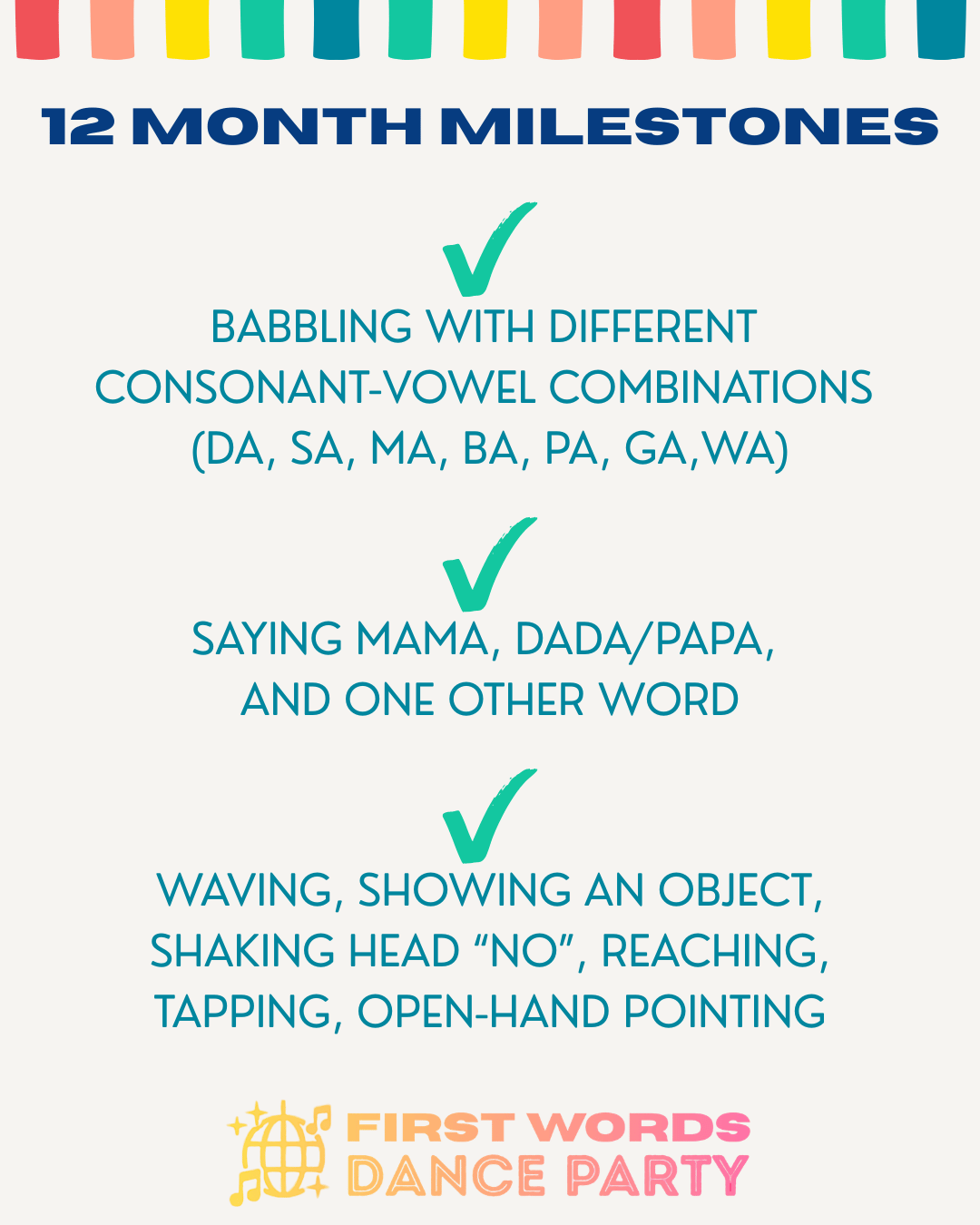
Development varies considerably at this age, so we want to look at the whole communication picture rather than becoming overly focused on one specific word count. However, the CDC does include calling a parent “mama,” “dada,” or another special name among its 1-year communication milestones.
To see the CDC’s 12 month milestones, you can click here.
Babies Spend the First Year Preparing to Talk
Here’s something fascinating: your baby has already been doing important language work for months on end before that first word appears.
Early in infancy, babies can hear differences between speech sounds from many different languages. Over the first year, their brains become increasingly tuned to the sounds they hear in the language or languages around them. Researchers refer to this process as perceptual narrowing.
At the same time, babbling becomes increasingly speech-like.
Your baby practices putting consonants and vowels together:
ba
ma
da
baba
mama
badadaba
Those seemingly silly strings of sounds are practice for speech.
By the time the first meaningful words begin to appear, your baby has already spent months listening, experimenting with sounds, and learning how the language spoken around them works.
Key Takeaway: Talking doesn’t begin with the first word. Babies spend their entire first year listening, babbling, experimenting with sounds, and learning how communication works.
Around 15 Months: Child Not Talking Yet? Look at Actions and Gestures
If your child is not talking much around 15 months, look closely at how they communicate without words.
Between 13 and 18 months, toddlers are learning to point for the purposes of requesting and sharing information, and using more gestures, like nodding yes and clapping. They begin to understand words for familiar people and objects, follow simple commands like “sit down” and “come here,” and slowly but surely using words for their favorite toys, objects, and foods, to say “hi” and “bye”, and to advocate for their needs.
This is a period when play and gesture development can tell us quite a bit about a child’s early communication skills.
The 16 Actions and 16 Gestures That Come Before More Words
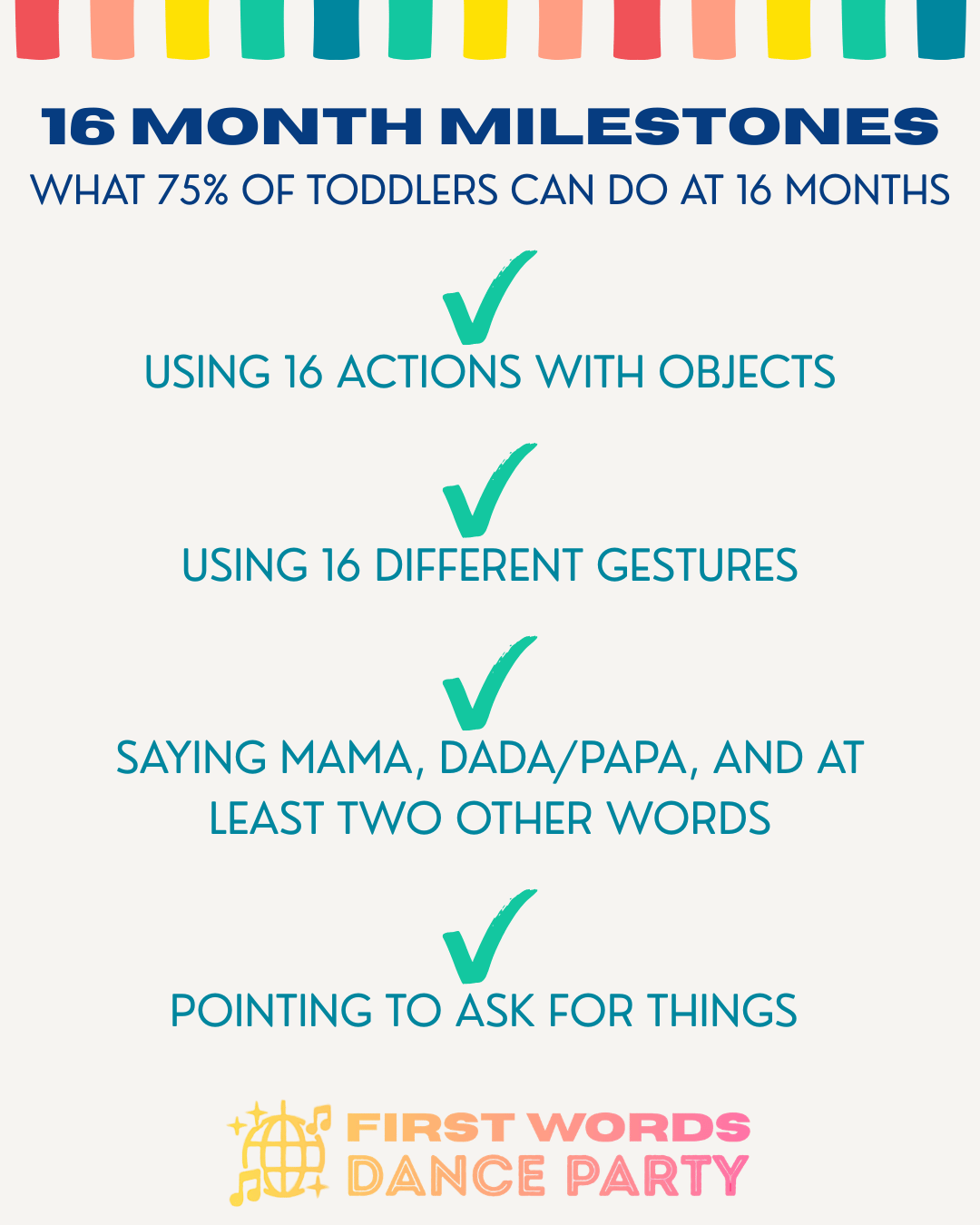
The FIRST WORDS Project developed its 16 by 16 series to highlight important social communication skills that develop between 9 and 16 months.
Two particularly helpful benchmarks are:
Gestures include things like waving, pointing, clapping, blowing a kiss, nodding yes and shaking head no, and giving a thumbs up.
Actions with objects include things like stirring a spoon in a cup, pushing a toy car, brushing hair with a brush, scribbling with a crayon, and stacking blocks.
These skills are important because infants and toddlers are learning that they can communicate with others with their bodies and their actions. They’re learning by watching and imitating what other people do.
The FIRST WORDS Project describes these early social communication skills as part of the foundation for later language and learning.
So if your toddler is 15 months and not talking, it’s very important to look at these skills versus only counting how many words your toddler is using.
Ask yourself:
Is my toddler copying actions with toys and objects?
Is my toddler able to use a variety of different toys and play with them in different, flexible ways?
Are they using different gestures?
Are they pointing?
Are they showing me things– not just giving me something because they need help, but holding something up and looking at me just to get me to notice?
Are they trying to get my attention with words, gestures, and actions?
Are they copying playful sounds, like blowing raspberries, a pretend sneeze, or saying “ahhhh” into a microphone?
Do they understand familiar words like cup, shoes, bath, etc. as well as the names of family members? and simple directions?
Are they able to follow simple commands like “come here” and “sit down” without you having to gesture to add additional meaning to the direction?
Those little skills tell you a ton.
Key Takeaway: Between 12 and 16 months, pay close attention to actions, gestures, sounds, understanding, and intentional communication in addition to spoken words.
Not Talking at 18 Months? Look at Receptive Language and Imitation Skills
If your toddler is not talking at 18 months, it’s worth bringing your concerns to their pediatrician and contacting early intervention rather than simply waiting for more words to appear.
But this is also where understanding developmental milestones can get confusing.
Not Talking at 18 Months: Milestones vs. Averages
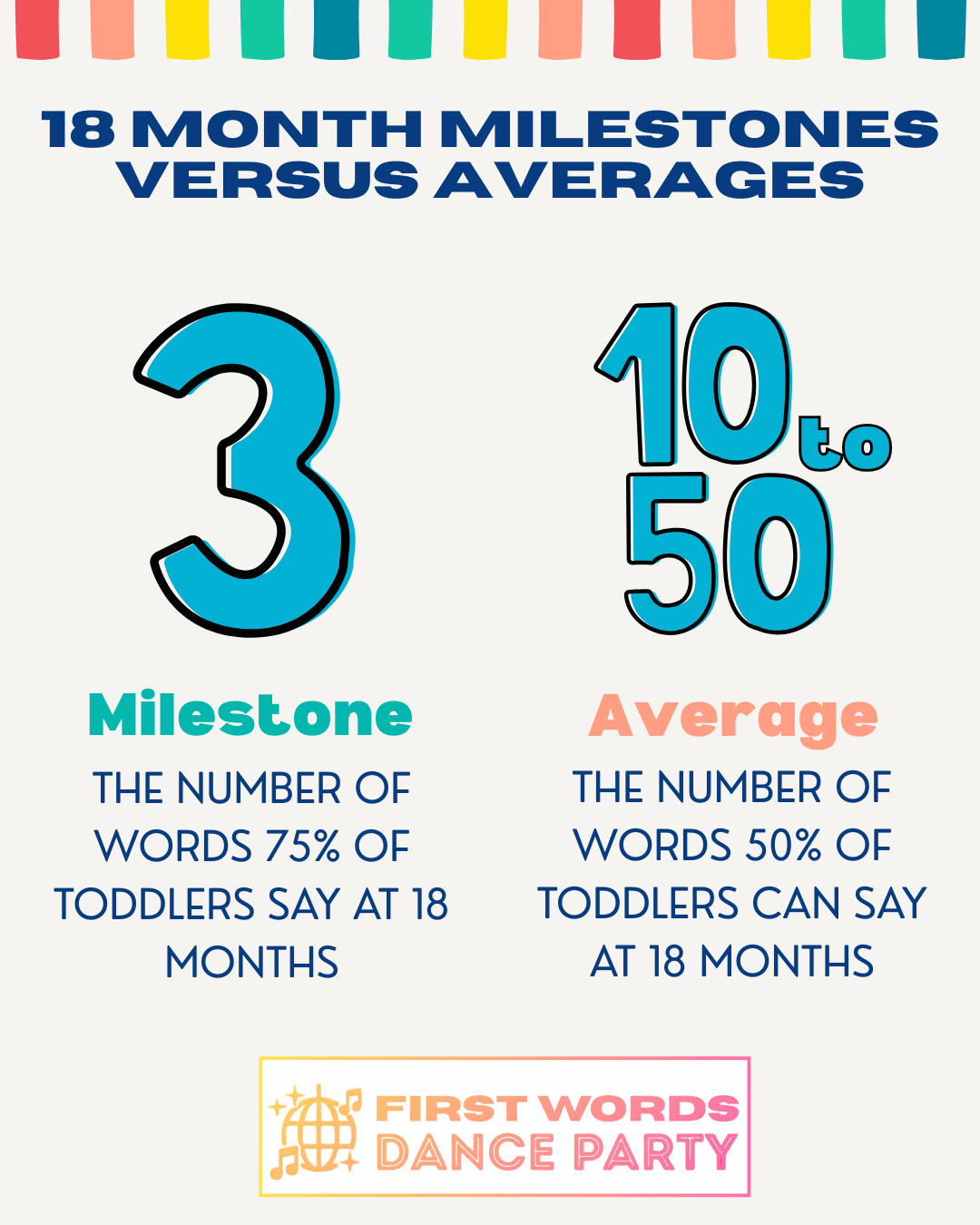
Milestones come from the Centers for Disease Control and Prevention, or the CDC. At 18 months, the CDC milestone states that toddlers of this age should be trying to say at least three words besides “mama” or “dada.”
But this does not mean that a vocabulary of three words represents the average skills of an 18-month-old. This is where it’s super important to understand the difference between milestones and averages.
The CDC intentionally places its developmental milestones at skills that at least 75% of children demonstrate by that age. The purpose is to make missing milestones actionable, so families and providers know when it may be time to screen, evaluate, or refer rather than continuing to “wait and see.”
Average or median vocabulary estimates at 18 months are considerably higher, although the exact number varies depending on the research sample and measurement tool. Published estimates have ranged from around 50 to more than 100 words, and Wordbank data have placed the median for English-speaking toddlers around 90 words at 18 months.
Notice how much higher the average is compared to the milestone.That variation is exactly why I find it more helpful to consider both pieces of information than to go with only milestones alone.
If an 18-month-old only says "mama" and "dada", I also want to know what is happening with imitation.
By this stage, we want word imitation to be getting easier and more consistent. Your toddler may not repeat every word you say, and we certainly don’t need to spend the day quizzing them, but they should increasingly be able to hear a simple word and attempt to copy it.
Look Beyond the Number of Words
If your toddler is not talking at 18 months, consider:
Do they imitate actions?
Do they imitate gestures?
Do they copy animal sounds and vehicle sounds?
Do they attempt to imitate words?
Are new words gradually appearing?
Do they point to request something they want and to show you something they are interested in?
Do they follow simple directions, like “Go get your cup,” and “Put the wrapper in the trash,”?
Do they understand most of what you tell them? A child can have strong receptive language, even if their expressive language is delayed,
Do they combine actions, gestures, sounds, and words to get their message across?
This helps you see much more than a vocabulary number ever could.
For a more in-depth look at exactly what to look for at 18 months, and what to do if your 18 month old is not talking, you can check out this article: 18 Month Old Not Talking? How to Make Valuable Progress This Week
Use Music to Make Imitating Words Easier for Your Toddler
If I could recommend just one activity to support early communication, it would be music.
Why? Because music naturally packages together almost every foundational communication skill children need before they begin talking.
Think about your favorite children's songs. They're full of:
Actions and movement
Gestures and signs
Animal sounds and sound effects
Exclamatory expressions like "ouch!" or "pop!"
Repetition
Predictable lyrics
For tired, worried parents, songs naturally package opportunities to practice the exact imitation skills that come before words. You can check out this guide on music-based activities for speech therapy at home to learn more.
First Words Dance Party® songs for speech therapy are intentionally written to create these kinds of opportunities. These songs were created specifically for toddlers who aren’t repeating words yet.
If you want to try using music intentionally with your toddler, download my free Music for Speech Therapy Starter Kit. It gives you my songs, printable song boards and song choice cards, and simple strategies you can start using right away to support imitation and communication.
Key Takeaway: The CDC milestone at 18 months is not the same thing as the average 18-month-old’s vocabulary. Look at vocabulary growth alongside imitation, gestures, understanding, and intentional communication, and reach out for support if those skills are not developing.
Baby Not Talking by 20 Months? Look for Growing Words and Early Combinations
If your baby is not talking by 20 months, I would be looking for much more than a specific number of words. I want to know whether words are becoming easier to imitate and whether their vocabulary is continuing to grow daily.
Sometimes parents of 20-month-olds worry because their toddler isn’t speaking in sentences yet.
At this stage, we aren’t expecting long sentences.
Between 19 and 24 months, toddlers are moving toward combining two or more words. The American Speech-Language-Hearing Association (ASHA)’s milestones for this age range include using and understanding at least 50 different words, putting two or more words together, using words to ask for help, and following two-step directions.
Before toddlers spontaneously generate lots of their own combinations, you may hear them begin by imitating simple phrases after you say them:
“go car”
“more bubbles”
“open door”
“mama help”
“up please”
The important thing is movement forward. Words should be becoming easier to imitate, new words should be appearing, and simple combinations should begin emerging as your toddler approaches age 2.
What Kinds of Words Does Your Toddler Know?
This is something I wish we talked about more.
It’s so important to focus on functional language than pre-academic concepts, like shapes and colors.
A toddler might know the names of some colors and recognize a few shapes, but those words only take communication so far.
If your goal is helping your toddler talk more throughout the day, they need words they can use across lots of activities, people, and situations.
Think about words like:
more
help
open
go
stop
again
up
down
on
off
eat
drink
hungry
thirsty
play
run
sit
hi
bye
hot
cold
names for favorite foods and objects
outside
When your toddler wants milk, they don’t need “blue” or “circle”. They need to tell you they are “thirsty”, that they need “help”, and that they want a “drink” or “milk”.
Plus, focusing on functional words give you the exact words toddlers need to combine words into all kinds of combinations.
“more milk”
“mama help”
“go outside”
“open box”
“dada sit”
“ball down”
“eat crackers”
That’s one reason I love focusing on functional words, action words, and other vocabulary toddlers can use in many different situations.
Of course, there is nothing wrong with your toddler loving letters, numbers, colors, or shapes. Keep talking about them!
Just make sure you aren’t putting more focus and emphasis on these words over functional words.
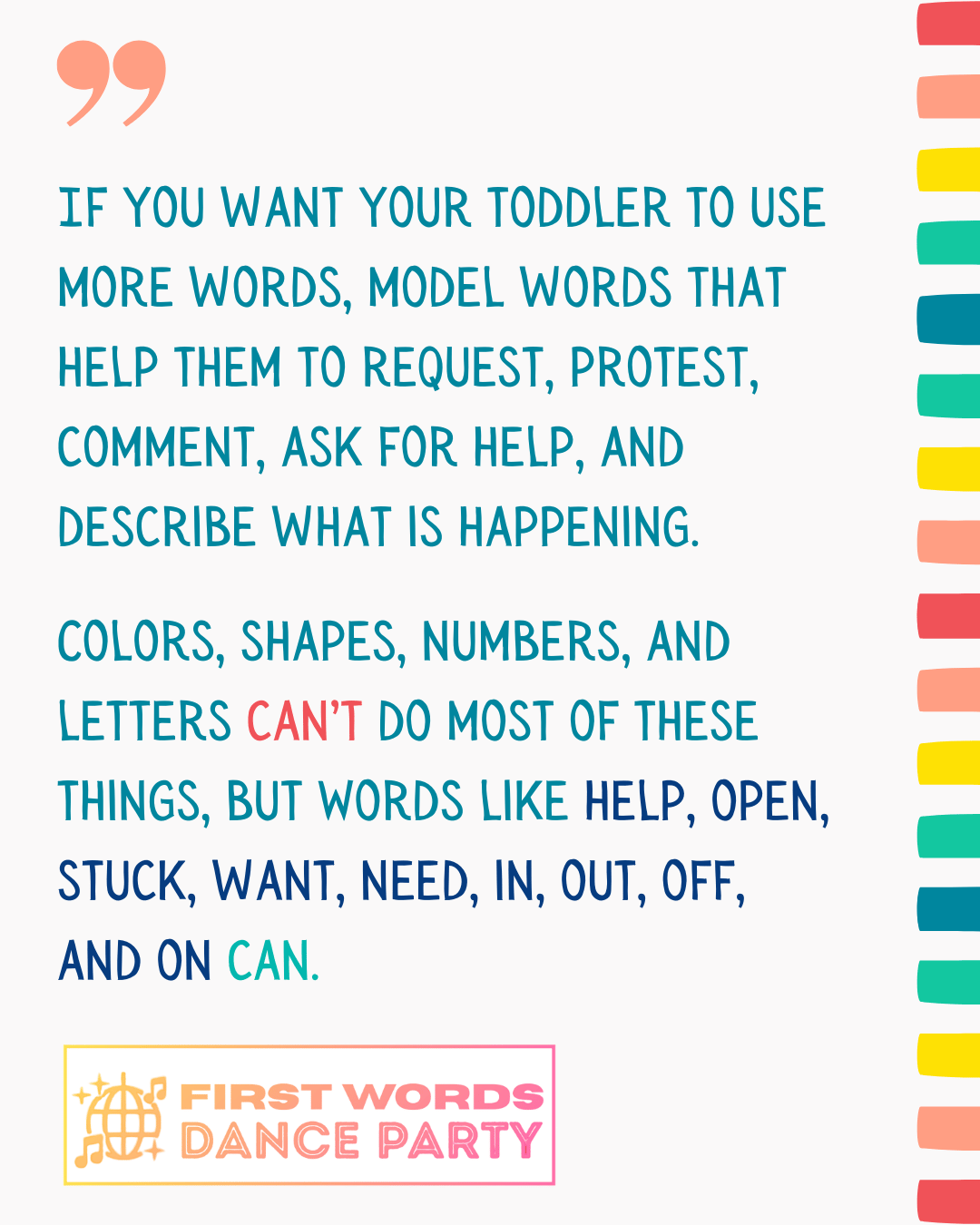
If you want your toddler to use more words, model words that help them request, protest, comment, ask for help, and describe what is happening. Colors, shapes, numbers, and letters can’t do most of these things., but words like help, open, stuck, want, need, in, out, off, and on can.
Key Takeaway: Around 20 months, look for increasingly easy word imitation, a vocabulary that continues to grow, and the beginning of simple imitated combinations. Prioritize useful words that your toddler can eventually mix and match to create new messages.
Baby Not Talking by 24 Months? What to Look For
By 24 months, we want to see a toddler moving beyond single words and regularly putting words together.
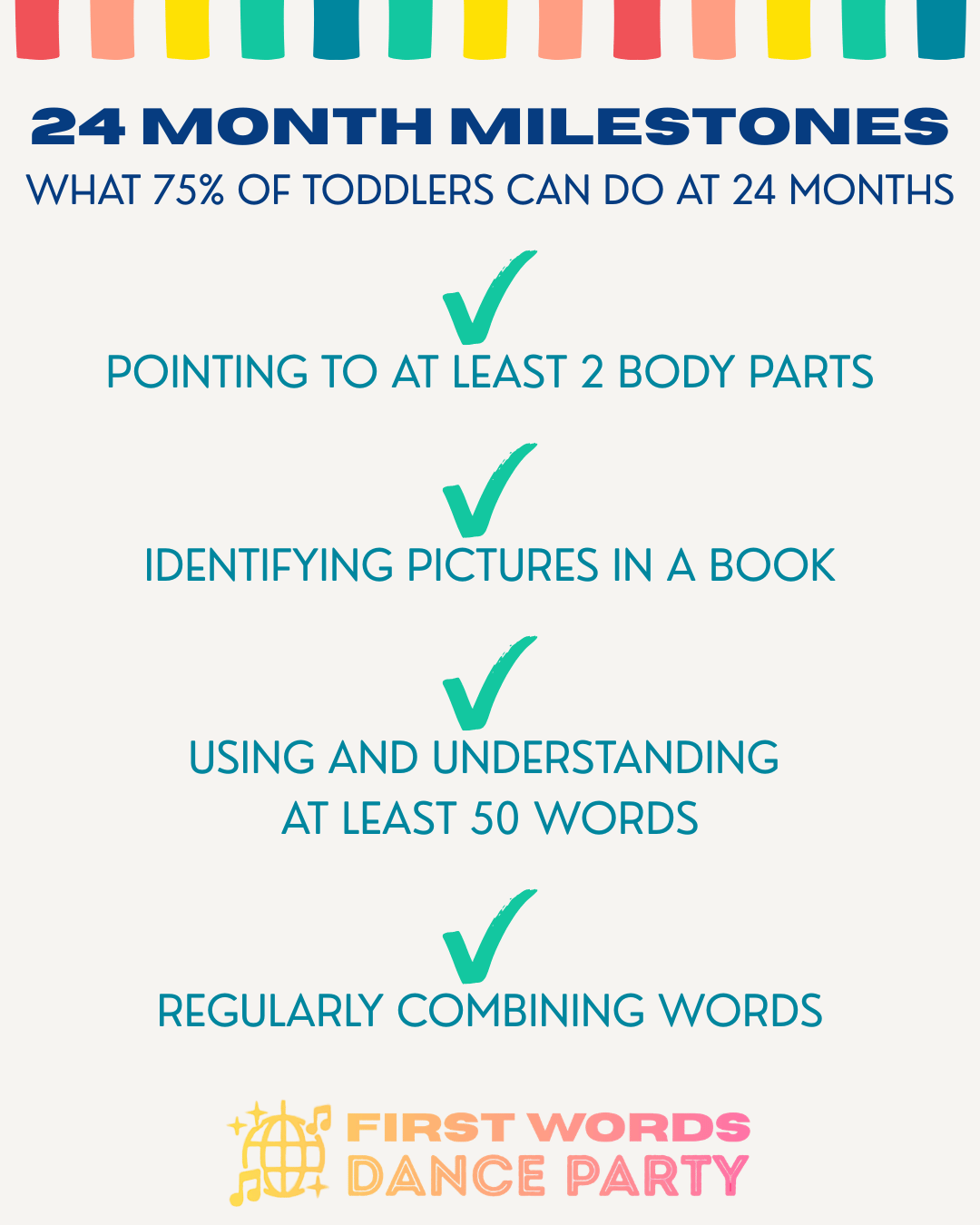
The CDC states that toddlers should regularly be combining at least two words together, such as “more milk,” as a 2-year communication milestone. Other communication milestones at this age include pointing to things in a book when asked, pointing to at least two body parts, and using gestures beyond waving and pointing.
ASHA’s broader 19-to-24-month milestones also include using and understanding at least 50 words, combining two or more words, and using words to ask for help.
This is where the progression we’ve been talking about starts coming together.
Your toddler has spent months moving through these stages:
Copying actions
↓
Copying gestures
↓
Copying sounds
↓
Copying words
↓
Copying simple combinations
↓
Beginning to create combinations independently
That last step is a big one. Instead of only repeating “more bubbles” after you, your toddler begins independently saying “more bubbles” when they want you to blow again.
Instead of repeating “mama help,” they use language flexibly into new combinations, like “Help me mama,” and “Help open”.
That flexibility is what makes language so powerful.
Key Takeaway: By 24 months, we want to see more than isolated words. Most toddlers are combining words so they can communicate increasingly specific ideas.
Child Not Talking by Age 2? Don't Wait and See
If your child is not talking by age 2, I do not recommend a “wait and see” approach.
There is tremendous variation in early language development, and being a late talker does not automatically tell us why a child’s speech is delayed or what their communication will look like in the future.
But we don’t have to know the cause before getting support. And we just don’t have a way to predict which late talkers will suddenly have a burst of language and catch up, and which toddlers won't.
That’s why it’s so much better to refer and see, so you can get your toddler the support they need.
If your toddler is not talking at two years old, it’s time for an evaluation to check and see.
The CDC specifically encourages families to act early when a child is missing milestones or when a parent has developmental concerns. Its milestone checklists are intended to help families recognize when further screening, evaluation, or referral may be appropriate.
You do not need to wait until your child is “far enough behind” to ask questions. Contact your local early intervention provider or ask your pediatrician for a referral for a speech/language evaluation through a local clinic.
How to Start Turning Things Around Immediately
If your toddler is not talking, you can start using strategies at home to turn things around today.
You can do this by:
Following the things that already hold your child’s attention
Model language in 1-3 word phrases, instead of prompting
Model actions and gestures they can copy
Model functional words, like words for actions (open, sit, eat, jump) and descriptors (in, out, on, off)
Build predictable verbal routines into play, like "Ready, Set....Go!" and "Peek A...Boo!"
Pause during familiar songs and verbal routines to invite participation
Respond to communication attempts, even when they aren’t spoken words
And, my favorite, use songs and music intentionally to incorporate ALL of these things!
You don’t need flashcards, “learning toys”, or apps. You just need YOU.
Key Takeaway: If your toddler isn’t talking by 2, pursue an evaluation rather than waiting. At the same time, you can start supporting imitation, interaction, and functional communication during everyday life right now.
How Music Can Help When Your Toddler Is Not Talking by 2
Music is a game-changing tool for supporting toddlers who aren’t talking yet, because a good song can meet a child at any point in the communication progression.
A child who isn’t ready to imitate a gesture in a song can imitate an action with a prop, like a stuffed animal.
A child who isn’t ready to copy a word in the song can copy a gesture.
A child who isn’t ready to say “dog” can try “woof.”
A child who has a few words can fill in a favorite lyric they know.
A child who is readily imitating words can begin copying short combinations within the lyrics.
And a child who already knows the song can start using those familiar words outside the music.
That is exactly why I created First Words Dance Party®.
The songs intentionally include:
Repetition
Actions and movement
Gestures and sign language
Playful sounds
Predictable language
Simple, highly functional words and phrases
Opportunities to pause and take turns
Opportunities to take the words from the songs into your day to day life
The goal isn’t to get your child to perfectly sing along.
The goal is to create opportunities for them to participate and communicate at whatever stage of imitation they are in. Music gives us countless opportunities to do exactly that, so we can model the skills that are coming next for them.
First Words Dance Party® Songs for Late Talkers and Speech Delays
After more than 15 years working in early intervention, I began writing my own songs because I wanted parents to have music that intentionally targets the communication skills children need most.
Each song is designed around evidence-informed strategies and everyday routines, making it easy to model gestures, sounds, core words, functional phrases, and opportunities for turn-taking and imitation.
Here are three of my favorites for toddlers who aren’t yet copying words:
It's a Dance Party: A Song for Actions and Body Parts
"It's a Dance Party" gets children moving while introducing names for body parts and simple actions and gestures, like putting hands up, hopping down to the floor, and pointing.
Children can point to their nose and ears or put their hands up while hearing those words paired directly with the actions.
This song also offers so many opportunities within the lyrics to use the words “up” and “down”.
Open: Signs for Two Powerful Words Your Toddler Needs
The "Open" Song focuses on a few powerful words that children can use throughout their day, including "open" and "help."
You can pair the spoken words with signs while you sing, giving your child another way to participate even if they aren't ready to say the words yet.
That means the goal isn't simply getting your toddler to repeat "open."
You're giving them repeated opportunities to see, hear, and practice communication that can actually help them get their needs met.
It's My Turn: A Better Way to Ask for a Turn
"It's My Turn" pairs the phrase "my turn" with a gesture children can use during play.
For a child who isn't using many words yet, learning a meaningful gesture can give them another way to communicate that they want a turn instead of reaching for or taking a toy from another child.
Your child can begin with the action or gesture for “my turn” while repeatedly hearing the words that go with it. And then over time, they can replace the gesture with the words.
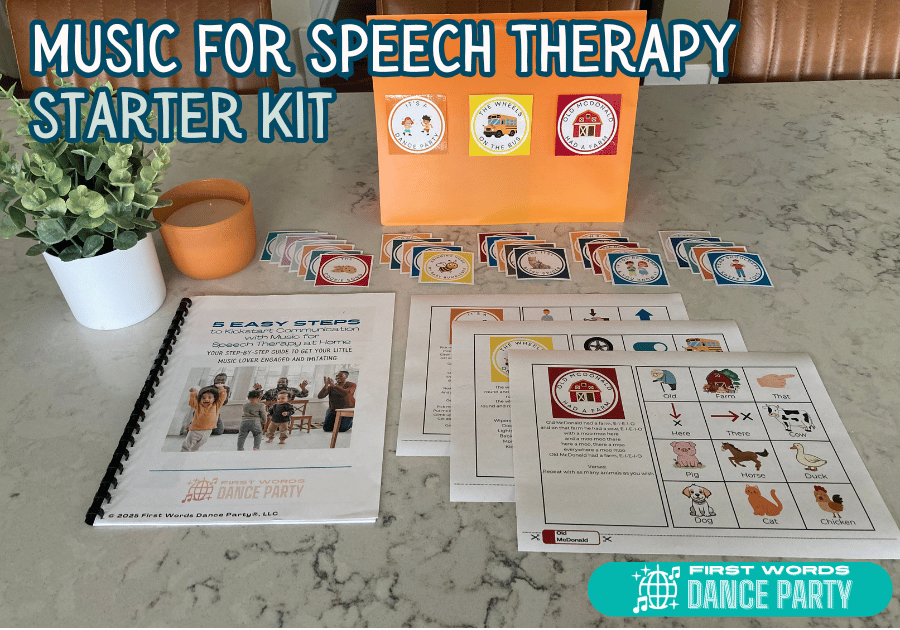
If you're wondering where to start, my free Music for Speech Therapy Starter Kit was created for parents just like you. It includes my 5 Easy Steps to Kickstart Communication with Music for Speech Therapy at Home, printable song boards, song choice cards, and original songs that will help you confidently use music to support your child's communication from the very first day.
And if you’re tired of guessing what your toddler wants and feeling like you don’t know what to do to get your toddler communicating, the Speech Therapy Handbook gives you the confidence to know exactly what to do. You’ll learn what to do and what not to do, and how to take the strategies from the songs to help your toddler communicate during day to day life.
Key Takeaway: When used intentionally, music gives you an easy, practical way to support communication during the many hours you spend living everyday life with your toddler. Music gives us countless opportunities to meet a child exactly where they are, so we can model the skills that are just within their reach.
Final Thoughts for Parents Worried About Not Talking at 2
If your toddler is not talking at 2, pay attention to the words you aren’t hearing, but don’t miss all of the communication development happening underneath those words.
Look for the wins before words.
Is your child copying actions? Using more gestures? Trying new sounds? Imitating sounds or words more readily?
Those skills help show you where your toddler is in the process and what you can help them work on next.
And if your child isn’t meeting communication milestones, don’t wait for them to catch up on their own. Reach out to early intervention or a speech and language evaluation with a local clinic while continuing to create simple opportunities for communication at home.
You don’t have to wait to start.
Frequently Asked Questions About Not Talking by 2
Is Not Talking at 2 a Sign of Autism?
Not talking at 2 can be one characteristic seen in autistic children, but a speech and language delay by itself cannot tell you whether your child is autistic.
Autism involves differences across social communication, interaction, behavior, interests, and/or sensory integration. Some autistic toddlers have significant language delays, while others use many words. Children can also have delayed speech or language for many reasons unrelated to autism.
If you’re wondering about autism, it’s best to reach out to early intervention for a developmental screening or evaluation. Information is always your friend! Once you refer and see, you have the information you need.
You can also share your concerns with your pediatrician to ask for an evaluation That being said, it can be hard for a pediatrician to “see” your concerns within their office during an appointment. My advice is to trust your gut, and bring this checklist of 16 signs of autism by 16 months so that you can discuss specific characteristics that your pediatrician may not be able to “see” during the visit.
Is Not Talking at 2 Normal?
There is a wide range of development, but a 2-year-old who is not talking should be evaluated rather than simply waiting to see what happens.
By age 2, CDC includes combining at least two words among the communication skills that at least 75% of children are expected to demonstrate.
A child who isn’t talking at 2 may eventually make significant progress, but we can’t know which children will catch up on their own simply by waiting. Early evaluation gives you more information and, when needed, earlier access to support.
Why Hasn't My 2 Year Old Started Talking?
There are many possible reasons a 2-year-old may not be talking yet, and it often isn’t possible to determine the cause when they are this young. But there are several common causes for speech delays, which you can read about here: What Causes Speech Delays? 8 Clear Reasons You Absolutely Need to Know
Differences in hearing, speech production, language development, motor planning, overall development, or neurodevelopment can all affect how and when spoken language develops.
That’s why an evaluation is more useful than trying to diagnose the reason yourself.
In the meantime, pay attention to how your toddler communicates in other ways. Their gestures, sounds, understanding, play, imitation, and attempts to interact can provide valuable information about their overall communication development.
What If My Child Is Not Talking by 2.5?
If your child is not talking by 2.5, seek a speech and language evaluation if you haven’t already.
By this age, we expect communication to have progressed well beyond first words. A child between 2 and 3 is typically continuing to add vocabulary and developing increasingly varied word combinations.
You can still support communication at home through play, routines, gestures, visuals, AAC when appropriate, and music, but home strategies should complement rather than replace professional evaluation and support.
What If My Baby Is Not Talking by 18 Months?
If your baby is not talking at 18 months, consider both spoken vocabulary and the broader communication skills.
The CDC’s 18-month milestone is attempting at least three words besides “mama” or “dada,” but remember that this is an actionable milestone rather than an average vocabulary count. An average vocabulary of an 18 month old is anywhere from 10-50 words.
Look at whether your child is:
Using gestures
Pointing and showing
Understanding a variety of directions
Imitating actions
Imitating sounds
Beginning to imitate words
Learning new ways to intentionally communicate
If these skills are delayed or you have concerns about your child’s development, reach out to your pediatrician, a local speech therapy clinic, and/or early intervention program rather than waiting to see if your child will catch up on their own.
You can always cancel an evaluation if your 18-month-old starts to talk, but you can’t ever get the time back that you spend waiting to see.