Gestalt Language Learning: 5 Simple Visual Supports That Can Make Life Easier
- 0 comments
Gestalt language learning is a style of language development in which children often learn phrases, scripts, or chunks of language before single words. Because many gestalt language learners are strong visual learners, visual supports can make language easier to understand, remember, and use.
In this article, I’ll explain why visual supports can be so helpful for gestalt language learners, simple ways to start using them at home, and tools that can make communication feel easier for both you and your child.
We’ll discuss several easy options to support your gestalt language learner at home with visuals, including:
Sign language
Video modeling
Picture magnets of favorite foods
Song boards, and
Core boards
If you’ve wondered about using a core board (a type of communication board) with your child, but you’re not sure where to start, I’ve got you. Want to know the perfect set of beginner words to start with, so you don’t have to guess or waste your time?
You can grab my free Top 10 Core Words for AAC Starter Pack for printable core symbols, fail proof activity and toy ideas, and a curated song list you can start using right away to teach powerful core words.
What Is Gestalt Language Processing?
Gestalt language learning is a natural language development style in which a child first learns larger chunks of language instead of starting with single words.
For example, instead of first saying words like “eat,” “drink,” or “help,” a child may learn and use phrases, like:
Singing whole parts of songs
Repeating lines from favorite shows
Phrases they hear their parents say often
These chunks of language are called gestalts.
At first, the phrase may carry one overall meaning rather than each individual word being fully understood. Over time, many children begin breaking those chunks apart and using smaller, more flexible pieces of language.
This is one reason a child may say a long phrase but still have difficulty answering a question or following spoken directions. Their expressive language can sound advanced, while their receptive language, or understanding, may need more support.
While many gestalt language learners are autistic, not all are. Some children with speech delays or other communication differences may also be gestalt language processors.
For a deeper dive into what gestalt language processing is, examples of gestalt language learning, myths to avoid, and resources and strategies to support gestalt language learners, make sure to check out this comprehensive guide to gestalt language processing.
Signs a Gestalt Language Learner May Need More Visual Support
Many gestalt language learners benefit from visual support.
Since gestalt language processors often use long strings of language, adults may assume they understand more spoken language than they actually do. In reality, one long sentence may hold one big meaning rather than each individual word within the sentence being fully understood.
For example, a gestalt language learner may say a phrase like, “Driving in the car” to mean “I want to leave”. A gestalt language processor who processes language in chunks uses that whole phrase to communicate one single idea, but they don’t understand the meaning of the individual words “driving”, “in”, and “the”.
A gestalt language learner may need more visual support if they:
repeat familiar phrases, but struggle to answer simple questions
have difficulty following spoken directions that involve objects (like “put your shoes by the door”)
understand spoken language better when there is a book, picture, or video for them to see
love watching the same videos over and over
become frustrated when they cannot express what they need
repeat scripts of language they’ve heard before, but have trouble using the words within their scripts to form new phrases and sentences
If several of these sound familiar, visuals can be a very helpful next step.
Why Visual Supports Help with Gestalt Language Learning
Spoken language disappears almost instantly. Once words are said, they’re gone.
Visual supports give language something spoken words alone cannot: they make language stay available long enough for a child to process it.
That can be especially helpful for gestalt language learners, who benefit from having extra time to process.
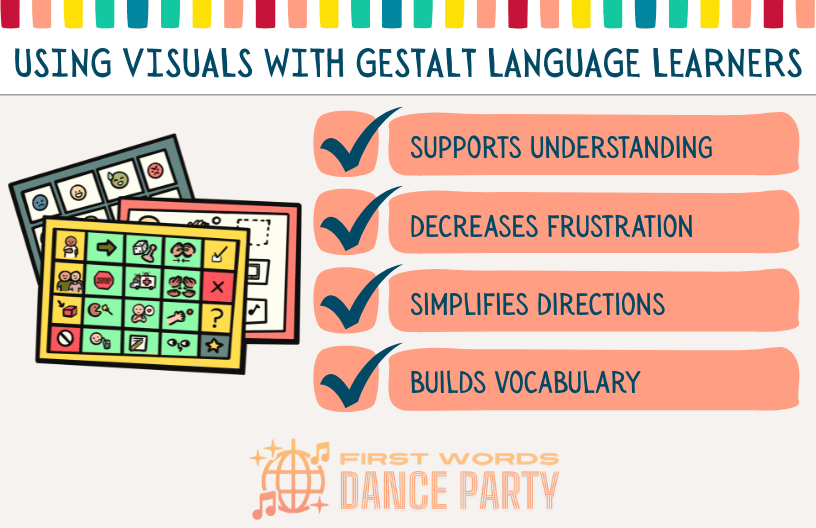
Visual supports help because they:
make language easier to understand
make it easier to use new words
support receptive language development
break directions down into concrete steps
give children an alternative way to express themselves
decrease frustration
Research on communication development and autism frequently supports the use of visuals, because they can improve both receptive and expressive language, independence, and participation in daily life. Since many gestalt language learners are also autistic, this overlap can be especially relevant.
Many families find using visuals at home to be incredibly helpful.
A Real-Life Gestalt Language Learning Example
I recently worked with a two-and-a-half-year-old boy I’ll call Rowan. Rowan is autistic and a gestalt language learner. He often communicated with scripts he heard from his mom, as well as lines from his favorite shows.
When we first started working together, his mom’s biggest concern was safety. She wanted him to understand words like stop and wait so trips to the park could be safer and feel less stressful.
Rowan loved rainbow colors, especially objects or cards that he could line up on the floor. So I made simple stop sign visuals in different rainbow colors and let him explore them first.
As he explored the cards, I took one of his circular puzzle pieces, spun it on the floor, and said,
“Ready, set… go!”
When the puzzle piece slowed and came to a stop, I pointed to the card again and said "stop."
Though he'd never said it before, Rowan immediately said the word “stop”. He put my hand on the puzzle piece to do it again. We repeated this several times.
About ten minutes later into the session, his mom had to take something unsafe away from him that he was trying to put in his mouth. Rowan walked over to her, and clearly said:
“Stop!”
His mom was stunned.
Within ten minutes, Rowan had not only discovered the meaning of the word “stop”, but he used it with his mother to protest. It was truly remarkable.
Sometimes, it just takes a visual to help a child make a connection.
5 Simple Visual Supports That Can Make Life Easier
Here are five game-changing types of visual supports you can use to support your child’s gestalt language learning style.
Sign Language for Gestalt Language Learners
Simple sign language is a fantastic starting point. Sign language can make language visible and easier to understand. Learning to imitate some simple signs can be a fantastic way for gestalt language processors to learn how to initiate to have their needs met.
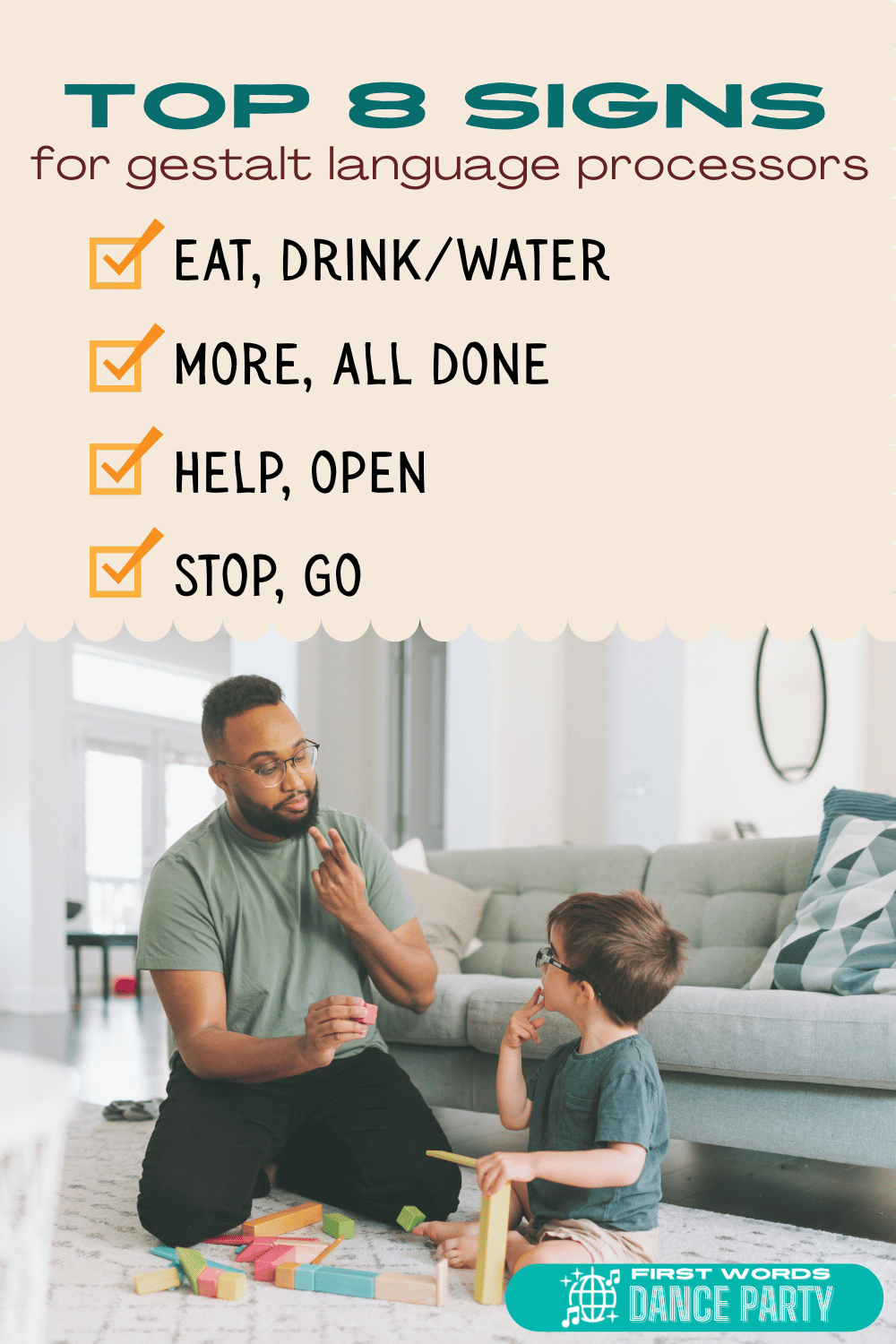
Some of my favorite beginner signs include:
more
help
open
stop
all done
Eat
water/drink
Pick a couple of signs to start with and model them naturally before offering the item or action your child wants.
A Simple Core Board for Gestalt Language Learning
A core board is a simple communication board with high-frequency words children can use across their entire day. Simple core words like you, me, in, out, like, and want are the types of words you’ll see on a core board.
For many gestalt language learners, a core board is a powerful way to support social language. Since every word on a core board has its own symbol, a core board offers visual meaning to the words your child needs to communicate with others.
To use a core board at home, we use modeling to teach a child how it works. This simply means pointing to a word on the core board as you are interacting with your child.
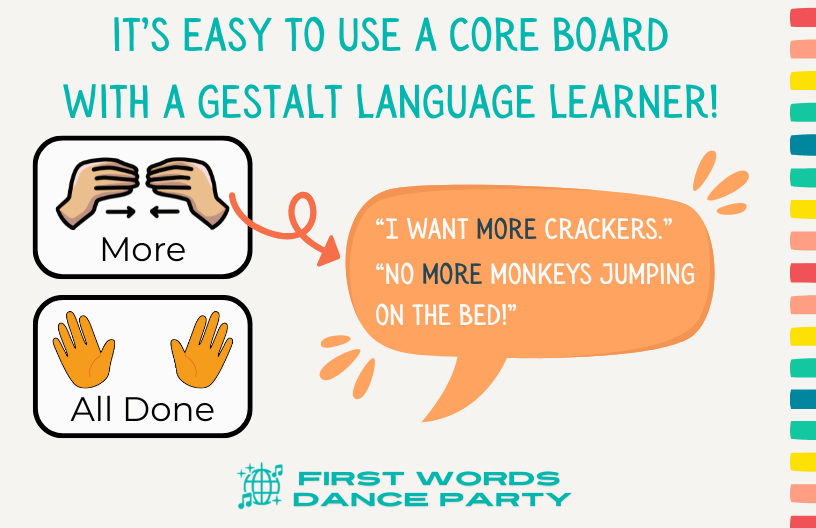
Choose a few words to model during routines, like:
point to more during snack time
point to open before opening a snack
point to help before assisting with a toy or other object
The goal is not to prompt them to point to the symbols. The goal is to teach them how the core board works by modeling and providing frequent access to the it.
The more opportunities your child has to use it, the more your child can learn.
For a more comprehensive look at core vocabulary and how to feel confident using low tech AAC at home, check out this guide: Using AAC Core Words.
Grab Your FREE Core Words Starter Pack
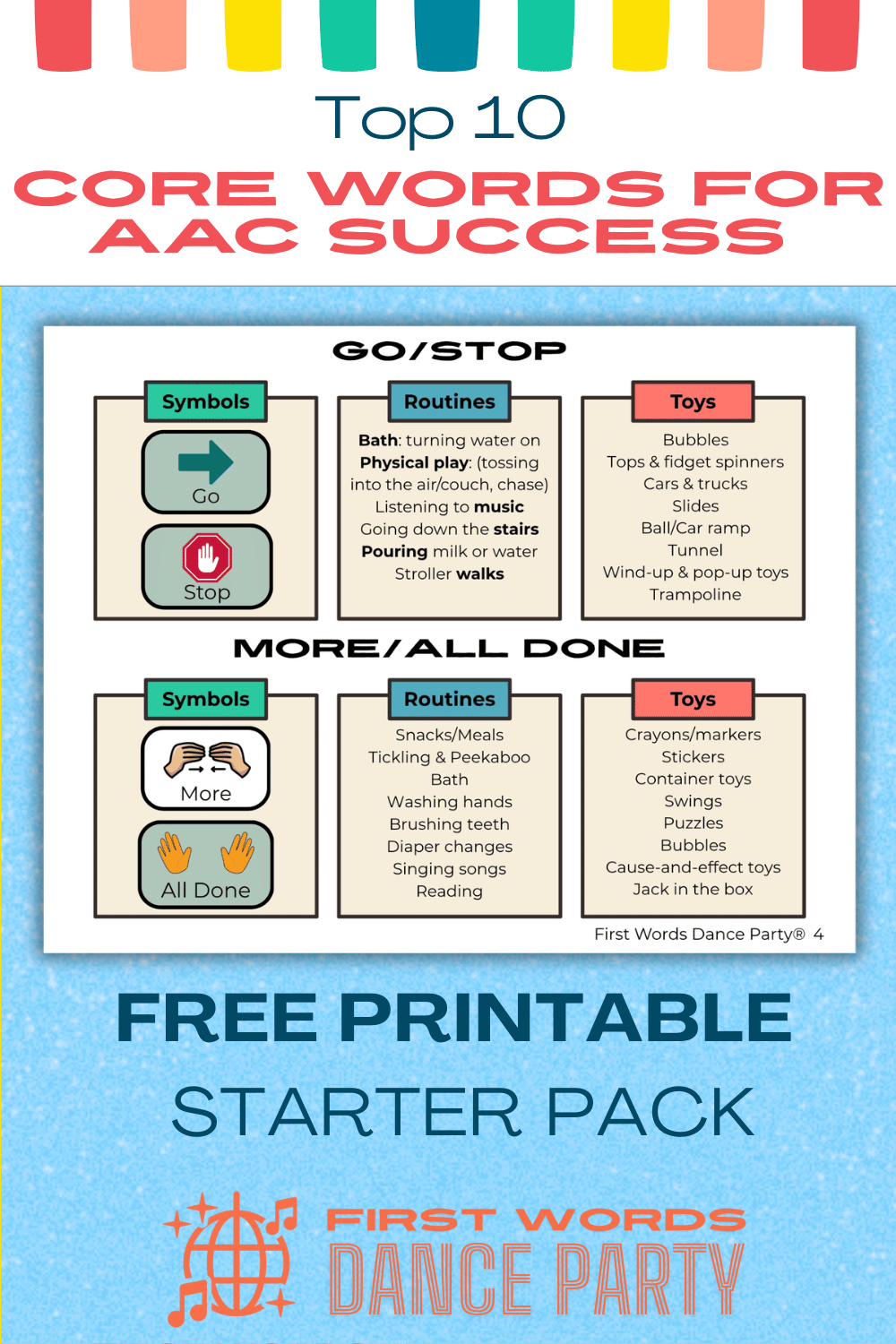
If you’ve been thinking, I love the idea of using a core board… but I don’t know where to begin, this is for you.
I created a free printable to make starting with an AAC core board feel simple and doable—even if you’re brand new to AAC (Augmentative and Alternative Communication).
Inside, you’ll get:
a beginner-friendly starter word list (so you’re not guessing)
simple toy and activity ideas to help you model those words during everyday routines
a curated song list that naturally models the Top 10 core words (because music makes AAC easier to stick with)
Picture Choices for Meals and Snacks
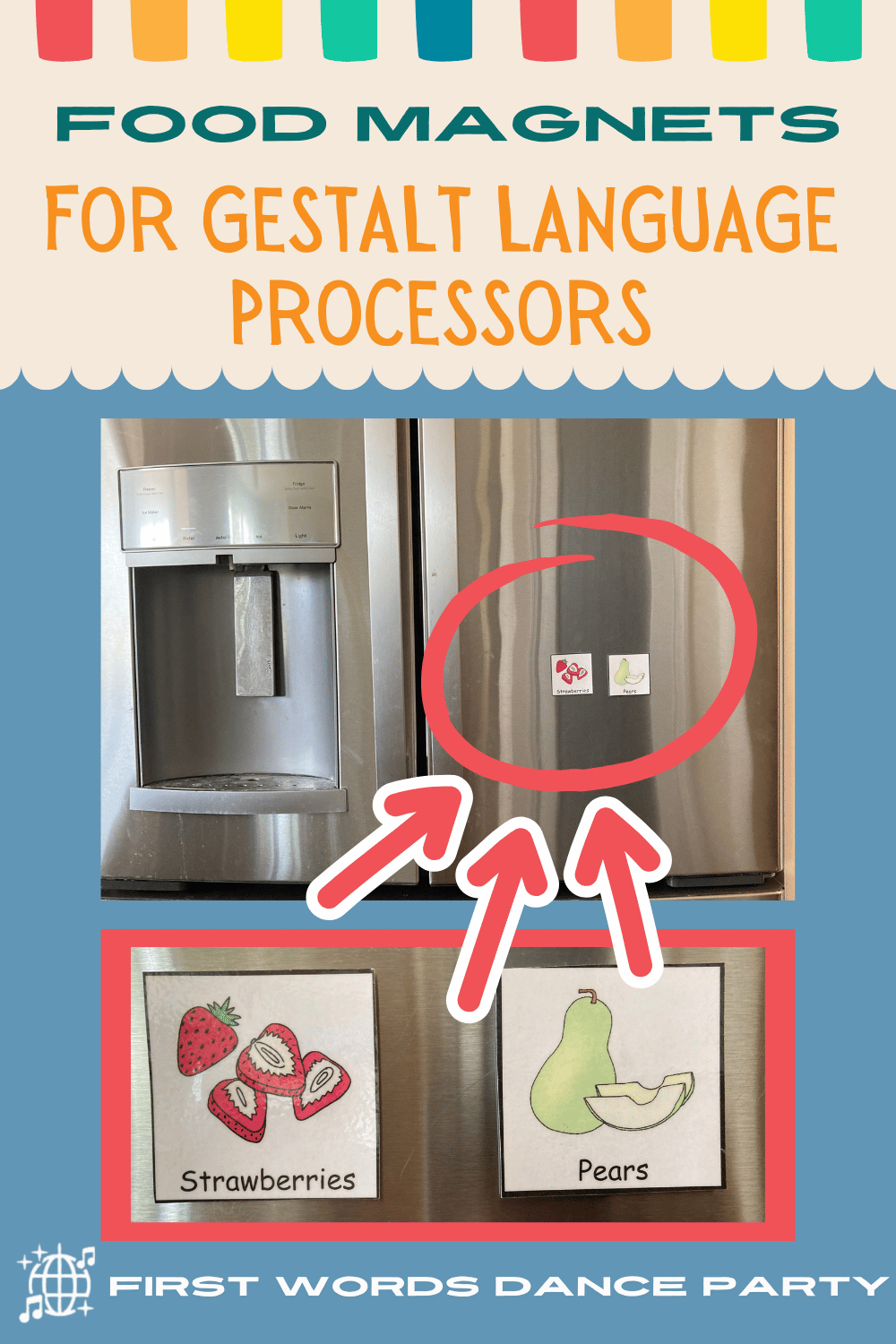
Pictures can be a simple first step for families who are brand new to visuals.
Many parents I work with share that their child lets them know when they are hungry by taking them by the hand and leading them to the fridge.
Using pictures of favorite foods and beverages is my favorite strategy to teach gestalt language processors how to request.
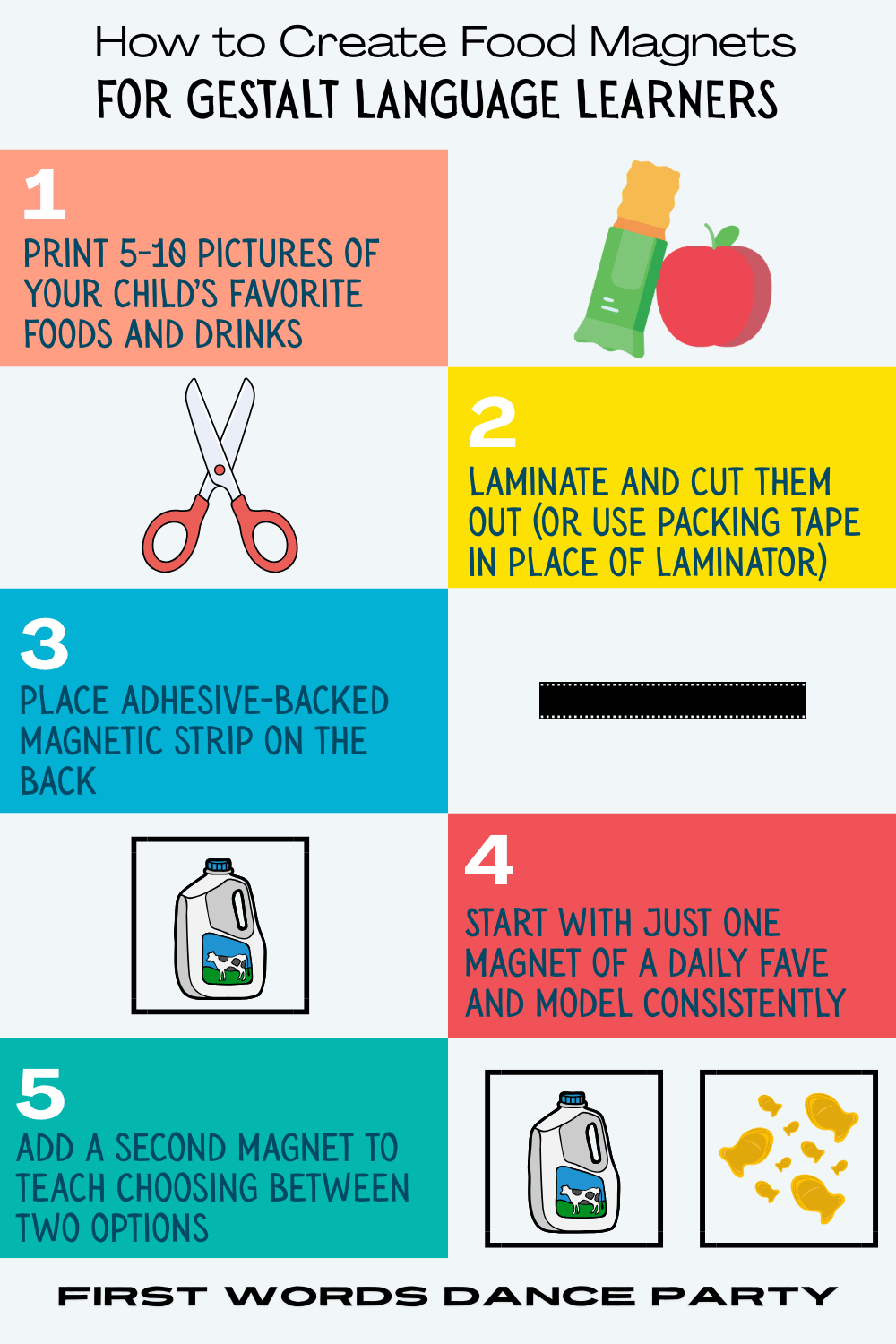
Try printing some pictures of your child’s favorite snack foods. You can also cut out part of the packaging, if you think your child will recognize it.
If you have a laminator and a roll of adhesive-backed magnetic strip, you can laminate and cut out the pictures and turn them into magnets for the fridge. Or, if you don’t have a laminator, you can use packing tape to cover each side of the picture before sticking them together. If this feels like a headache, you can also just tape a couple of pictures to the fridge.
Or, you can print the pictures all on one page, like a menu, and stick it on the fridge.
When your child takes you by the hand and then brings you to the fridge, point to the picture of the food they want before you offer it. You're teaching them the symbolism of the pictures and how to use them.
It often works best to start with just one picture of something like milk or juice, so that your child can have many repeated opportunities to see you model, without being visually overwhelmed. Once the symbolism of the picture clicks, you can add in another picture so there are two.
With two pictures on the fridge, now your child can learn how to select the picture they want by looking between them and making a choice.
This strategy gives your child a clear way to advocate for their needs, even before they are saying the words consistently.
Using Song Boards with Gestalt Language Learners
If your child loves music, song-based visual supports can be a natural next step for gestalt language processors. After all, gestalt language learners are often referred to as "intonation babies".
Song boards make it easier to break down the meaning of the words within the lyrics. For gestalt language learners who can easily sing entire lines from their favorite songs, but struggle to use language to interact socially with others, song boards are worth their weight in gold.
Some benefits of song boards include:
Songs are already language-rich activities
They support receptive and expressive language
They are easy to use
They take advantage of an activity children already find motivating
They increase participation and engagement
For many gestalt language learners, familiar songs can feel soothing, predictable, and easier to join. And, if your child is on the autism spectrum, you may have noticed their almost innate musical interest and ability.
Song boards add meaning to the words within the lyrics.
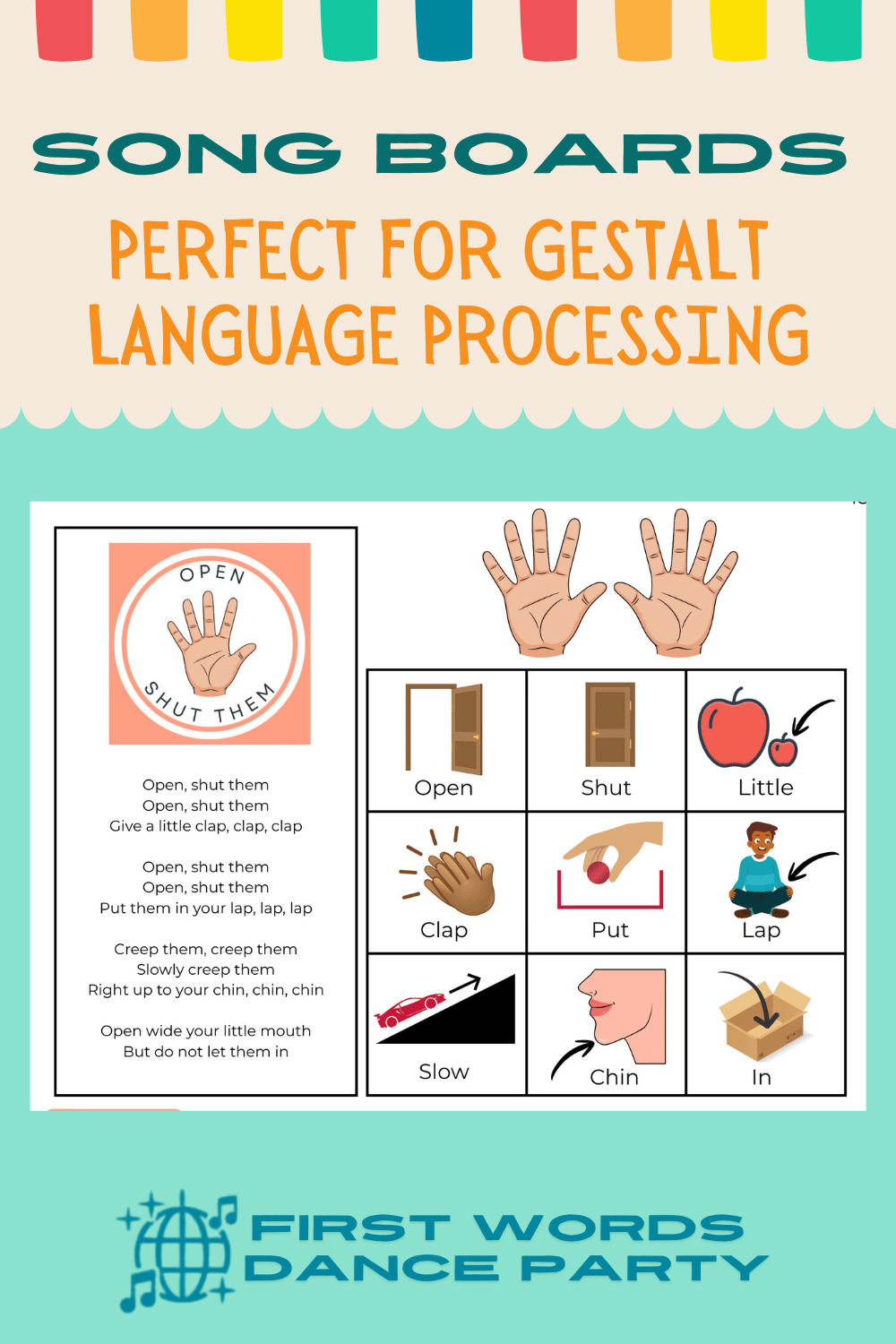
This set includes 30 song boards for classic favorites, like:
Wheels on the Bus
The Itsy Bitsy Spider
Head, Shoulders, Knees and Toes
Old McDonald
And many other favorites
Worried you won’t remember all the words? The lyrics are on the left so you don’t have to worry about forgetting.
Why Videos Help Support Gestalt Language Learning
Many gestalt language learners are naturally drawn to videos because videos combine visuals, repetition, and predictable language patterns.
That combination can make language easier to process and more motivating to watch. Gestalt language learners love to rewatch their favorite videos over and over.
Many gestalt language learners especially love watching videos of their favorite songs, because music videos naturally combine two of their favorite things.
Videos can be especially helpful because they are:
repeatable
predictable
visually engaging
easy to watch again and again
a visual portrayal of an emotional experience
This is one reason video modeling is often recommended for autistic children and other visual learners. Seeing language used by others in real contexts can support understanding, language, behavior, and social skills.
For gestalt language learners, videos can offer a welcome break from the sensory overwhelm of social interaction. They can help teach a new skill without putting the same level of demand on the child.
Plus, a child can repeat the video over and over again. Video modeling can be individualized to the child to teach specific skills.
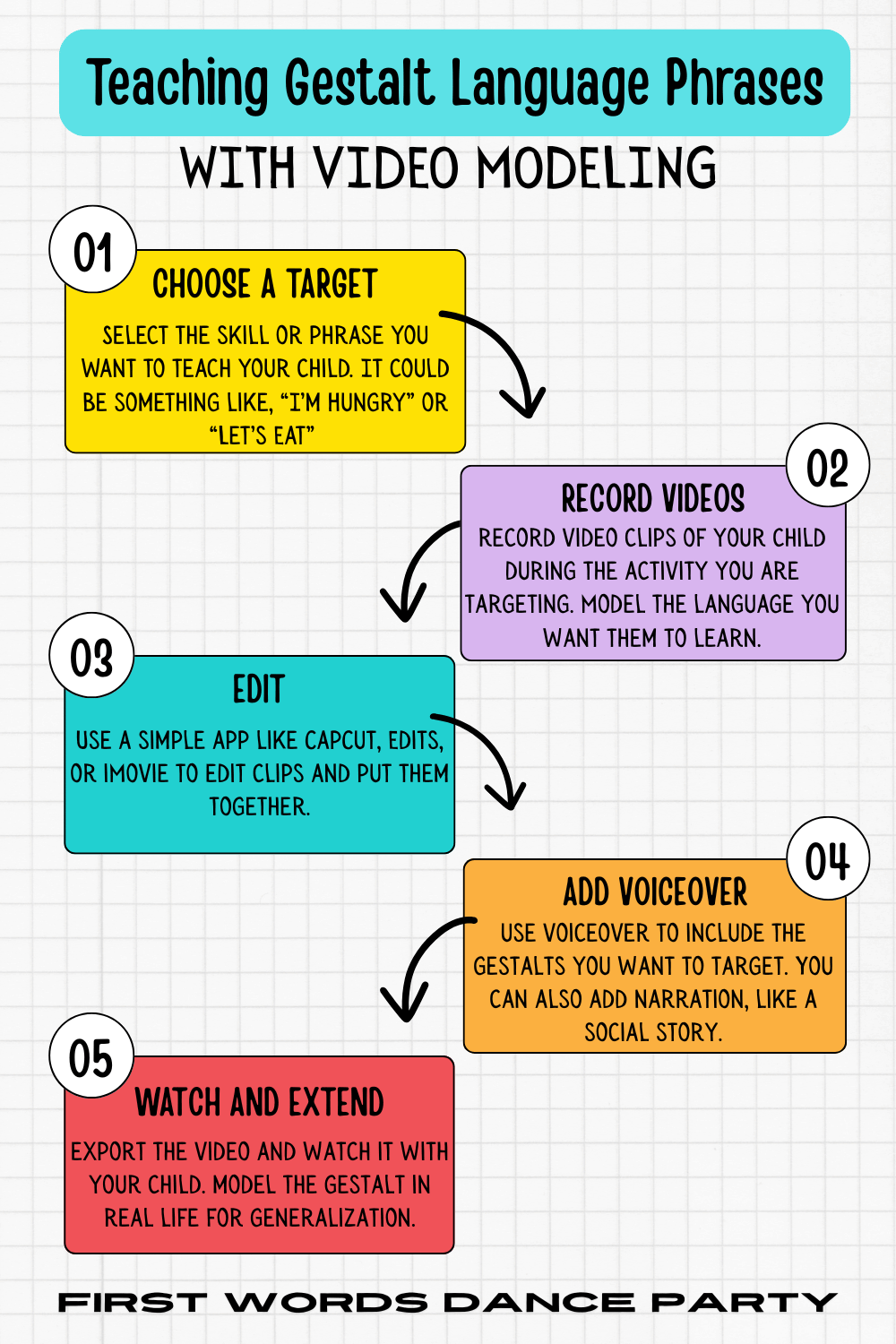
Want a Done-for-You Video Modeling Solution for Your Gestalt Language Learner?
If you’re looking for a done-for-you video modeling solution, that’s exactly why I created the First Words Dance Party® Speech Therapy Music Video Series.
First Words Dance Party® is a collection of original songs written specifically for speech and language development. Unlike nursery rhymes—where the lyrics are cute but not always functional—each song is built around early-developing words and core vocabulary that makes imitation easier for children with speech delays and language disorders.
After fifteen years coaching the parents of children with speech delays, I created every lyric with a purpose. Every song is designed to help your child understand and use real, meaningful language.
These are short, engaging music videos that show real children using communication in everyday routines, paired with the language modeled directly within original speech therapy songs.
You’ll see examples of:
sign language used during meaningful moments
core words modeled on a communication board
functional language paired with real actions like requesting favorite foods, taking turns with peers, and playing with a variety of toys
Each video is built around situations children experience every day, like snack time, play, and getting ready to go outside.
And because the language is modeled in time with the music, it provides the repetition and predictability that many gestalt language learners respond to so well.
These videos are designed to support your child, but also to support you.
They give you a clear picture of how to model language in a way that feels natural, so you don’t have to guess what to say or how to say it. When the songs are over, you have the exact phrase to model in real-world situations as they come up.
If you’ve been wanting to support your child’s communication but weren’t quite sure where to start, this is an easy way to begin.
How to Start Supporting Gestalt Language Learning Today
You do not need to do everything at once. Starting small and staying consistent is often the best approach.
It's better to pick one thing and be consistent with it than to try several different things at once, and stretch yourself too thin to provide the repetition your child needs.
1. Choose A Visual Support to Start With
Pick the support that best matches your child right now:
a few simple signs
a beginner coreboard
picture choices at snack time
a favorite song with visuals
video modeling
Keep it simple so you can consistently offer the repetition your child needs.
2. Model Without Expectation
Your child does not need to imitate you right away or provide a verbal response.
The goal is exposure, understanding, and connection. You can do that by modeling frequently and offering opportunities for your child to respond.
3. Repeat During Everyday Routines
Children learn through the repetition of meaningful experiences that occur within natural contexts.
Model those powerful words during routines like:
snack time
bath time
play
singing songs
Repetition inside predictable routines is huge.
4. Follow Your Child’s Interests
Notice the things that capture your child’s attention. You know better than anyone the things that are most likely to motivate your child.
That might be:
songs
spinning toys
water play
books
vehicles
favorite characters
small objects they can hold, carry, or organize
Model those powerful words while they’re engaged in their favorite things. When children are engaged, they are in a better state for learning.
Remember to provide pauses so your child can process what you're saying and respond in their own way.
Final Encouragement for Parents of Gestalt Language Learners
If your child is a gestalt language learner, it can be confusing when they say long phrases in one moment and yet struggle to use simple words to communicate with you the next.
You are not alone. This is common with gestalt language learning.
Many children who learn language this way benefit when words become more visual, meaningful, and connected to real experiences.
Often, one simple visual support can create meaningful progress over time. Start with what feels doable. Stay playful. Follow what engages your child.
Before you go, don’t forget to grab your Top 10 Core Words for AAC Success Starter Pack to make your core word modeling even easier, so you can stop spinning your wheels wondering where to start and get back to enjoying spending time with your child.
Frequently Asked Questions About Gestalt Language Learning
What is gestalt language learning?
Gestalt language learning is a style of language development in which a child processes language in larger chunks, rather than in individual words. Gestalts, or scripts, can come from shows, music, or conversations. The gestalt language phrases that a child uses are highly meaningful and individualized to their experience..
What is a gestalt language processor?
A gestalt language processor is a child who understands and uses language in chunks, rather than in individual words. By contrast, children who process language word by word in the more common language processing style are analytic language processors.
Do gestalt language learners need visuals?
Not every child needs the same level of support, but many gestalt language learners benefit from visuals because they can make language easier to understand and use. Visuals can help gestalt language learners use language with other people for different functions.
Are all gestalt language learners on the autism spectrum?
No. Many autistic children are gestalt language learners, but not every autistic child is a gestalt language processor, and not every gestalt language learner is autistic.
Does video modeling help gestalt language learners?
Yes! Videos provide repetition, visual context, predictable routines, and engaging models of communication, which can be especially helpful for gestalt language learning. Plus, video modeling can be individualized to teach a child specific skills.