Gestalt Language Learner? How Video Modeling Leads to Breakthrough Results
- 0 comments
If your child is a gestalt language learner, you’ve probably noticed something.
They’re drawn to songs, shows, and certain videos, and they want to watch them again and again.
It can be a bit puzzling. You might wonder if it’s normal or feel guilty about how much your child prefers their videos over everything else. You might worry that it’s getting in the way of language development.
But what if their pull toward videos is actually giving you a clue?
Gestalt language learners process language in chunks. They pick up meaning through intonation, emotion, and familiar scripts that are tied to real experiences.
And many of those experiences come from what they see and hear on screen.
That’s why videos can become more than just something your child enjoys. When used intentionally, they can support communication in a way that feels natural and meaningful.
And for many gestalt language learners, their favorite videos include music, like Super Simple Songs. Music carries those same patterns of repetition, rhythm, and meaningful language within the lyrics.
If you want a simple starting point with this, I put together a FREE guide of 5 Easy Steps to Kickstart Communication with Music for Speech Therapy at Home that you can come back to later.
In this post, we’ll walk through why video modeling works so well for gestalt language learners, what it looks like in real life, and how you can start using it in simple ways at home.
What Is a Gestalt Language Learner?
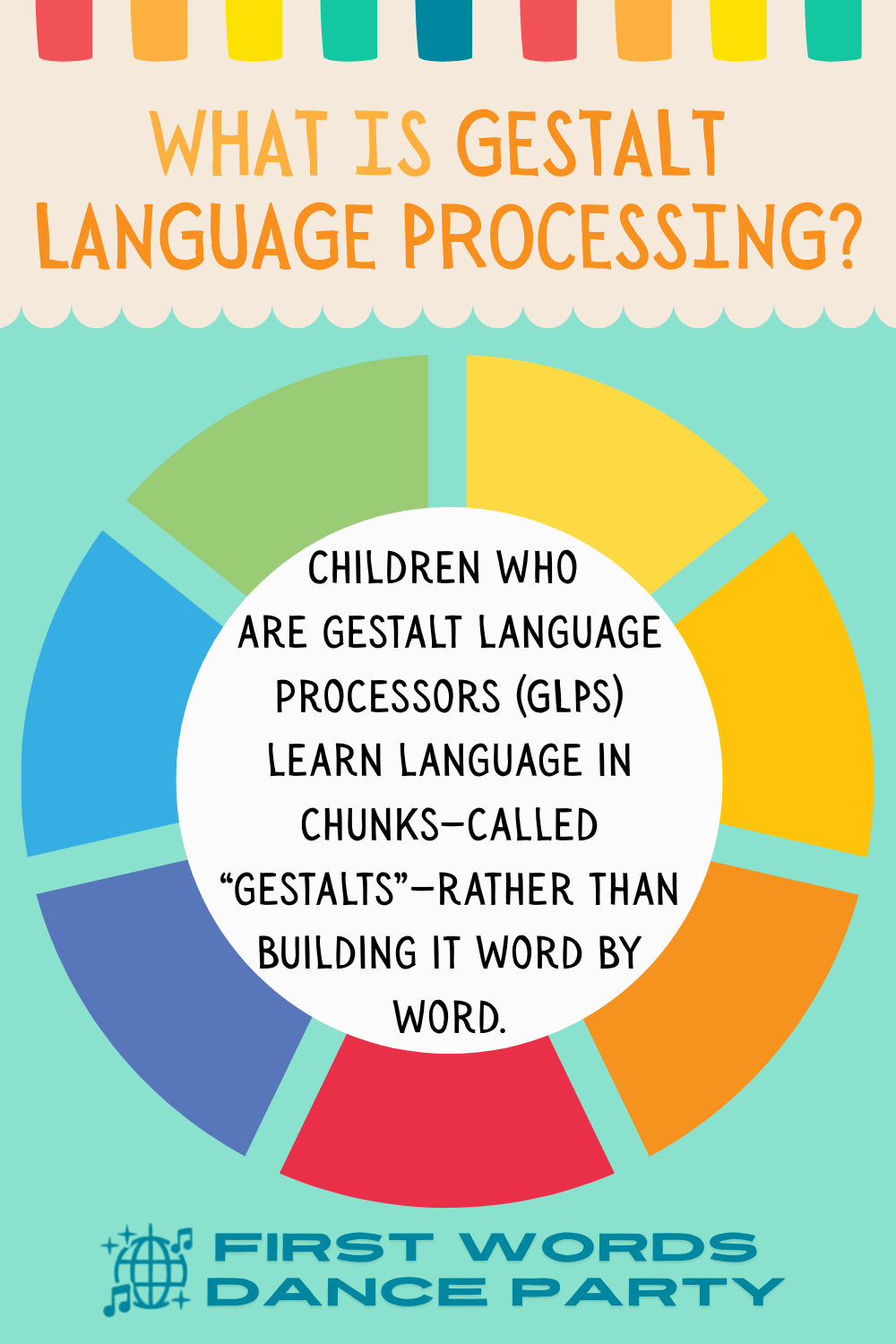
A gestalt language learner is a child who processes the meaning of language in chunks rather than in individual words.
Instead of starting with first words like "ball", “up”, or “mama,” they often pick up longer phrases or scripts that they’ve heard before. These might come from songs, shows, or everyday routines.
These phrases might not seem flexible. They may sound like exact repetitions of something your child has heard.
But over time, those chunks begin to break down and recombine into more flexible, original language.
This process is known as Gestalt Language Processing.
Researchers like Marge Blanc have outlined how children move through stages as they shift from memorized phrases to more spontaneous language.
For many parents, this can feel very different from what they expected. It may not look like typical language development, especially in the early stages.
But it is a meaningful and valid way of learning language.
And once you understand how gestalt language learners process language, it becomes much easier to see why certain supports, like video modeling, can be so effective.
If you're just learning about gestalt language processing, check out these other posts in the series:
Is Your Child a Gestalt Language Processor? How to Know and Why It Matters
Gestalt Language Processors Myths Debunked: 6 Untruths You'll Want to Nix
The Gestalt Language Process: How to Use Music for Quick, Powerful Wins
Why Many Gestalt Language Learners Are Drawn to Videos
Many gestalt language learners are naturally drawn to videos that they can watch over and over again.
At first glance, it might seem like a simple preference. But when you look a little closer, it often reflects how they process and learn language.
As an early intervention teacher, I’ve seen this play out again and again. The children I work with who are gestalt language learners are especially drawn to videos of their favorite songs.
They know exactly what they are looking for on the screen. They scroll past videos they don’t want, and they watch their preferred songs repeatedly.
Their preference for videos holds their attention deeply in a way that can be hard to replicate in other activities.
Videos offer something that is especially supportive for a gestalt language learner.
They are predictable.
The same words are used in the same way, every time.
The same scenes unfold in the same order.
This consistency helps children anticipate what is coming next, which supports understanding and makes it easier to take in the language they are hearing.
Videos also pair language with strong visual and emotional context.
A child can see what is happening, hear the words that go with it, and experience the tone, facial expressions, and actions all at once. This creates a more complete picture of meaning.
And because favorite videos are often watched repeatedly, children get many opportunities to hear and process the same chunks of language again and again.
What might look like repetition is often something much more meaningful.
It is practice.
It is familiarity.
It is your child building a foundation for language in the way that works best for them.
Why Gestalt Language Learners are Drawn toward Music
Gestalt language learners are often drawn toward videos of children's songs.
To a gestalt language processor, music is language in its most accessible, emotional, and memorable form. Gestalt language processors are known as “intonation babies” because they cue into the melody of language rather than honing in on individual words.
The repetition, prosody, and motivating nature of music is worth its weight in gold for children with language delays and disorders.
In the 15 years that I've coached the parents of children with speech delays, I've never once met a child who doesn't love music. So, I created First Words Dance Party® to create fun, original speech therapy songs.
First Words Dance Party® is a fun, catchy collection of songs designed to support early language development. Each song models core vocabulary and words of the simplest syllable shapes, making the songs a powerful tool to help little ones imitate.
What makes First Words Dance Party® especially helpful for gestalt language processors is the way each song is rich with naturally embedded scripts and phrases.
For children who learn language in chunks, not just words, these original songs provide ready-made, functional phrases that can be repeated, generalized, and eventually transformed into more flexible speech.
Here are a few examples:
“The Cookie Song”: A kid favorite that models the words yes and no with lots of repetition and rhythm, along with the phrases "I wanna eat", "I'm hungry", "Let's eat, please"
“Ready, Set, Go”: A super fun little number that models phrases like "I want more", "More bubbles", "Where'd it go?", and of course, "Ready, Set, Go!"
“What I Want”: This one targets phrases to self-advocate, like "I want to go outside", "open the door", "I want to eat chicken nuggets", and "I want water, please". Check out the core word video below to see how you can model AAC along with the songs. (Note that this core video YouTube series does use individual symbols to highlight core words at the single word level, versus using one symbol to represent an entire phrase.)
You can stream First Words Dance Party on Spotify, YouTube Music, Apple Music, and anywhere else you get your music.
Why Video Modeling Works So Well for Gestalt Language Learning
What is Video Modeling?
Video modeling is a strategy in which you teach a child a specific skill by showing them a video of a real person demonstrating it. Ideally, it includes clips of the individual child engaging in the skill.
Because video modeling can be completely individualized to the child, you can also model the language you want your child to use. Children see exactly how that language connects to real-life experiences. For a gestalt language learner, this is especially powerful.
For gestalt language processors, video modeling presents communication the way they naturally process it, through whole, meaningful chunks tied to context, emotion, and action.
It is also different from simply watching videos for entertainment.
With video modeling, the language, actions, and interactions are intentionally chosen to support communication. This makes it easier for children to understand, remember, and eventually use what they see.
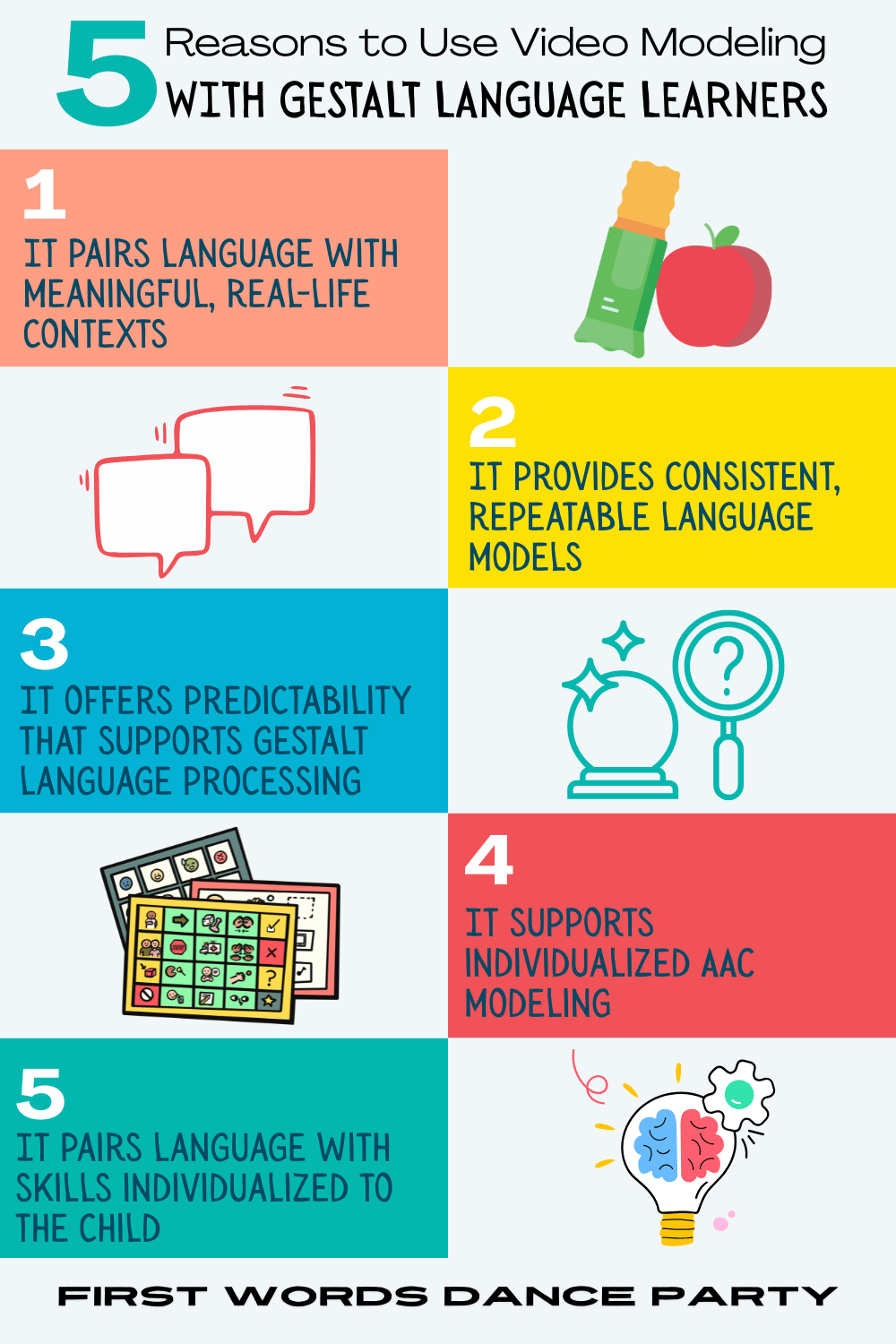
It Pairs Language with Meaningful, Real-Life Context
In video modeling, language is always connected to something that is happening.
A child is not just hearing the word “help.”
They are seeing a person encountering a problem and saying or signing the word “help”.
They are watching the moment unfold as a whole.
This helps build meaning in a way that is much more concrete and easier to understand.
It Provides Consistent, Repeatable Language Models
Video modeling allows children to hear the same words used in the same way, over and over again.
The phrasing stays consistent.
The situation stays the same.
This repetition supports gestalt language learning by giving children multiple opportunities to take in and process the same chunks of language.
It Builds Predictability that Supports Gestalt Language Processing
When a child watches the same video multiple times, they begin to anticipate what is coming next.
They know what will happen.
They know what will be said.
This predictability reduces cognitive load and makes it easier for them to focus on the language itself.
It Supports Customizable AAC Modeling
One of the most powerful parts of video modeling is how flexible it can be.
You can include the exact communication system your child is already using, whether that is sign language, gestures, or an AAC device.
You can also model new symbols or words that you want to introduce.
This allows you to meet your child where they are, while gently expanding their communication in a way that feels natural and supported.
It Pairs Language with Real-Life Teachable Skills
Video modeling teaches a child a specific, high-priority skill . These can be play skills, social skills, and functional skills.
Children can watch:
how to feed a baby doll and put it to sleep during pretend play
how to stack blocks or do a puzzle
how to play with another child and take turns
how to use the potty
They are seeing both the action and the language at the same time.
This helps bridge the gap between understanding and using language in real-life situations.
The Power of Video Modeling in Real Life
A True Story That Moved Me to Tears
Recently, in one of my music classes, I played a music video for the First Words Dance Party® song Open.
In the video, a toddler moves through everyday situations where he needs help opening things: the pantry, a cheese stick, a water bottle, the door, etc. Each moment is paired with the signs for “open” and “help,” along with a core symbol for “open.”
As the video played, a two-year-old boy in the class lifted his hands and signed “help.”
Right there, in the moment.
When the video ended, his mom started crying.
She told me she had been trying to get him to sign “help” for three months. She had modeled it consistently, given him opportunities, and waited. But he had never done it until that moment.
It was one of those moments that stays with you. It showed how powerful it can be when language is presented in a way that truly matches how a child learns.
That is what video modeling can do.
It brings language, action, and meaning together in a way that makes sense, and sometimes, that is what opens the door.
This is one example of what video modeling can look like.
You can explore more videos like this in the First Words Dance Party® Speech Therapy Music Video Series.
Video Modeling, Autism, and Gestalt Language Learners
Video modeling is widely used as a support strategy for autistic children, especially for building communication, social interaction, and play skills. Research has shown that it can lead to meaningful improvements in these areas.
It is also considered an evidence-based practice for supporting children with autism across a wide range of skills.
Many autistic children benefit from seeing skills modeled visually in a consistent and repeatable way. Video modeling allows them to watch, process, and revisit those moments without pressure, which can make it easier to understand and eventually use what they see.
For children who are both autistic and gestalt language learners, this approach can be especially powerful.
It combines visual support with meaningful, repeated language, which aligns closely with how gestalt language learners process language.
At the same time, it’s important to remember that not all gestalt language learners are autistic, and not all autistic children are gestalt language learners.
What matters most is understanding how your individual child learns and choosing supports that match their strengths.
Video modeling is one of the tools that can do that, whether your child is autistic, a gestalt language learner, or both.
How to Use Video Modeling to Support Your Gestalt Language Learner
You do not need anything fancy to start using video modeling at home. You really only need your phone.
Simple, short videos can be incredibly effective, especially when they focus on everyday routines and meaningful moments.
Here is one way to get started.
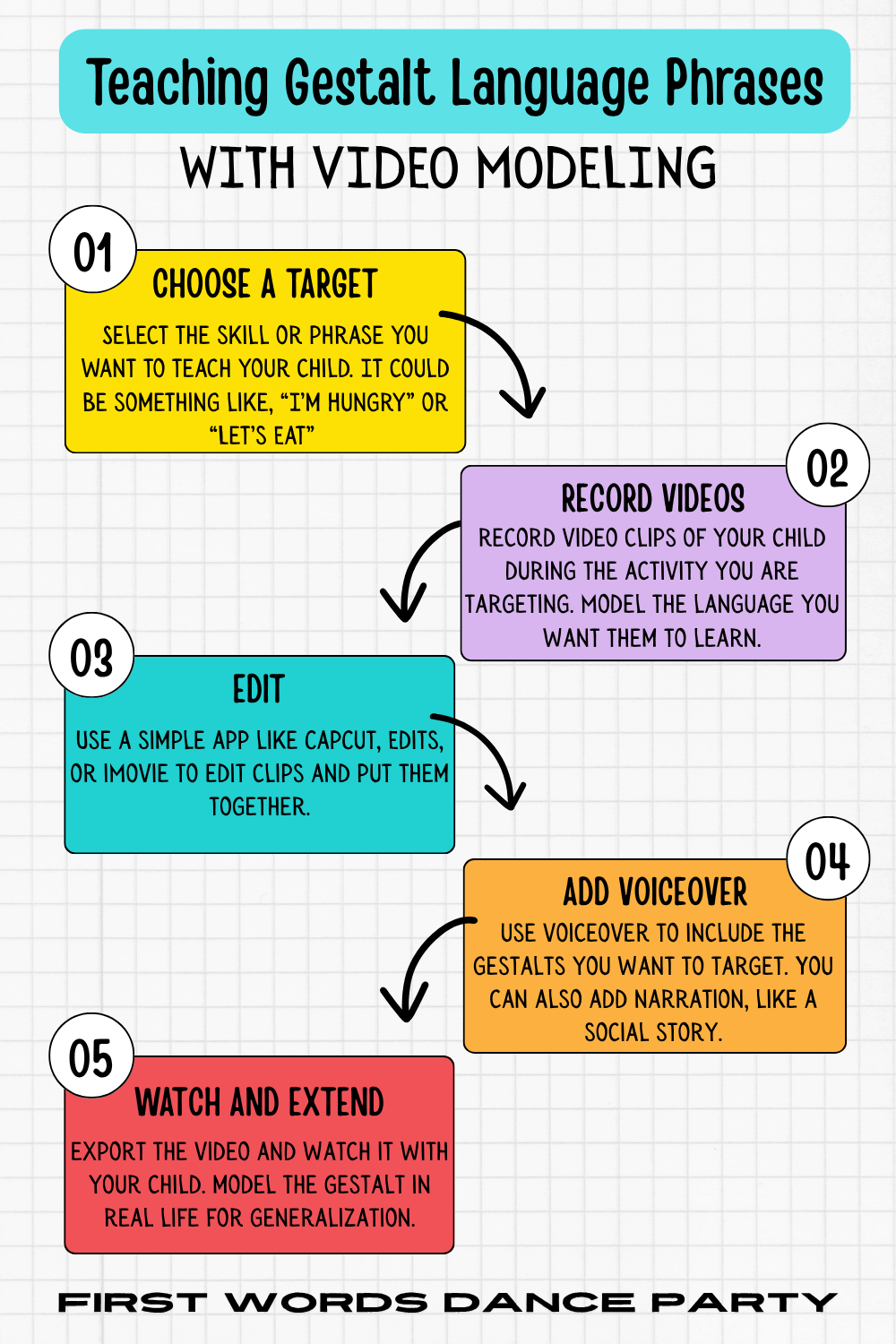
1. Start by choosing a simple skill or phrase
Think about a word or phrase that would be useful in your child’s daily life.
This might be something like:
“I’m hungry”
“Help me”
“Let’s play!”
When I do this with parents, we pick a phrase that would help to overcome a problem.
For example, we’ll target a phrase like “Let’s eat” or “I’m hungry” if the child doesn’t yet have a way of letting others know that. If the child is consistently getting fussy and irritable when their parent knows they are hungry, and the parent has to read the child’s cues to introduce a snack, this is a perfect target.
Whatever you choose, keep it small and meaningful.
2. Record short video clips on your phone
Using your phone, record some video clips of your child during this time. In our “Let’s eat” example, you could record a few clips of your child when they are fussy, a clip of you and your child getting a snack out of the pantry, and a clip of your child eating.
Record yourself or a sibling modeling the language you’re trying to teach. This could be you or an older sibling modeling the sign “eat”. It could be a close-up of you pointing to “eat” on a coreboard.
It doesn’t have to be long. A thirty second video that simply shows the routine and models the language is pure gold.
Pro tip: Because gestalt language processors are often visual learners, core boards can be incredibly helpful when you are trying to teach your child functional words. If you’re new to the idea of using a core board, you can check out this article to learn more: How to Feel Good Using an AAC Core Board (No Experience Needed).
3. Use a simple editing app if you want to combine clips and voiceover
You can keep your video exactly as you recorded it, or you can use a simple editing app to combine a few short clips together.
Apps like iMovie, CapCut, and the Edits app make it easy to trim clips and add a voiceover. There’s a bit of a learning curve at first, but thankfully, these apps are meant for beginners.
4. Use voiceover to repeat gestalt language phrases
Voiceover is a game changer when it comes to video modeling and gestalt language learning.
You can use voiceover to add a bit of storyline to the video, just like a social story. You’ll always use the point of view of the child, using personal pronouns like “I”, “me”, and “mine”.
In our “Let’s eat” example, it might sound like this:
“When my tummy is empty, I feel cranky. I’m hungry. Let’s eat!”
Try to repeat the same phrase for more practice. You could use voiceover to say, “Let’s eat!” while the clip shows you pouring the cereal into the bowl and again during the clip of your child eating.
Consistency helps your child recognize and process the language as a whole, which is especially important for your gestalt language learner.
5. Watch it together and repeat the gestalt in real life
Download your completed video so that you can watch it on your phone, tablet, or TV.
You can also share it with other caregivers so your child has more opportunities to watch it.
Watch the video with your child so it’s a shared experience.
There is no need to ask your child to repeat the word or test their understanding. Just let them watch and take it in.
Then later, when the opportunity arises, model the same phrase from the video in real-life. When you notice your child getting cranky right around 10am, you’ll model, “Let’s eat!”.
This will click for your gestalt language learner, because it’s a chunk of language they’ve already processed to that same context.
A Simple Way to Get Started Using Music and Video Modeling
If this sounds exactly like your gestalt language learner, but you feel a bit overwhelmed thinking about where to start, you’re not alone.
Many parents quickly recognize the signs of gestalt language processing in their child, but they still feel unclear what to actually say, when to say it, or how to make it feel natural in everyday moments.
This is where music can be especially helpful.
Songs naturally include repetition, rhythm, and predictable language patterns. They create opportunities to hear the same phrases over and over again, paired with actions, routines, and emotional meaning.
For gestalt language learners, this kind of input can be especially supportive.
It presents language in complete, meaningful chunks while also making it engaging and easier to remember.
If you want a simple way to begin, I put together a free resource called 5 Easy Steps to Kickstart Communication with Music for Speech Therapy at Home.
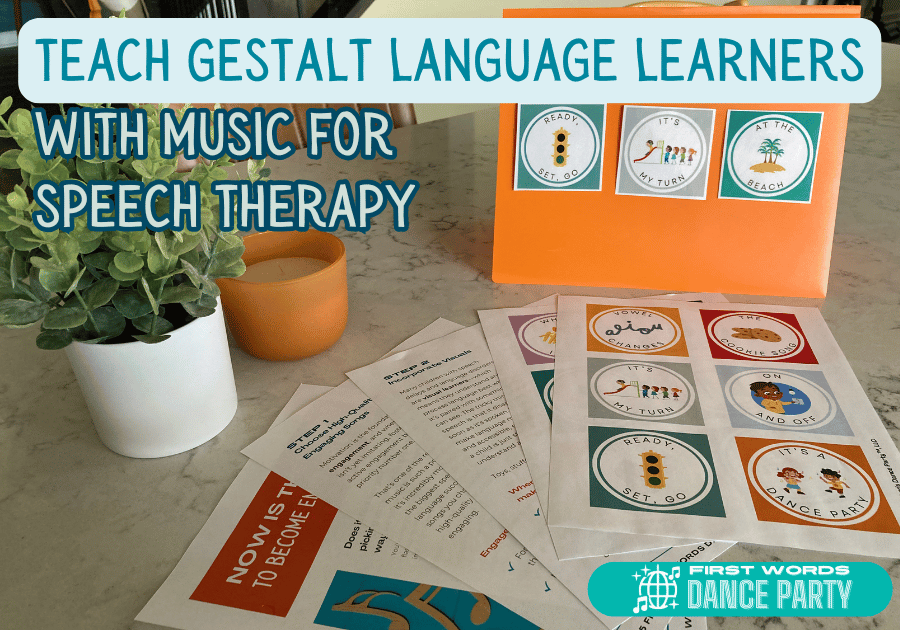
Inside this free guide, you’ll learn how to:
Create connection and shared attention using speech therapy and music
Support imitation of actions, gestures, and words with songs for speech therapy
Use music intentionally for speech and language success at home
Plus, you’ll get a bonus. You’ll receive song choice cards for First Words Dance Party® songs, giving your child a visual way to:
Choose their favorite speech therapy songs
Initiate communication
Increase their understanding
You can come back to this free resource anytime as you begin exploring what works best for your child.
Want a Done-for-You Video Modeling Solution for Your Gestalt Language Learner?
If you’re looking for a done-for-you solution, that’s exactly why I created the First Words Dance Party® Speech Therapy Music Video Series.
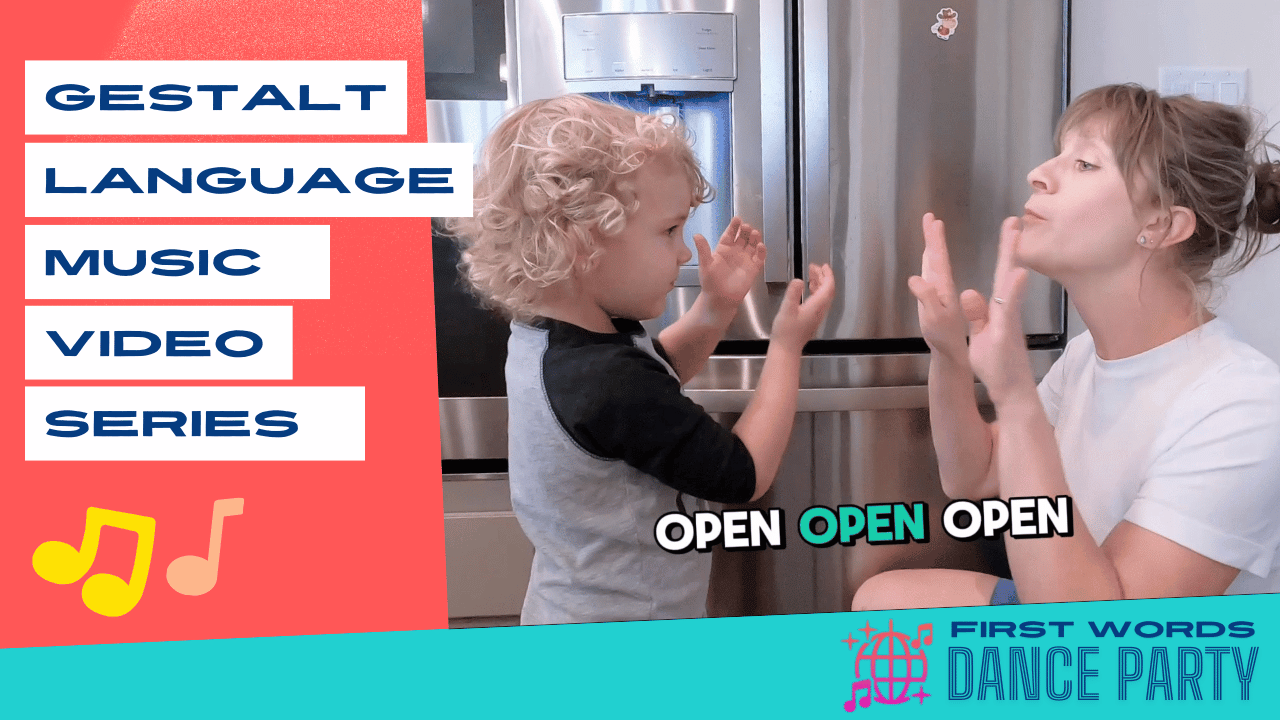
These are short, engaging music videos that show real children using communication in everyday routines, paired with the language modeled directly within the song.
You’ll see examples of:
sign language used during meaningful moments
core words modeled on a communication board
functional language paired with real actions like requesting favorite foods, taking turns with peers, and playing with a variety of toys
Each video is built around situations children experience every day, like snack time, play, and getting ready to go outside.
And because the language is modeled in time with the music, it provides the repetition and predictability that many gestalt language learners respond to so well.
These videos are designed to support your child, but also to support you.
They give you a clear picture of how to model language in a way that feels natural, so you don’t have to guess what to say or how to say it. When the songs are over, you have the exact phrase to model in real-world situations as they come up.
If you’ve been wanting to support your child’s communication but weren’t quite sure where to start, this is an easy way to begin.
Final Thoughts: Supporting Your Gestalt Language Learner in a Way That Feels Natural
If you have a gestalt language learner, you don’t need to fight against what they are drawn to.
You can follow it.
The repetition, the scripts, the love of songs and videos are not obstacles. They are clues. They show you how your child processes language and where their strengths are.
When you begin to use those interests intentionally, whether through video modeling, music, or everyday routines, you create opportunities for communication that feel meaningful instead of forced.
You don’t have to model perfectly.
You don’t need a complicated plan.
Small, consistent moments add up.
Over time, those moments can become the foundation for more flexible, spontaneous language.
And just as important, they can create more connection between you and your child along the way.
FAQ: Gestalt Language Learners and Video Modeling
What is a gestalt language learner?
A gestalt language learner is a child who learns language in chunks or phrases rather than one word at a time. These chunks often come from songs, shows, or familiar routines and are gradually broken down into more flexible language over time.
What is gestalt language processing?
Gestalt Language Processing is a natural way of learning language that begins with whole phrases and moves toward smaller, more flexible combinations of words. This process has been described in stages by researchers such as Marge Blanc.
How do you teach gestalt language learners?
Teaching a gestalt language learner involves modeling meaningful, functional language in real-life contexts. This often includes using repetition, routines, music, and visual supports like video modeling, rather than focusing on isolated single words.
Are videos helpful for gestalt language learners?
Yes, videos can be very helpful because they provide predictable, repeatable language paired with visual and emotional context. This aligns well with how many gestalt language learners process and understand language.
What are examples of gestalt language phrases?
Examples of gestalt language phrases might include lines from songs, favorite shows, or specific phrases echoed from conversations.
Can video modeling support gestalt language processing at home?
Yes, video modeling can be used at home by creating simple videos that show actions paired with language. These videos give children repeated opportunities to see and hear communication in meaningful contexts without pressure to respond.