Why Fringe Vocab Matters More Than You Think (It May Surprise You)
- 0 comments
Core words get most of the attention in AAC conversations — but fringe vocab might be the missing piece.
You’ve probably heard a lot about words like more, go, help, and want. These core words are powerful because they can be used across so many situations. They build flexible, functional communication.
But what about the words that make communication personal?
The words your child really pays attention to, like Bluey, cookie, shoes, and bath?
If your child wants to talk about the things they love, those words matter just as much.
These specific, meaningful words are called fringe vocabulary — often referred to as fringe words in AAC. And while they may not get as much attention as core words, fringe vocab plays an important role in keeping children engaged, motivated, and connected through communication.
Before we talk about how to use fringe vocabulary effectively, let’s take a closer look at what it actually means.
What is fringe vocabulary in AAC?
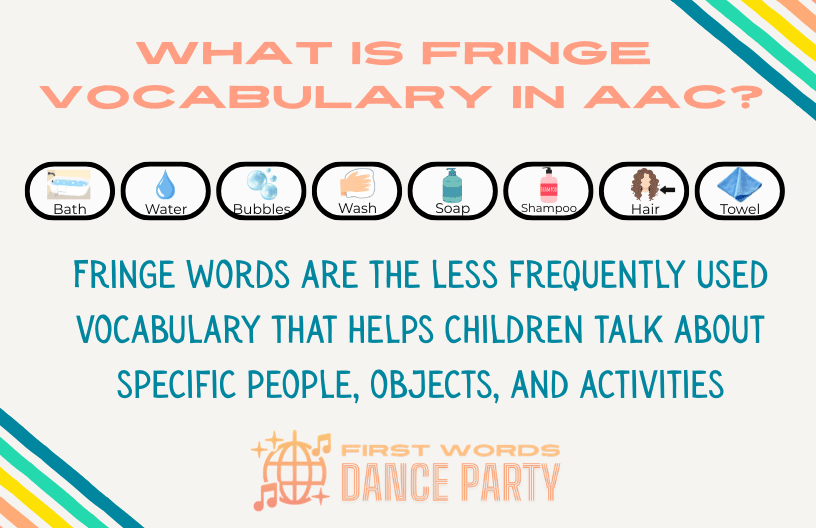
Fringe words are the less frequently used vocabulary that helps children talk about specific people, objects, and activities, often changing depending on the routine, environment, or personal interests.
In AAC systems, these words are often organized on separate pages or around the edges of a communication board because they change depending on the activity. The American Speech-Language-Hearing Association explains that AAC tools support communication by giving individuals access to a wide range of words that allow them to express needs, ideas, and experiences.
If core words are the flexible building blocks of communication, fringe words are the details that make a message specific.
Because fringe vocabulary is usually tied to specific routines and activities, the words change depending on what your child is doing.
Here’s what that might look like in everyday life:
Mealtime fringe words: grapes, milk, crackers, granola bar
Play fringe words: blocks, puzzle, color, Legos®
Getting ready: shirt, pants, wash hands, brush teeth
Notice how those words wouldn’t all be needed throughout the entire day. They’re specific to a routine. But in that moment, they’re incredibly important.
Fringe vocabulary gives children access to the words that match what’s happening right now.
Why fringe vocab increases engagement and motivation
Fringe vocab might not be used as frequently as core words — but for beginner AAC users, it often carries the strongest motivation.
When I’m first introducing AAC to some children, I actually sometimes start with fringe vocabulary words.
Specifically, I’ll create simple picture symbols of a child’s absolute favorite foods and turn them into magnets for the fridge.
We teach them that when they hand over or point to that picture, they get the snack they want most.
And then — it clicks.
Not just because they receive the snack, but because they realize that the picture and the written word are symbols for the actual food item.
After all, every spoken or written word is a symbol for the thing it represents. That “aha” moment of understanding — that picture symbols in AAC stand for meaning — is powerful.
That’s the power of fringe words.
Because fringe vocabulary is tied to what a child cares about most, it can unlock engagement in a way that feels immediate and meaningful. It shows them that communication isn’t just something adults model — it’s something they can use to get, share, and connect.
Motivation drives communication attempts. When a child is excited about the word available to them, they are more likely to try, repeat, and expand.
Core words build flexible structure. Fringe vocab supports interest and initiation.
And when those two work together, communication grows.
Want to know the perfect set of beginner core words to start with, so you don’t have to guess or waste your time? You can grab my free Top 10 Core Words for AAC Starter Pack for fail proof activity and toy ideas, printable core symbols, and a curated song list.
Combining core words with fringe vocab
If core words build the structure of communication and fringe vocab adds the details, the real growth happens when they’re used together. As many AAC specialists explain, core and fringe vocabulary work best when they are used together, giving children both flexible language and specific words that matter in their lives.
One strategy we use all the time in spoken language modeling is expanding on what a child says by adding just one more word.
If a child says, “cookie,” we might model back, “more cookie.”
If they say, “shoes,” we might respond with, “shoes on.”
We’re not correcting. We’re not testing. We’re simply modeling what a slightly longer message could sound like.
That same strategy applies beautifully when using fringe vocabulary in AAC.
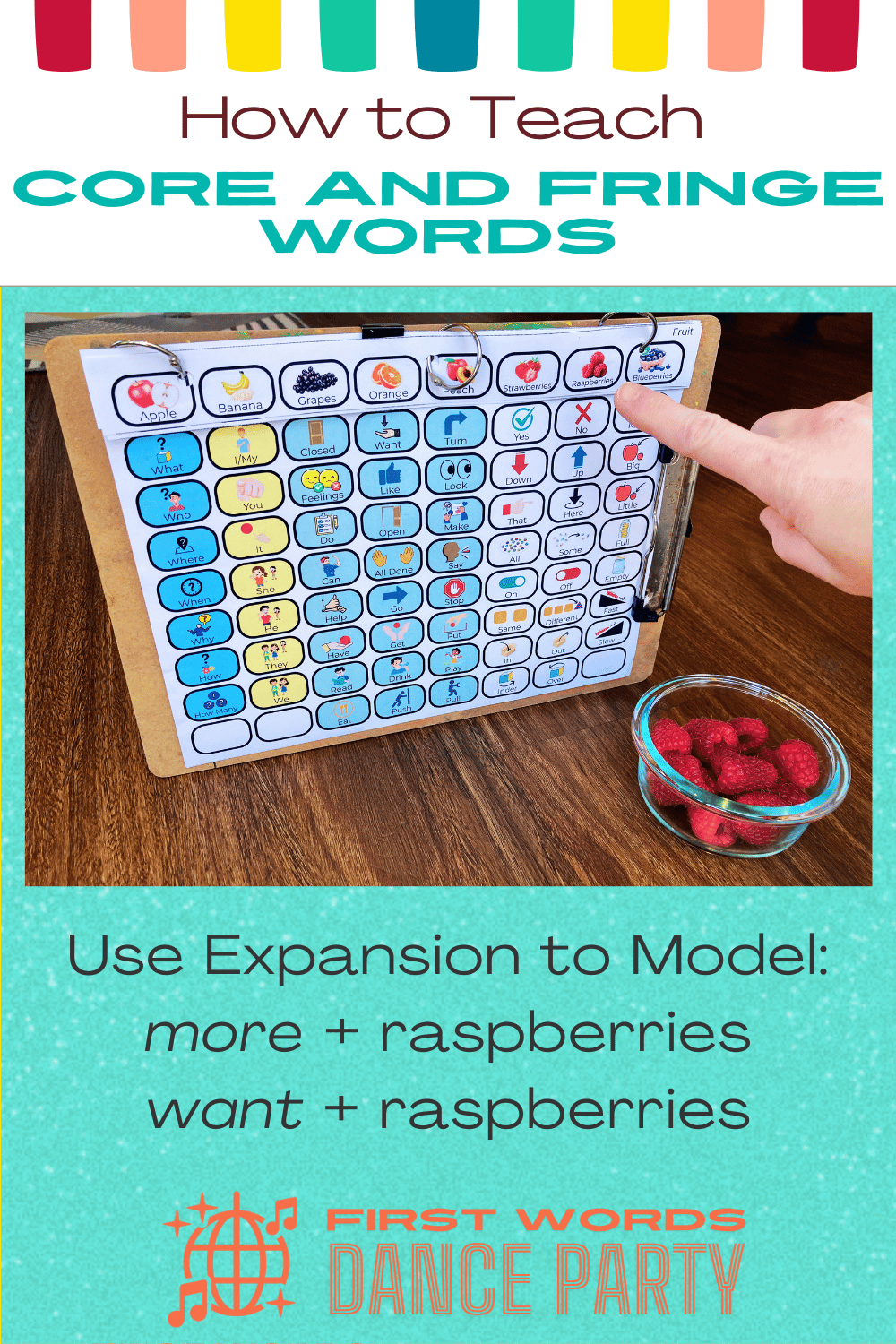
When a child says or points to a fringe word like raspberry, we can use that moment to model important core words in the exact same way:
want + raspberry
more + raspberry
If they say or point to a fringe word like Humpty Dumpty, we might model:
like + Humpty Dumpty
Fringe words give us the meaningful topic. Core words give us the flexible structure.
Together, they show children how messages grow.
You don’t have to choose between core and fringe vocabulary. In fact, the most powerful modeling often happens when we combine them in simple, manageable ways — adding just one word at a time.
When we combine core and fringe vocabulary this way, we’re modeling how flexible language really works.
For a more in-depth look at core words and why it's so important to prioritize them within speech therapy, you can check out this post: What are core words? How simple but powerful words actually spark new growth.
And, if you're new to using a coreboard and wondering how on earth to make it work, this article is for you: How to Feel Good Using an AAC Core Board (No Experience Needed).
First Words Dance Party supports language development
In First Words Dance Party®, I intentionally write songs that combine powerful core words with motivating, routine-based fringe vocabulary. That way, children hear flexible, functional language modeled in meaningful, repeatable contexts that stick.
Music makes that repetition feel natural instead of forced, and it gives you a built-in opportunity to model core and fringe vocabulary together in a way that feels engaging.
The repetition, prosody, and motivating nature of music is worth its weight in gold for children with speech delays and language disorders. For a more in-depth look at all of the research-backed reasons to include music in speech therapy, check out this article: Music for Speech Therapy: 5 Easy Ways to Accomplish Speech Success at Home.
These songs were made with both kids and grown-ups in mind. They’re just as enjoyable for adults as they are for children, with catchy melodies, dance-y rhythms, and lyrics that reflect real-life routines and interactions.
Every single song was created to target specific core words:
“The Cookie Song” targets the words yes, no, eat, please, and I
“On and Off” (you guessed it!) highlights on, off, all done, turn, put, it with lyrics that tell a story about listening to your favorite song
“What I Want” targets I, want, on, go, open, eat, and please within a song about favorite foods, bubbles, and water
“Open” focuses on I, need, help, open, and please
Whether your child is starting to imitate, signing, or using AAC, these songs give you a playful, meaningful way to support their communication. Harnessing the joyful nature of music to teach core vocab is such a no-brainer. For more on how to target core words within music; you can check out this post: How to Leverage the Joyful Nature of Music to Easily Teach Core Vocab.
You can stream First Words Dance Party on Spotify, YouTube Music, Apple Music, and anywhere else you get your music.
You can find more core word lyrics videos on my YouTube channel.
The Top 10 Core Words for AAC Success Starter Pack includes a curated song list that models the hands-down best core words for beginners—so you can start using your core board with music without wondering where to start.
How to organize your AAC system without overcomplicating it
Because fringe vocabulary is usually tied to specific routines and activities, it makes sense to organize it that way.
During meals, certain fringe words naturally belong together.
At the park, a completely different set of words becomes relevant.
At bedtime, yet another group of words is needed.
Many communication boards are organized for specific activities. They include both fringe and core words on the same grid and can be an easy, doable starting point for parents wondering how to start with AAC. For a closer look at communication boards and must-know tips to consider, you can check out this post: Printable Communication Boards: 5 Secrets to Know Before You Buy for Better Results.
While routine-specific communication boards are a simple way to start with AAC, there’s one downside to this approach: the location of core words often changes from board to board.
If more is in the bottom left corner of a “Blowing Bubbles” communication board, but in the top right corner of a mealtime board, your child has to learn the location for every individual communication board they use.
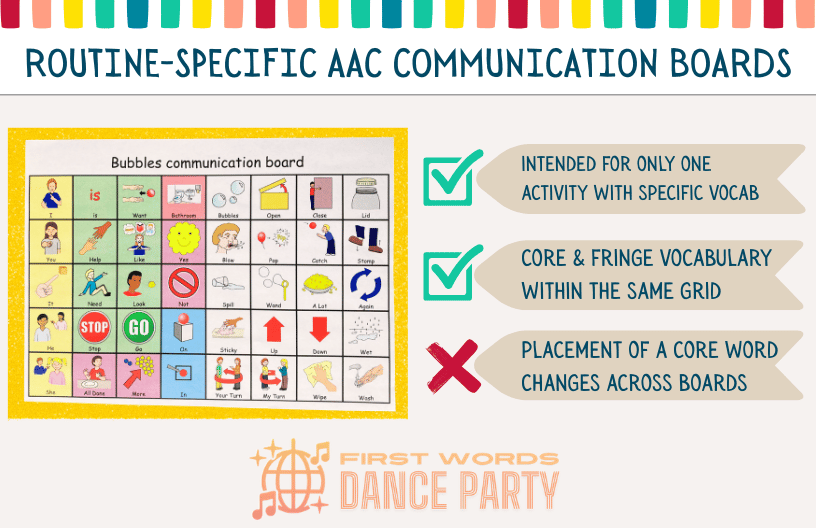
This is a downside. With AAC, it is so important for a child to remember where a word is when they need it.
When core words stay in the same place every time, your child can begin to develop motor memory — the physical memory of where a word is located.
Think about how you type on your phone. You don’t search for every letter each time. Your fingers begin to “remember” where they go.
The same thing can happen with AAC.
When you use a layout that keeps the coreboard stable and places fringe vocabulary above it, you preserve those motor patterns. The core words stay put, and only the fringe words rotate along the top depending on the routine.
This gives you flexibility without sacrificing consistency.
There are two simple ways to make this work with a low-tech printed system:
Option 1: Separate core boards with routine-specific fringe
In this approach, the core board remains the same every time. Across the top are fringe vocabulary words for a specific routine or activity.
For example:
A mealtime board
A playground board
A getting dressed board
The benefit is that the location of the core words stays the same from board to board while specific fringe words are located above. Each board can be placed around the house where it will be used to provide access.
The downside is keeping the different boards organized. If your kiddo carries their playtime core board from the playroom to the living room, it might not make it back to the playroom when they need it next.
You almost might find that you are missing fringe words when you need them. For example, when you are at the playground, you may wish you had a board with fringe vocab for snacks on it when your kiddo gets hungry.
This is why the next option is my personal favorite.
Option 2: Core board on loose-leaf rings with rotating fringe pages
Another simple option is placing your coreboard on loose-leaf rings and three-hole punching fringe vocabulary pages so everything stays together in one system.
The coreboard remains stable and consistent, while different fringe pages can be flipped in based on the activity.
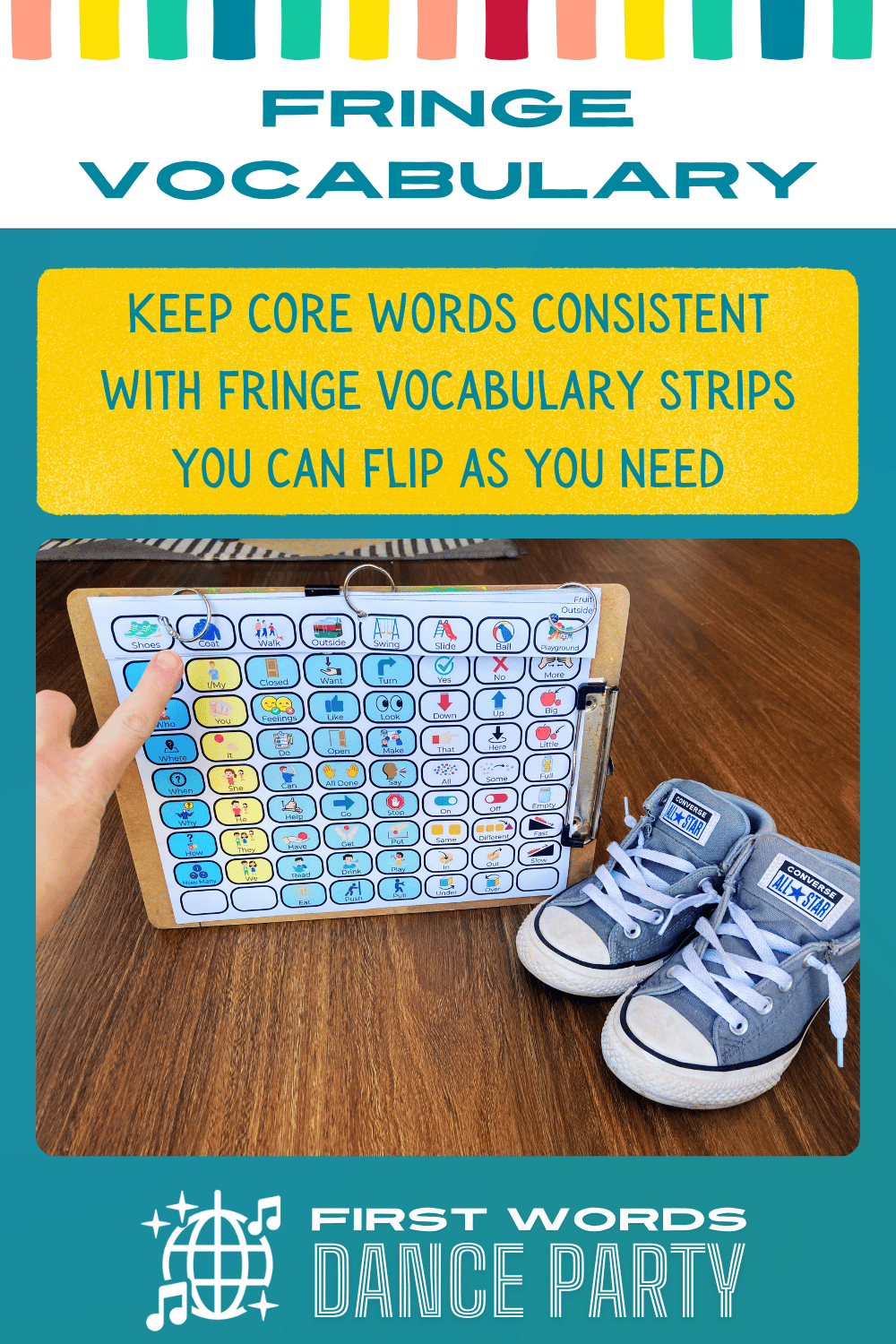
This keeps your system flexible, organized, and easy to change and update.
The goal isn’t to add hundreds of additional words. It’s to provide access to a small set of meaningful fringe words that match what’s happening in the moment — while keeping core words stable and easy to find.
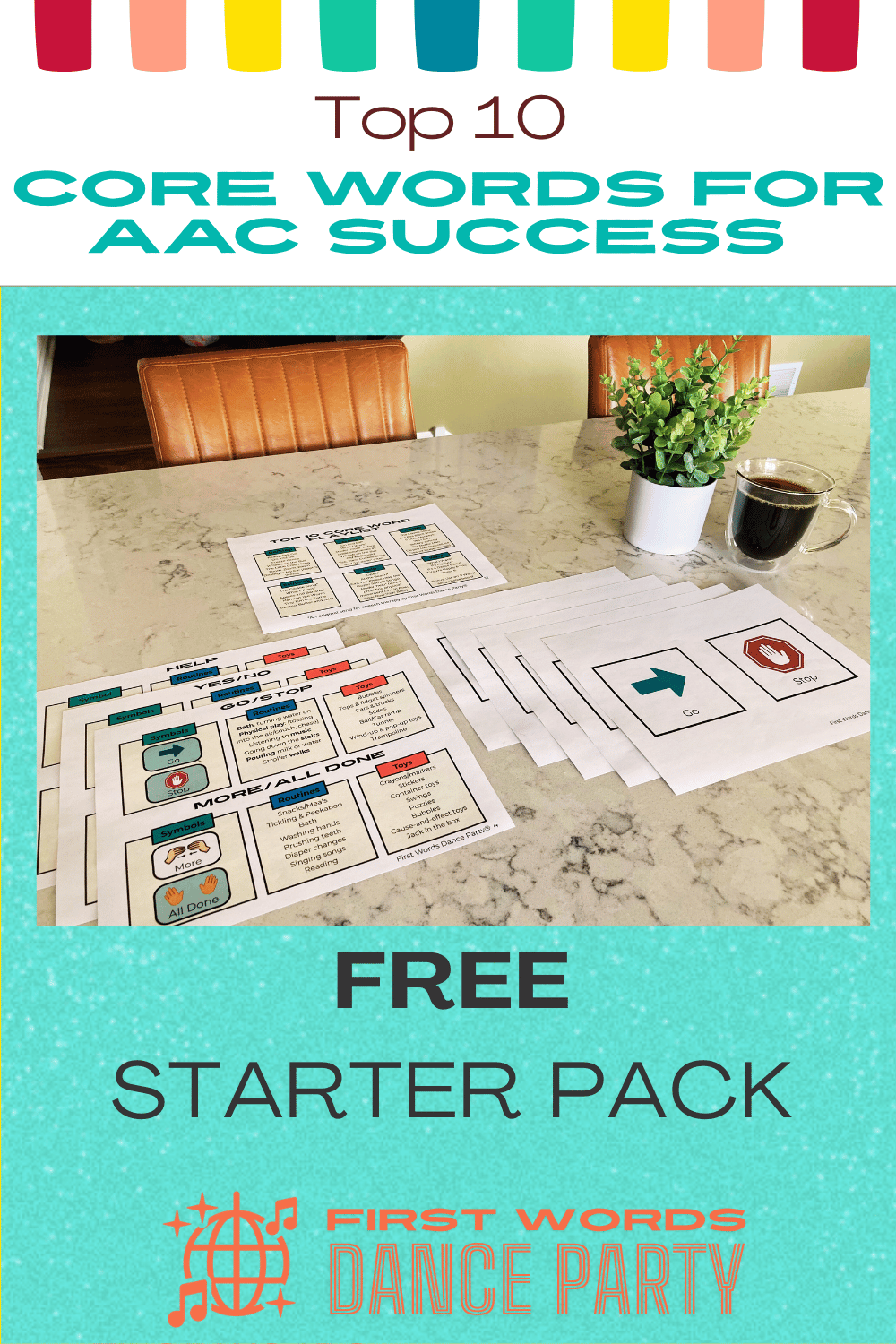
Free download: Top 10 Core Words for AAC Success Starter Pack
Fringe vocab gives children the words to request and comment on their favorite things. Core words give children the tools to build longer, more flexible messages.
When we combine motivating fringe words with powerful core words, that’s when communication really starts to expand.
If you want to tap into the power of those high-frequency core words, I created a free printable to make starting with core vocabulary feel simple and doable — even if you’re brand new to AAC.
Inside, you’ll get:
A beginner-friendly starter word list (so you’re not guessing)
Simple toy and activity ideas to help you model those words during everyday routines
A curated song list that naturally models the Top 10 core words (because music makes AAC easier to stick with)
Build a stable foundation with the coreboard starter set
If just looking at AAC has felt like “too much” in the past, having a consistent core layout can make everything feel more manageable.
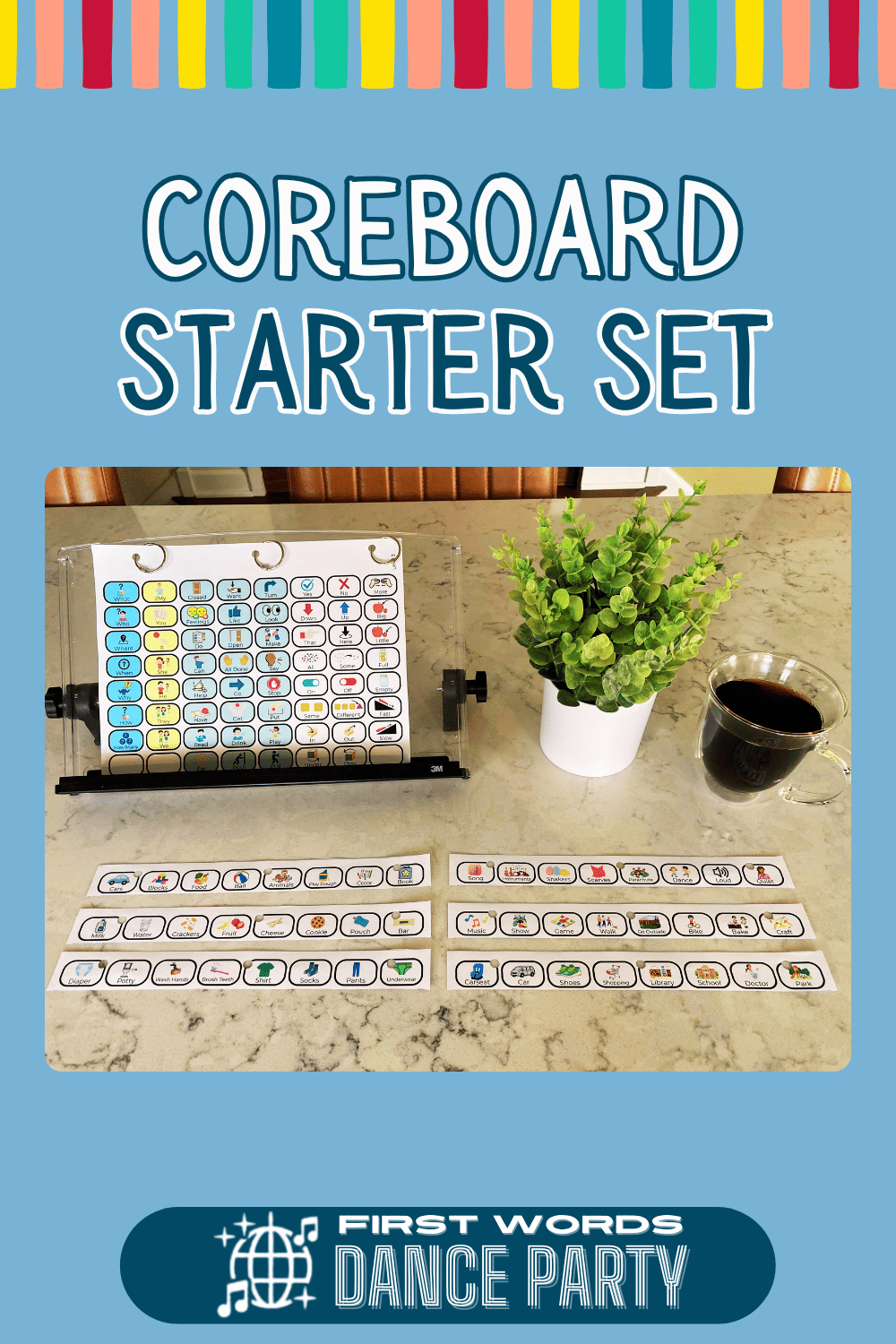
The Coreboard Starter Set is a printable 8x8 core board designed to keep your child’s core words stable and easy to find — so they can begin to remember where their most-used words are located while you layer in motivating fringe vocabulary.
Instead of needing multiple, separate communication boards from one activity to another, this system gives you one consistent core layout that stays the same across your child’s day.
That consistency makes it easier to combine core words with meaningful fringe vocab — without making your child search for the same words in new places every time you switch activities.
With a simple three-step, gradual approach, these core boards:
Reduce overwhelm for beginners
Give your child visual support for understanding and combining words
Help you feel confident modeling core words across your child’s day
When core words stay consistent, it becomes much easier to combine them with motivating fringe vocab in everyday routines.
Add routine-based vocabulary with the expansion pack
Once your core words are consistent, adding routine-based fringe vocabulary becomes much easier.
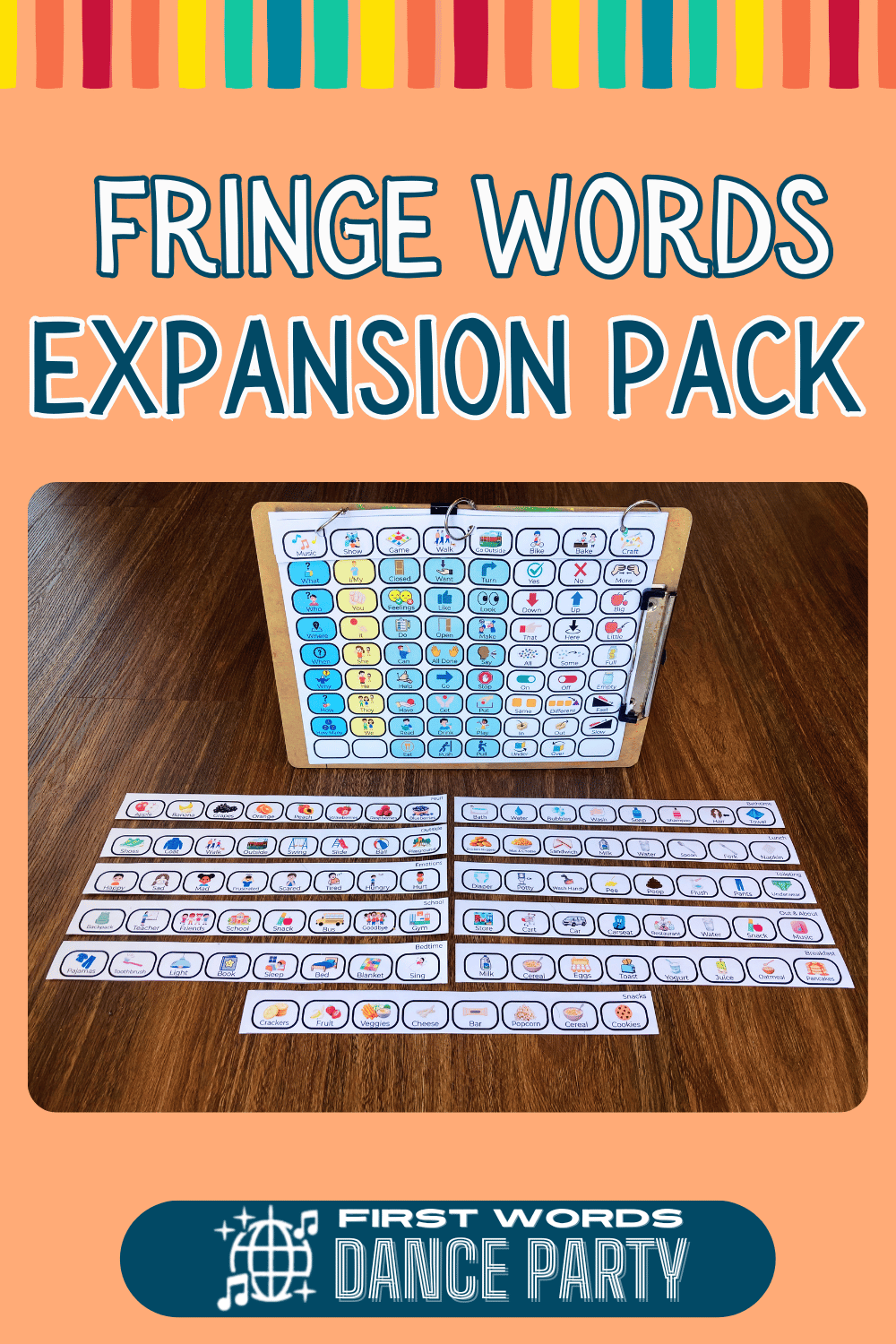
The Fringe Words Expansion Pack includes printable fringe strips organized around everyday activities, so you can rotate meaningful words above your coreboard without changing your layout.
Instead of creating completely separate boards for every routine, you simply swap the fringe words along the top — while your core words stay exactly where your child expects them to be.
Together, the Coreboard Starter Set and Fringe Words Expansion Pack create a simple system that supports both structure and motivation — without overwhelming you or your child.
Final thoughts on fringe vocab
When children can talk about their preferred interests, and they have the core words to build on those ideas, language starts to grow naturally.
Fringe vocab gives them the meaningful topics. Core words give them the words they need to combine words together and use language for a variety of different functions.
You don’t need a complicated system to make that happen. Low-tech options can be the perfect starting point.
Keep the core word layout consistent. Add motivating fringe vocabulary. Model one extra word when it makes sense.
That’s how communication grows.
Frequently Asked Questions About Fringe Vocab
What is fringe vocabulary in AAC?
Fringe vocabulary in AAC refers to the specific, detailed words that are tied to a child’s routines, interests, and daily life. Unlike core words, which are used across many situations, fringe vocabulary changes depending on what your child is doing or talking about.
What are fringe words in AAC?
Fringe words are the individual vocabulary symbols that make up fringe vocabulary. These are often nouns, descriptive words, and actions like cookie, swing, Grandma, or Bluey — words that are meaningful in certain contexts but not used throughout every part of the day.
How is fringe vocabulary different from core words?
Core words are high-frequency words like more, go, want, and help that can be used across many activities and settings. Fringe vocabulary is more specific and tied to particular routines or interests.
Core words provide flexible structure. Fringe words provide meaningful detail. When combined, they support more complete communication.
Do I need fringe vocabulary in an AAC system?
Yes. Fringe vocabulary allows children to talk about what matters most to them, while core words help them build flexible messages. When children have access to both core and fringe vocabulary in AAC, communication becomes more meaningful and more expandable.