Printable Communication Boards: 5 Secrets to Know Before You Buy for Better Results
- 0 comments
Printable communication boards are low-tech AAC (Augmentative and Alternative Communication) tools that help children communicate using pictures, symbols, and words. For children with speech delays, language disorders, autism, or other communication differences, communication boards make language visual and accessible, supporting both understanding and expression.
If you're searching for printable communication boards, you're not alone. Many parents know their child could benefit from visual supports but feel overwhelmed by the number of options available.
Some communication boards are designed around daily routines, some focus on core vocabulary, and others are tied to specific activities or AAC systems. Knowing what to look for before you buy can help you choose a communication board that fits naturally into your family's life.
As an early intervention teacher and the creator of First Words Dance Party®, I've worked with many families who are eager to support communication but aren't sure where to start with AAC. The good news is that communication boards don't need to be complicated to be effective.
In fact, the best communication boards are often the ones that are easiest to use consistently during meaningful, motivating routines.
In this guide, you'll learn:
What communication boards are and how they work
Why communication boards support language development
Examples of different communication boards and when to use them
How to choose vocabulary that supports real communication
What to consider before purchasing printable communication boards
We'll also explore one routine families often overlook: music. Music is one of the most engaging and predictable times of day to model language because rhythm, repetition, and melody naturally support understanding. When communication boards are paired with motivating routines, children have more opportunities to see language modeled in a meaningful way.
If you’re looking for a simple place to start, you can download my free Top 10 Core Words for AAC Success starter kit and get printable supports, song ideas, and play and activity ideas for the ten best core words that you can begin using right away.
Let's start with the basics.
What are printable communication boards?
Printable communication boards are simple, low-tech AAC tools that display words alongside picture symbols. They help children communicate by making language visual and accessible, supporting both receptive language (understanding) and expressive language (communication).
Communication boards are commonly used by:
Children with speech delays
Children with language disorders
Children on the autism spectrum
Children with motor speech disorders
You may also hear communication boards referred to as:
AAC communication boards
Core boards
Language boards
Picture communication boards
Low-tech AAC supports
While the wording varies, the purpose is the same: helping children understand language and communicate more effectively.
One of the biggest benefits of printable communication boards is that they provide visual support. When a child sees a symbol and hears the word at the same time, it strengthens understanding and creates additional opportunities for language learning. Because understanding comes before expression, communication boards can be a powerful tool for supporting early communication development.
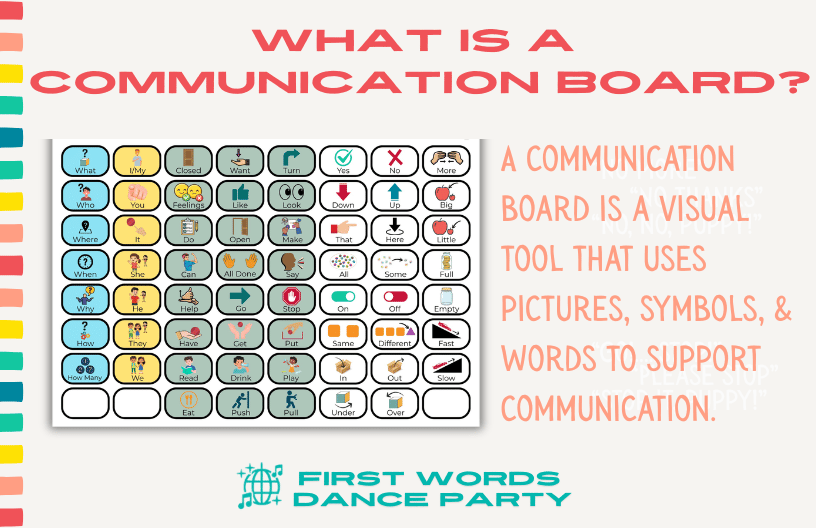
How does an AAC communication board work?
The goal of a communication board is for a child to eventually use it independently to communicate. In order for that to happen, they first need opportunities to see how communication boards work.
We teach this through a strategy called aided language stimulation. Instead of expecting a child to immediately point to symbols, we model by pointing to words ourselves while speaking naturally during everyday routines.
Think of a communication board as a visual support for the language you're already using.
When you're playing with blocks, you might point to:
up
down
more
When you're having a snack, you might point to:
eat
drink
all done
The goal isn't to test your child or make them perform. The goal is to show them how communication works by consistently pairing words, symbols, and meaningful experiences.
Over time, children begin to understand what the symbols mean and how they can use them to communicate their own wants, needs, thoughts, and ideas.
If you're new to AAC, you may also want to start with my guide to AAC core words. I’ll walk you through what core words are, why they matter, and how to start modeling core vocabulary during everyday moments like playtime, meals, music, and daily routines.
Communication Board Examples for Everyday Routines
One of the most common questions parents ask is: "What should a communication board actually look like?"
The answer depends on how and when you'll use it.
Some communication boards are designed around a specific routine, while others contain flexible vocabulary that can be used throughout the day. The best communication board is often the one that fits naturally into activities your child already enjoys.
Here are a few common communication board examples.
Core Communication Boards
A core communication board contains high-frequency words that can be used across many different situations. These words are often called AAC core words because they make up a large percentage of what we say every day.
Examples include:
go
stop
more
help
want
open
on
off
in
out
Many families find that a core communication board is one of the easiest places to begin because the same vocabulary can be modeled repeatedly throughout the day.
Simple Communication Boards
Some children benefit from a communication board with a smaller number of symbols.
A simple communication board might include just a handful of highly motivating words.
These boards can feel less visually overwhelming and may be easier for parents who are just getting started with AAC.
Communication Boards for Daily Routines
Many printable communication boards are designed around a specific activity or routine.
Any of these routines could have its own designated communication board:
snack time
bath time
playground play
favorite toys
bedtime routines
These boards often contain vocabulary that is highly relevant to the activity at hand.
For example, a bedtime board might include:
brush teeth
pajamas
book
goodnight
hug
sing a song
These kinds of communication boards can create natural opportunities for language learning because the vocabulary directly matches what your child is experiencing in the moment.
AAC Communication Boards
Communication boards are one form of AAC, or Augmentative and Alternative Communication.
AAC includes many different tools and supports, including:
printable communication boards
core boards
sign language
speech-generating devices
Many families start with low-tech AAC communication boards because they are affordable, easy to use, and simple to print at home.
Whether you choose a core communication board or a board designed for a favorite routine, the most important factor is not the board itself.
The most important factor is how often your child has opportunities to see language modeled in meaningful, motivating situations.
The Benefits of Using a Communication Board for Autism
Communication boards can be especially helpful for autistic children because they make language visual, accessible, and easier to process.
Many autistic children are naturally drawn to visual information. When spoken language moves too quickly or is difficult to process, a communication board provides an additional way to access meaning. Seeing a picture symbol while hearing a word can help children better understand what is being communicated.

And understanding language is important because receptive language lays the foundation for expressive language.
Communication boards can support:
Language comprehension
Participation in daily routines
Expressing wants and needs
Commenting
Social interaction
Communication confidence
While you may see products marketed as an "autism communication board," there isn't a specific type of board that works only for autistic children.
Instead, the best communication board is one that:
Contains meaningful vocabulary
Fits naturally into daily routines
Supports consistent language modeling
Matches your child's interests and strengths
Whether a child is autistic, has a speech delay, or has another communication difference, the goal remains the same: providing visual support that makes communication easier to understand and use.
As an early intervention teacher, I've found that communication boards are often most successful when they're paired with activities children genuinely enjoy. When a child is engaged and motivated, they're more likely to notice the symbols you're modeling and connect them to what is happening around them.
When a communication board is paired with a motivating activity, like music, it can create even more opportunities for interaction and language growth. Learn how music can support communication, connection, and engagement in my guide to autism and the hidden potential music holds for communication.
The shift away from prompting and hand-over-hand
As you explore different printable communication boards pdf options, you may come across the term “PECS communication board”. PECS (the Picture Exchange Communication System) has been used for many years, especially in school settings, and some families still find parts of it helpful. But it’s important to understand what PECS is—and how current AAC practices have evolved.
PECS was originally built around teaching children to hand over a picture to communicate. In many early implementations, adults used hand-over-hand prompting to make a child pick up a symbol or complete the exchange. We now know much more about communication development, autonomy, and respectful prompting—and research strongly suggests that forcing hand-over-hand is not necessary and can even be counterproductive for many young learners.
Modern AAC research highlights a shift toward modeling, not manipulating:
Dr. Carole Zangari (Praactical AAC) has written extensively about replacing hand-over-hand prompts with aided language input—modeling on the board yourself, without physically guiding the child’s hand.
Senner & Baud (2016) recommend using least-to-most prompting and emphasize that modeling is often the most effective first step in AAC teaching.
The Autistic Self Advocacy Network (ASAN) and other neurodiversity-affirming groups advocate for communication approaches that respect autonomy and avoid physical prompting unless absolutely necessary.
ASHA also encourages modeling and responsive communication strategies as part of best-practice AAC intervention.
You don’t need to take your child’s hand or press their finger into a symbol. This can actually backfire when children become overly reliant on their communication partners to initiate for them. Instead, you simply model. You point to a word as you say it. You show the symbol during the routine. You pair the picture with the language you're using in the moment.

Why Modeling Matters More Than Prompting
As you explore different printable communication boards, you may come across a wide range of recommendations for how to teach children to use them. You may even come across the term PECS communication board, which is often associated with older approaches that relied more heavily on prompting strategies.
Years ago, some communication approaches relied heavily on prompting strategies that physically guided children to interact with symbols. Today, AAC best practices increasingly emphasize modeling, autonomy, and responsive communication.
Instead of expecting a child to immediately point to a symbol, or using your hand to direct theirs, we show them how AAC works by pointing to the pictures on the board ourselves as we talk during meaningful routines.
This approach is often called aided language stimulation.
How to Avoid Feeling Overwhelmed
It’s easy to feel overwhelmed when you look at a communication board for the first time. There are so many symbols and words on one page.
That’s why I created my Top 10 Core Words for AAC Success starter kit. Learn which words give children the most flexibility for communication and how to model them naturally throughout the day, so you can rest assured knowing that you’re setting yourself and your child up for success.
The benefits of low tech communication boards
Communication boards are considered low-tech AAC because they don't require batteries, internet access, or a power source to work successfully. They can be used on their own or as part of a larger communication system alongside sign language, speech, and speech-generating devices.
While high-tech AAC devices can provide a robust communication system for many children, low-tech communication boards offer several unique advantages.
Why Families Love Low-Tech Communication Boards
Printable communication boards are:
Affordable compared to speech-generating devices
Easy to print and use immediately
Portable and simple to take anywhere
Available even when batteries die
Easy to duplicate for use in multiple locations
Helpful for supporting communication during daily routines
Many families appreciate that low-tech communication boards allow them to begin modeling language right away without needing specialized equipment or extensive training.
Low-Tech AAC Can Be a Great Place to Start
For families who are new to AAC, printable communication boards can be a simple and approachable starting point.
Because communication boards make language visible, they help children connect spoken words with picture symbols in meaningful situations throughout the day. This visual support can strengthen understanding while also creating opportunities for communication.
Whether a child eventually uses a speech-generating device, sign language, spoken words, or a combination of communication methods, low-tech AAC communication boards can play an important role in helping language become more accessible.
5 Things to Consider Before You Buy a Speech Therapy Communication Board
While you may come across many types of printable communication boards online, the best match is one that will fit naturally into your daily routines and help your child stay engaged. That’s where the magic happens.
1. Consider When You’ll Use Your Communication Board Printable
One of the most important things to think about when choosing printable communication boards is when you'll actually use them consistently.
A communication board can be beautifully designed and full of great vocabulary, but if it doesn't fit naturally into your day, you may not find yourself using it often enough for your child to benefit.
The most effective communication boards are the ones that become part of meaningful routines.
For some families, that might be:
Snack time
Mealtimes
Playing with favorite toys
Bath time
Getting dressed
Music and movement activities
These are often the moments when you're already interacting with your child and can naturally model language throughout the activity.
When choosing a communication board printable, ask yourself:
Will I realistically use this board several times a week?
Does this routine naturally capture my child's attention?
Are there opportunities to model words repeatedly?
Is this an activity my child genuinely enjoys?
We want communication boards to feel relevant and useful, not an extra thing you have to force that becomes too much to use.
The best printable communication boards make it easy to:
Point to and model words naturally
Support communication during everyday routines
Repeat meaningful vocabulary throughout the day
Remember, communication boards don't work because they're laminated, colorful, or perfectly organized.
They work because they help you consistently model language during moments that matter.
2. Choose a routine when your child is actively engaged
Not every routine is equally effective for communication board use.
When introducing printable communication boards, choose activities that naturally motivate your child. Children learn language best when they're engaged, interested, and actively participating.
Think about the activities your child already loves.
Examples might include:
Playing with bubbles
Eating favorite snacks
Reading books together
Playing with cars, dolls, or blocks
Singing songs and doing movement activities
When children are enjoying an activity, they're more likely to notice the words and symbols you're modeling.
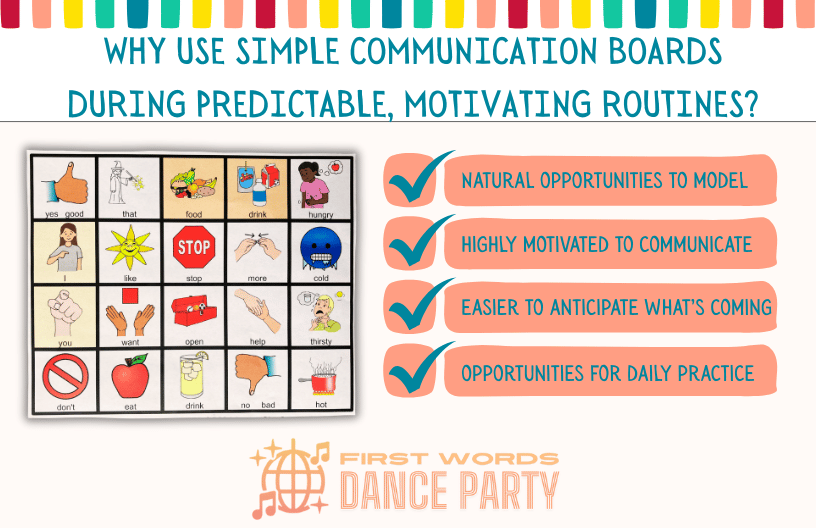
This is one reason communication boards often work so well during play and daily routines. Instead of creating a separate "AAC time," you can weave communication support into activities you're already doing together.
As an early intervention teacher, I've found that parents often see the most success when they start with just one highly motivating routine. Once communication boards become part of that activity, it's much easier to expand into other parts of the day.
Try asking yourself:
When is my child happiest and most engaged?
Which activities naturally keep their attention?
Where do we already spend time interacting together?
What routines happen consistently throughout the week?
The goal isn't to use communication boards all day long.
The goal is to create repeated opportunities for meaningful language experiences.
Starting with a favorite routine can help communication boards feel natural, enjoyable, and sustainable for both you and your child.
Here’s why this matters:
If you choose a board tied to a routine your child enjoys, you’ll have more natural opportunities to model words.
If you choose a board tied to a routine your child tolerates but isn’t really motivated by, modeling may feel harder and less effective.
If you choose a board tied to a predictable routine, your child will anticipate what’s happening. This helps them to follow along with you as you point to symbols.
3. Make sure the vocabulary Is functional
As you explore different printable communication boards, you'll notice a huge range of vocabulary options.
Some communication boards are built around a specific activity and contain words that are unique to that routine. For example, a play dough communication board might include words like:
squish
roll
cut
cookie cutter
A dinosaur-themed board might include:
dinosaur
T-Rex
stomp
roar
These kinds of communication boards can be fun and engaging. They aren't wrong, and they can be incredibly meaningful when used during those activities.
However, if you're new to AAC, it's often helpful to start with vocabulary that can be used across many different situations.
That's where core communication boards come in.
What Is a Core Communication Board?
A core communication board contains high-frequency words that make up a large percentage of what we say every day.
These words are often called AAC core words.
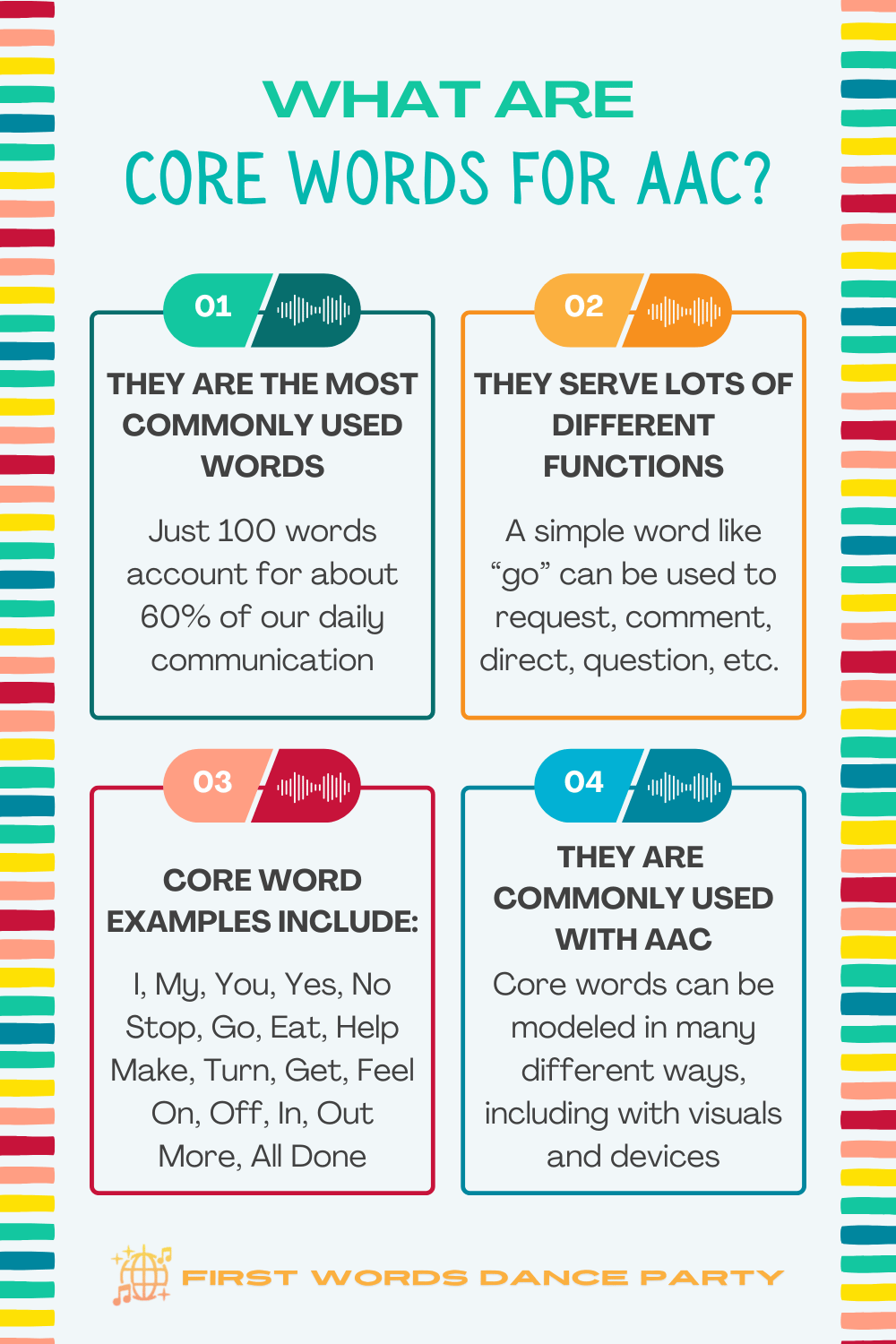
Examples include:
I
My
Eat
Drink
want
open
on
off
in
out
Unlike activity-specific vocabulary, these words can be used throughout the day during many different routines.
For example, the word go can be modeled during:
play
meals
outdoor activities
music
getting dressed
The word more can be modeled during:
snack time
bubbles
swinging
songs
reading books
Because core words are so flexible, they create more opportunities for repetition and carryover.
Why Functional Vocabulary Matters
One of the biggest advantages of a core communication board is that the same words can be used repeatedly across different activities.
You don't need a different board for every part of your day.
Instead, you can focus on modeling a smaller set of highly useful words that help your child:
Request
Protest
Comment
Ask for help
Participate in routines
Interact with others
This repeated exposure helps children learn what words mean and how they can use them to communicate.
As an early intervention teacher, I've found that many families feel less overwhelmed when they start with functional vocabulary. Rather than trying to model dozens of words, they can focus on a handful of powerful words that show up again and again.
A Great Place to Start
If you're wondering which words to model first, I put together a free resource that walks you through the 10 most powerful AAC core words for beginners.
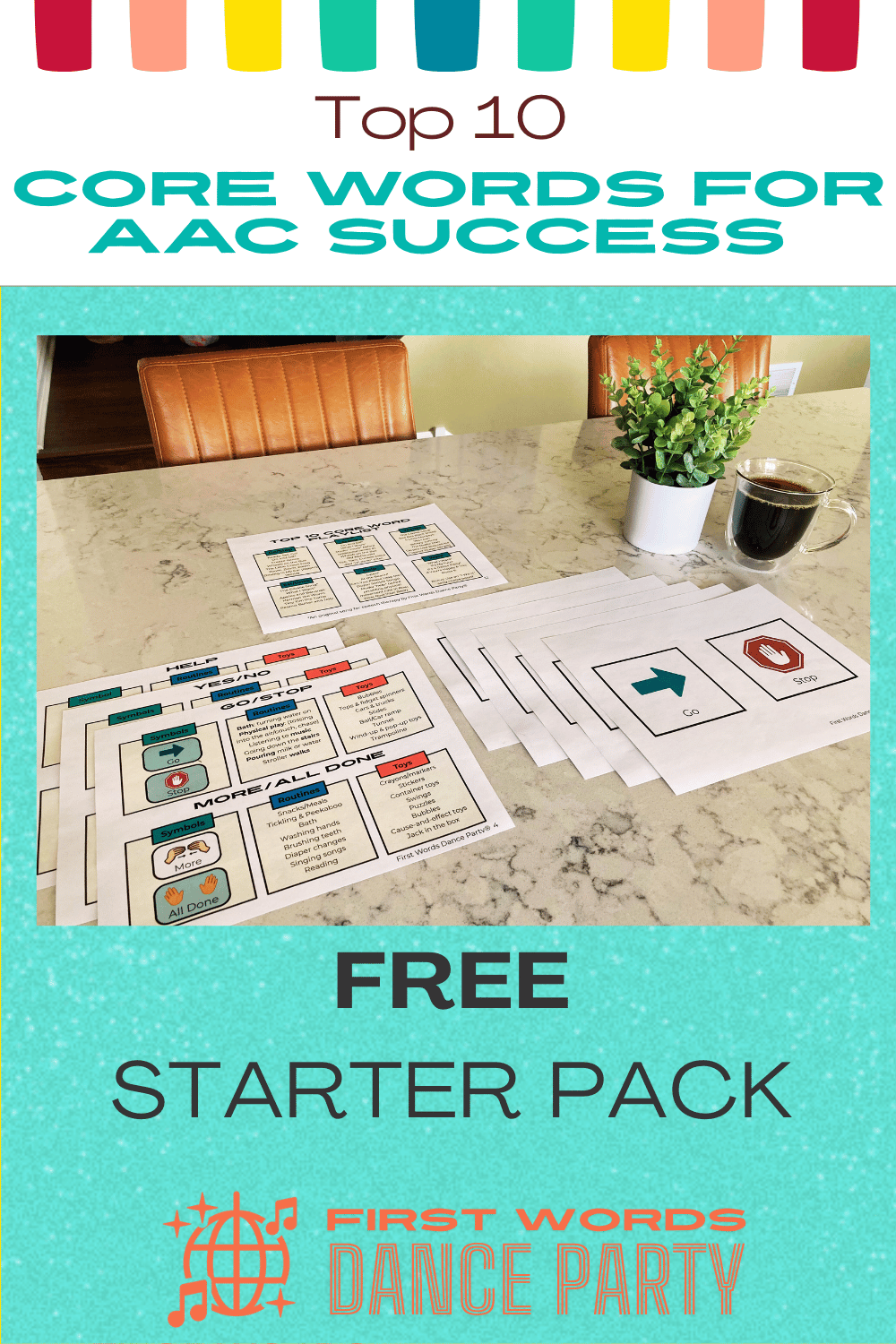
You'll discover:
The first core words many children learn to use
Why these words are so powerful
Everyday routines where you can model them
Simple ways to encourage communication throughout the day
When it comes to communication boards, functional vocabulary almost always beats complicated vocabulary.
The goal isn't to teach the most words.
The goal is to teach the most useful words first.
4. Consider how many symbols will work best for your child
As you compare different printable communication boards, you'll notice that some contain just a few symbols while others contain dozens.
So how many symbols should a communication board have?
The answer depends on your child.
Some children do well with a communication board that contains only a handful of highly functional words. Others are ready for a larger communication board with additional vocabulary options.
For example, a simple communication board for snack time might include:
eat
drink
more
all done
A core communication board may contain many more symbols because it is designed to be used across multiple routines throughout the day.
Things to Consider
When choosing a communication board, think about:
Your child's attention span
Whether they tend to get overwhelmed or distracted by visual input
Their ability to visually scan a page
The goal is to provide access to communication without creating unnecessary visual overwhelm.
For some children, fewer symbols make it easier to focus and participate when first introducing AAC. For others, a larger board provides more opportunities to communicate a variety of ideas.
Don't Worry About Getting It Perfect
One mistake I sometimes see families make is worrying too much about choosing the "right" number of symbols.
The truth is that communication boards can evolve over time.
You might start with:
4 symbols
6 symbols
12 symbols
and gradually add more vocabulary as your child becomes familiar with using visual supports.
Remember, communication development is a journey.
The goal isn't to find the perfect communication board on day one.
The goal is to provide your child with meaningful opportunities to see, hear, and experience language.
A communication board that gets used consistently is always more valuable than a communication board that's too overwhelming to use.
5. Consider Why Music-Based Printable Communication Boards Work So Well
Communication boards can be used during any routine.
But if I had to choose one activity that naturally creates opportunities for language learning, it would be music.
Music combines many of the elements that help children learn language:
Repetition
Predictability
Engagement
Shared attention
Opportunities for imitation
Many children who struggle to engage with spoken language alone become more attentive when music is involved. The rhythm and repetition help create a predictable structure, making it easier to anticipate what's coming next.
And when children are engaged, they're more likely to notice the words and symbols we're modeling.
Looking for easy ways to work on speech and language at home? These music-based speech therapy activities show how to build imitation and language with music for easy speech and language practice at home.
Music Creates Natural Opportunities for Repetition
One of the biggest challenges when using communication boards is finding enough opportunities to model vocabulary consistently.
Music solves that problem beautifully.
Think about a favorite song.
The same words and phrases are repeated again and again.
That means children have multiple opportunities to:
Hear a word
See a symbol
Experience the meaning of the word
Connect language to an enjoyable activity
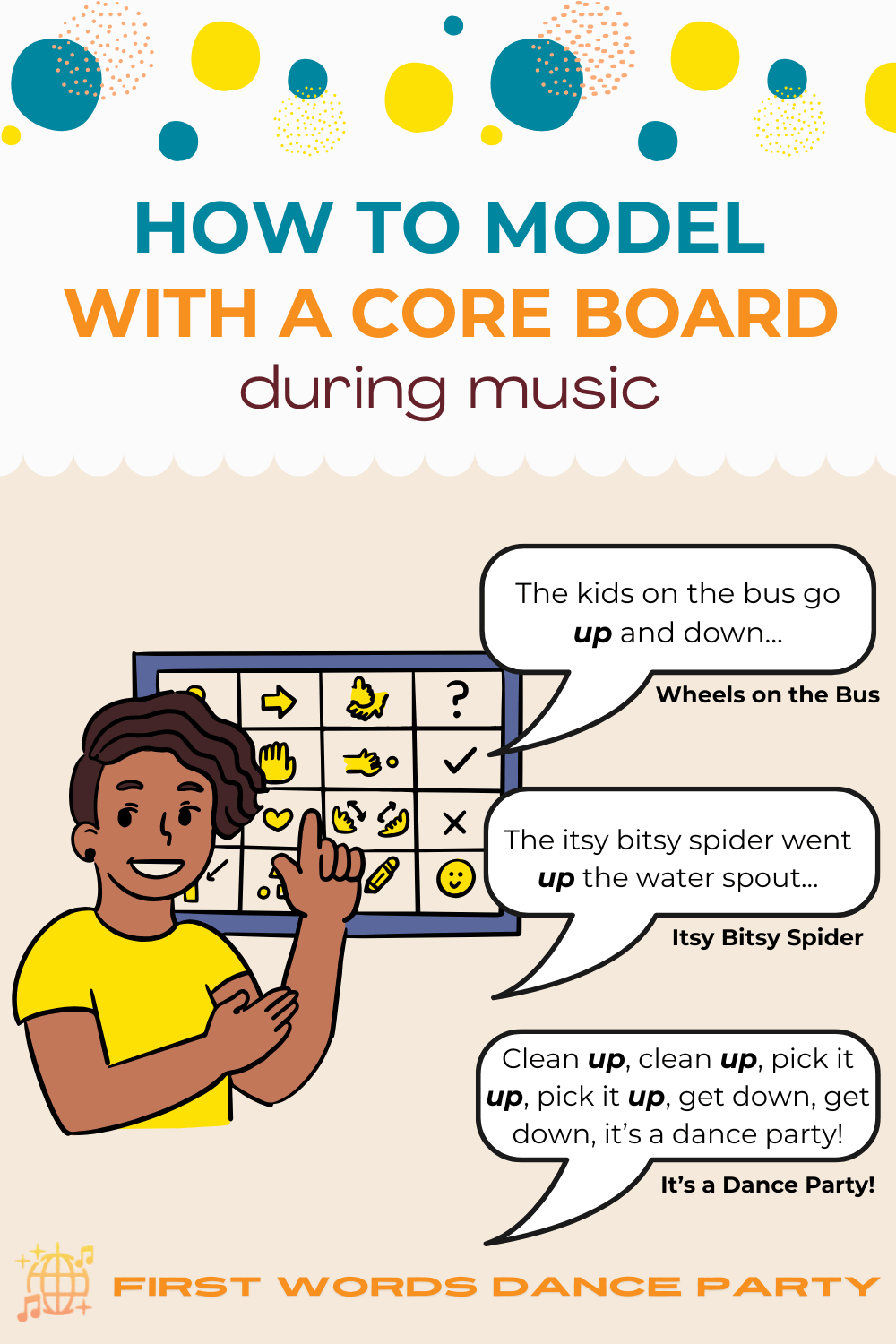
For example, during a song that includes the word up, you can repeatedly model:
up
go
more
stop
throughout the activity.
Music Supports Carryover
Another benefit of music-based communication boards is that songs don't stay inside a therapy session.
Families often sing the same songs:
In the car
During bath time
At bedtime
While playing
Throughout daily routines
This creates natural opportunities for repeated language exposure long after the activity ends.
As an early intervention teacher, I've found that children are often eager to revisit favorite songs again and again. That built-in motivation creates more opportunities for communication than many traditional drill-based activities.
Why I Created Music-Based Printable Communication Boards
When I created First Words Dance Party®, I wanted communication boards to feel practical, engaging, and easy for families to use at home.
That's why the Communication Boards Printable Sing and Model Toolkit pairs visual supports with original speech therapy songs.
Instead of wondering what to say or when to model language, families can simply sing, point to symbols, and enjoy meaningful interactions together.
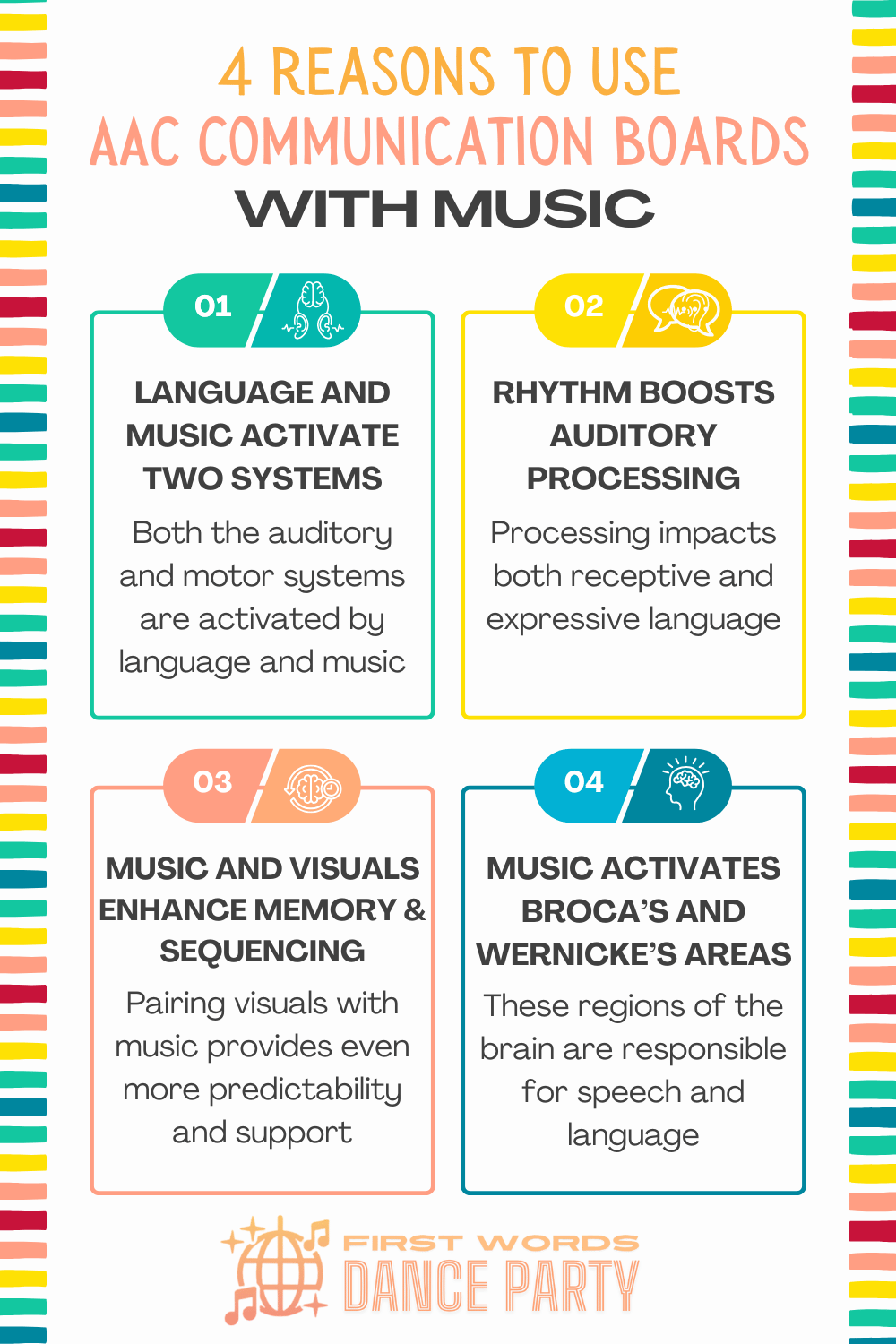
When communication boards are paired with motivating activities, language becomes easier to notice, easier to model, and easier to practice.
And for many children, music provides one of the most natural opportunities to make that happen.
Introducing the First Words Dance Party® Communication Boards Printable Toolkit
Once you know what to look for—functional vocabulary, motivating routines, and opportunities for consistent modeling—it becomes much easier to choose communication boards that truly support language development.
That's exactly why I created the First Words Dance Party® Communication Boards Printable Sing and Model Toolkit.
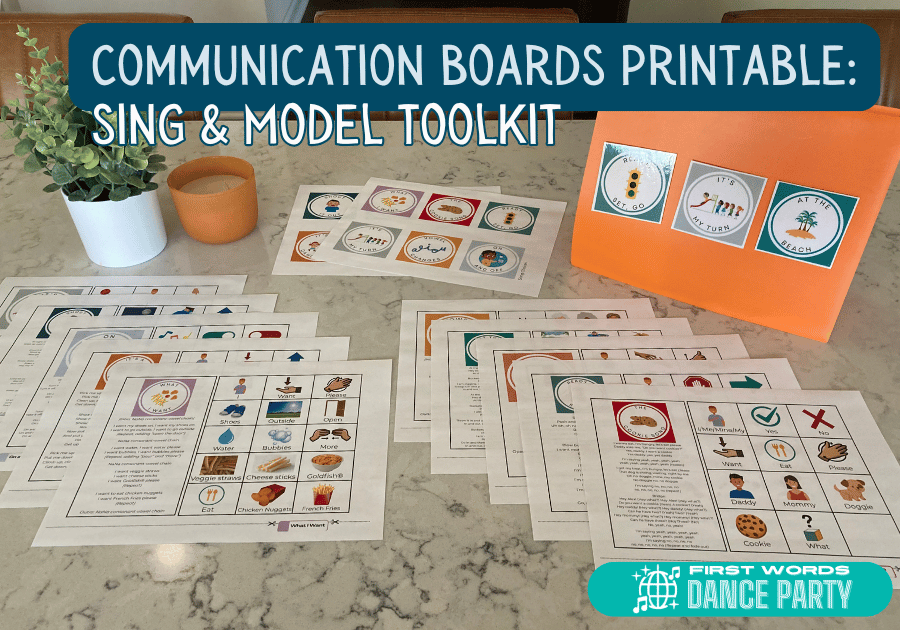
Unlike many printable communication boards that are designed around a single activity, these boards pair directly with original speech therapy songs written specifically to support early communication.
Each communication board is designed to make modeling easier by giving you clear picture symbols that align with meaningful, functional vocabulary throughout the song.
What Makes These Printable Communication Boards Different?
As an early intervention teacher and the creator of First Words Dance Party®, I wrote every song with speech and language development in mind. Each lyric is crafted with speech and language strategies behind it, giving parents a simple, engaging way to encourage language.
Instead of relying on random vocabulary, the songs intentionally target early communication skills, core vocabulary, and functional language that children can use throughout their day.
Here are a few examples:
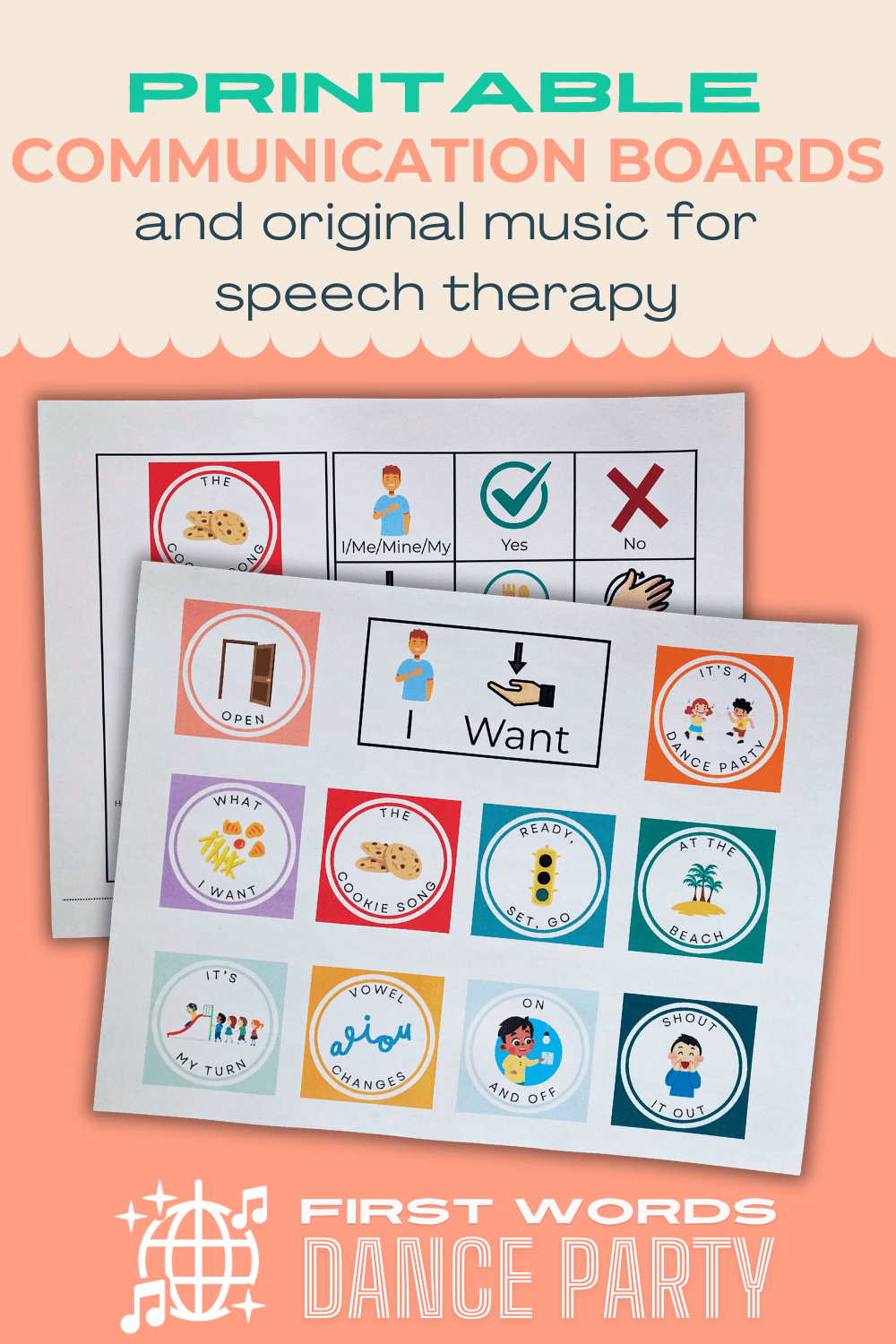
The Cookie Song: This kid favorite targets the core words yes and no, along with the words eat, want, what, doggie, and of course, cookie! This one is perfect for kids who aren’t yet gesturing or saying yes and no.
Ready, Set, Go: This one uses a powerful strategy, called an anticipatory set, to promote engagement. It targets the opposite pair stop and go, along with the words push, pull, bubbles, uh-oh, oh no, more, and I.
It’s a Dance Party: Another kid favorite, this one teaches the names of body parts- llke eyes, nose, ears, hands, and feet. It also targets the words up and down, with plenty of functional examples in the lyrics (like clean up, pick me up, get down, slide down, etc.)
This core word lyrics video models the words up and down along with names of common body parts for a fun departure from "Head, Shoulders, Knees, and Toes". This dance-y little number has some built in choreography.
You can stream First Words Dance Party® on Spotify, YouTube Music, Apple Music, and anywhere else you get your music.
Powerful visual support meets fun music for speech therapy
Because the boards are designed around the songs, families don't have to guess which words to model.
The vocabulary on the communication board directly matches the words children hear, see, and experience throughout the activity.
The toolkit includes:
Ten printable communication boards aligned to the songs
Core words and common first words
Clear picture symbols for modeling
Full song lyrics so you can sing with or without the songs as you point to the picture symbols
Layouts designed for aided language stimulation
An "I Want" communication board to help your child choose their favorite songs
The result is a communication support that feels natural, engaging, and easy to use at home.
Looking for the Best Value?
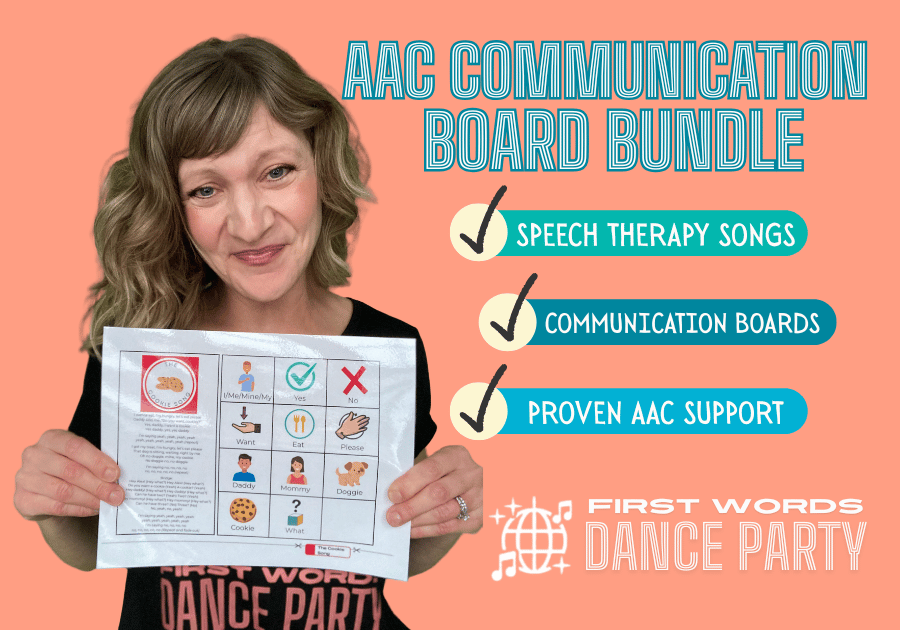
If you'd like both the communication boards and the speech therapy songs they were designed around, consider the AAC Communication Board Bundle.
The bundle includes:
Communication Boards Printable Sing and Model Toolkit
Speak Up & Dance album
Coordinated communication supports
Additional savings compared to purchasing separately
Imagine seeing your child point to the symbol for “open”, “eat”, or “help” when they’ve never been able to communicate those words before. Imagine hearing them say “mommy”, “yeah”, or “help” for the first time.
Music-based communication boards may be the thing that’s missing to help your child go from being a passive listener to an active communicator.
Whether you're just getting started with AAC or looking for a more engaging way to model language, these resources were created to help families turn everyday moments into meaningful communication opportunities.
Final Thoughts: Choosing Printable Communication Boards That Actually Get Used
When it comes to printable communication boards, the most effective option isn't necessarily the one with the most symbols, the most features, or the most complicated design.
It's the one that gets used.
Communication boards work best when they:
Contain functional vocabulary
Fit naturally into daily routines
Support consistent language modeling
Match your child's interests and strengths
Whether you choose a core communication board, a routine-based communication board, or a music-based communication board, the goal is the same: helping your child understand and express themselves through meaningful communication.
Remember, communication boards aren't about testing your child or getting them to perform.
They're about providing visual support that makes language easier to understand and use.
Over time, those repeated opportunities to see, hear, and experience language can help children build confidence, strengthen understanding, and develop new ways to communicate.
If you're wondering which words to start modeling first, be sure to grab the free Top 10 Core Words for AAC Success. It's a simple, parent-friendly resource designed to help you begin using AAC and communication boards with confidence.
And if you're looking for printable communication boards designed specifically for language development, you can explore the Communication Boards Printable Sing and Model Toolkit or save with the AAC Communication Board Bundle.
No matter where you're starting, remember that communication growth doesn't happen because of the perfect tool.
It happens through meaningful interactions, consistent modeling, and the connection you build with your child every day.
FAQ: Printable Communication Boards, AAC, and Communication Support
What is a communication board?
A communication board is a visual AAC tool that uses pictures, symbols, and words to support communication. Communication boards help make language visible, giving children another way to understand and express their thoughts, wants, and needs.
Communication boards are often used by children with speech delays, language disorders, autism, and children who are non-speaking or minimally speaking. They can be used at home, in therapy sessions, at school, and throughout everyday routines.
How does a communication board, aac, and modeling help with speech and language?
Printable communication boards are low-tech AAC tools that use picture symbols to support understanding and communication. They help by giving your child something to see while hearing the word as it is spoken, making it easier to process language and imitate. Pointing to the symbol as you say a word is a natural way to model language and make it more accessible for your child.
How do I use a communication board for non verbal toddlers or preschoolers?
For nonspeaking or minimally verbal children, you use the board by modeling, not by forcing them to point. Simply touch the symbols as you say the words during everyday routines. This shows your child how the board works and gives them a low-pressure way to follow along. Research from ASHA and PrAACtical AAC supports modeling (aided language input) over hand-over-hand prompting.
Is there a simple communication board I can use across the whole day?
Yes—core communication boards, or core boards, are designed for cross-routine use. They include early, functional vocabulary like open, go, more, stop, help, I, you, want, in, and out.
A core board includes words that make up the majority of what we say every day. These early core words are powerful because they help a child make requests, protest, comment, and participate. SLPs use core boards because they give the biggest communication return and allow carryover into many routines.
What words should be included on a communication board?
The best communication boards include vocabulary that is functional and meaningful.
Many families begin with AAC core words such as:
go
stop
more
all done
help
Motivating fringe vocabulary can also helpful, like:
Cracker
Cheese stick
Milk
Juice
These words can be used across many different routines, making them powerful communication tools.
The goal isn't to teach the most words. It's to teach the most useful words first.
What’s the difference between a core communication board and a PECs communication board?
A PECS communication board is tied to the Picture Exchange Communication System, which historically used hand-over-hand prompting to help children pick up and exchange individual symbols. Modern AAC and neurodiversity-affirming practice emphasize modeling instead.
Sometimes people use the word “PECS” generically when they mean “visuals”- sort of like saying “Band Aid®” instead of “bandage” or “Kleenex®” instead of “tissue”. PECS is actually a specific brand with a specific methodology.
By comparison, a core communication board doesn’t require exchanging pictures as all of the symbols are on one page. Instead, you model the words by pointing and speaking, which research supports as effective and respectful.
Are low tech communication boards effective for speech therapy at home, or do I need a high tech device?
Research consistently supports low tech communication boards as powerful tools for increasing understanding and supporting communication. They’re easy to print and use during everyday routines and are especially helpful for families who want a simple way to start with AAC. While dynamic communication devices are also highly effective, they are much more expensive, with a significant learning curve for both a child and their parents.
I’m not sure if my child is on the autism spectrum or not. Do I need a specific communication board autism resource for this to be effective?
Nope! Communication boards support receptive and expressive language for all children with speech delays—not only autistic children. Since many children on the autism spectrum are strong visual learners, and AAC is perfect for visual learners, you will find many printable communication boards marketed toward autism.